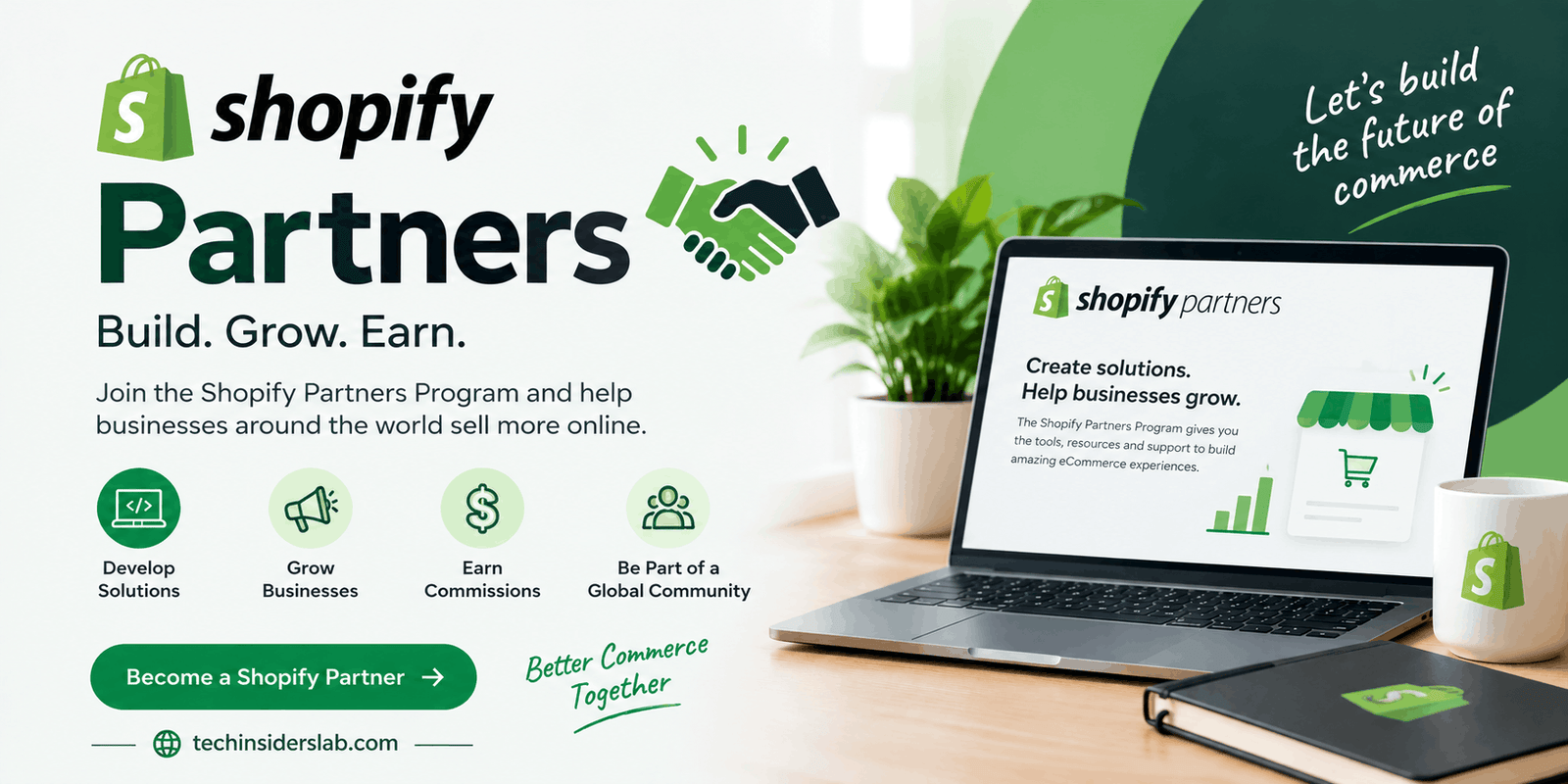
Shopify Partners: Complete Guide to the Shopify Partner Program
introduction
Shopify has become one of the most widely used platforms for building and managing online stores, but behind many successful Shopify businesses is a large ecosystem of developers, designers, agencies, consultants, marketers, and technology companies. This ecosystem is known as the Shopify Partner Program.
Shopify Partners gives professionals and businesses an opportunity to work with Shopify merchants, create ecommerce solutions, develop apps and themes, build online stores, provide specialized services, and generate revenue through different partner activities. Shopify describes its partner ecosystem as a network that helps merchants with everything from store setup and custom integrations to broader ecommerce transformation.
For someone interested in ecommerce technology, web development, design, or digital services, Shopify Partners can be an important way to turn technical skills into a business opportunity.
What Is Shopify Partners?
Shopify Partners is an ecosystem and partner program created by Shopify for people and organizations that help merchants use the Shopify platform.
Partners can include developers who create applications, designers who build storefronts and themes, agencies that create complete ecommerce stores, consultants who provide specialized advice, and businesses that refer merchants to Shopify.
According to Shopify’s official documentation, the Partner Program includes designers, developers, marketers, and affiliates who use Shopify to build ecommerce websites, themes, applications, and related solutions.
The program is therefore much broader than simply referring customers. A partner can build a business around Shopify services, develop software for merchants, create themes, build stores for clients, or participate in referral opportunities.
How Does the Shopify Partner Program Work?
The basic concept is straightforward: Shopify provides the platform, tools, documentation, developer resources, and partner ecosystem, while Partners provide products or services that help merchants succeed.
For example, a web developer could create a custom Shopify storefront for a client. An app developer could build an application that adds functionality to Shopify stores. A designer could create a theme, while an agency could manage an entire ecommerce implementation.
Partners can also refer merchants to Shopify through qualifying referral programs.
Shopify’s current program provides several earning paths, including building and transferring stores, merchant referrals, app development, theme development, and other specialized activities.
This makes Shopify Partners particularly useful for professionals who want more than a traditional freelance relationship with individual clients.
Who Can Become a Shopify Partner?
Shopify Partners is designed for a wide variety of professionals and organizations.
Developers
Developers can create Shopify apps, integrations, custom storefronts, and other technical solutions. Shopify provides development documentation and development environments that make it possible to build and test solutions before deploying them to production.
Shopify’s development stores are testing environments that allow developers to build and test applications in a realistic Shopify environment without affecting a live merchant store.
Designers
Designers can work on storefront experiences, themes, branding, user interfaces, and ecommerce experiences. Shopify’s ecosystem provides opportunities for professionals who combine visual design with ecommerce knowledge.
Agencies
Agencies can create complete Shopify stores for businesses, provide redesigns, migrations, custom development, integrations, and ongoing support.
Consultants
Consultants can help merchants with strategy, ecommerce operations, store optimization, implementation, and specialized Shopify services.
Technology Companies
Software companies can build integrations and products designed to work with Shopify. Shopify’s technology ecosystem is especially relevant to independent software vendors, application developers, ERP providers, and other technology businesses.
Shopify introduced Service and Technology tracks in its updated partner model, with the Technology track designed for organizations such as independent software vendors, app developers, ERP providers, and global technology companies.
Main Ways Shopify Partners Can Earn
One of the biggest reasons professionals join Shopify Partners is the range of potential revenue opportunities.
1. Building and Launching Shopify Stores
Partners can create Shopify stores for merchants and transfer or launch those stores for clients.
Under the current earning model effective August 10, 2026, eligible Launch Partners can receive 20% of the merchant’s monthly base subscription or platform fee, plus 0.1% of eligible online gross merchandise volume (GMV). The earning term for these incentives is four years under the applicable terms.
This model creates an interesting connection between the partner and the merchant’s long-term growth. Instead of earning only from the initial development project, eligible partners can continue receiving qualifying revenue share when the merchant grows.
2. Referring Merchants
Partners can also earn through qualifying merchant referrals.
For example, eligible referrals involving Shopify Plus or Enterprise can provide a one-time payout when the relevant requirements are satisfied. Shopify’s current documentation lists a $2,500 USD one-time payout for qualifying Plus or Enterprise referrals under the applicable terms.
Referral requirements matter, however. A partner cannot simply send any existing Shopify merchant and automatically receive payment. Shopify specifies conditions relating to lead submission, merchant eligibility, sales involvement, and other requirements.
3. Developing Shopify Apps
Developers can create applications that extend Shopify’s functionality.
Apps can solve specific merchant problems, automate workflows, improve store management, integrate external systems, or introduce new customer-facing features.
Shopify’s current earning structure allows eligible developers to receive 100% of revenue on their first $1 million earned through the Shopify App Store, with 85% applying to revenue above that threshold under the stated eligibility requirements. A 2.9% processing fee applies to app billing.
This can make app development an attractive long-term business model for developers who identify a genuine ecommerce problem and build a useful solution around it.
4. Creating Shopify Themes
Themes control much of the visual presentation and user experience of a Shopify store.
Professional designers and developers can create themes for merchants and potentially sell them through the Shopify Theme Store.
Shopify currently states that eligible partners receive 85% of revenue from themes sold through the Shopify Theme Store.
Theme development can therefore combine design skills, front-end development, ecommerce understanding, and product development.
Shopify Development Stores
Development stores are another important part of the Shopify Partner ecosystem.
A development store provides a controlled environment where developers can test applications, themes, and store functionality before working with a live customer environment.
Shopify documentation explains that development stores can be used to build and test apps without affecting live stores. Developers can also connect development stores with Shopify’s development tools and CLI workflows.
For beginners, this is particularly valuable because experimentation does not necessarily require making changes directly to a customer’s production store.
Shopify Partner Technology Ecosystem
Shopify Partners is closely connected with Shopify’s broader technology ecosystem.
Developers can use Shopify APIs and development tools to connect external services with Shopify stores. Businesses may build inventory systems, marketing integrations, analytics tools, customer service solutions, accounting integrations, fulfillment systems, and other ecommerce technologies.
Shopify also has a Certified Technology Partner Program aimed at technology providers whose products meet advanced requirements for Shopify Plus merchants. Shopify describes this program as a way for qualified app developers to demonstrate product quality for more complex enterprise requirements.
This demonstrates how Shopify Partners extends beyond simple website development and into larger ecommerce technology infrastructure.
Benefits of Becoming a Shopify Partner
There are several potential advantages to joining the ecosystem.
Business Opportunities
Partners can create multiple revenue streams instead of depending on a single service. A developer could build stores for clients while also creating an app or theme.
Development Resources
Shopify provides developer documentation, APIs, development environments, educational resources, and community support. Shopify currently highlights its developer documentation, community forum, Partner Blog, and Shopify Academy as resources for people building within the ecosystem.
Access to a Large Ecommerce Ecosystem
Partners can work with merchants ranging from small businesses to larger enterprises. Shopify’s partner directory emphasizes specialists who help merchants with store setups, integrations, and broader business transformation.
Long-Term Revenue Potential
Some partner activities can provide revenue beyond the initial project. The current Launch Partner model, for example, connects qualifying partner earnings with merchant subscription fees and eligible GMV.
Is Shopify Partners Free?
Creating a Shopify Partner account is generally different from paying for a merchant Shopify subscription.
The Partner Program is designed to give developers and other professionals access to the ecosystem, tools, and resources needed to build Shopify-related businesses. However, individual activities can have their own requirements, eligibility rules, commercial terms, and costs.
Developers should always review Shopify’s current Partner Agreement and earning documentation before making business decisions because program rules and revenue-sharing terms can change.
Shopify’s Partner Program Agreement was updated on February 27, 2026, and includes separate provisions covering referrals, developers, the Partner Directory, and the tiered Partner Program.
Shopify Partners vs Shopify Store Owner
A Shopify store owner uses Shopify to operate an ecommerce business. A Shopify Partner generally provides products, services, technology, development, or referrals that support Shopify merchants.
For example:
Store Owner: Sells clothing through a Shopify store.
Shopify Partner: Builds the store, creates its theme, develops an inventory application, or provides specialized ecommerce services.
The two roles can sometimes overlap. A business may operate its own Shopify store while also developing Shopify apps or providing Shopify services to other businesses.
Why Shopify Partners Matters for Developers
For developers, Shopify Partners can transform individual technical skills into scalable products.
Instead of developing a custom feature for one client and moving on to another project, a developer can identify a common merchant problem and turn the solution into an app that can serve many stores.
The same concept applies to themes. Rather than designing one store at a time, a developer can create a reusable theme product.
This product-oriented approach can potentially create more scalable revenue than traditional project-based development, although it also requires ongoing maintenance, customer support, marketing, testing, and compliance with Shopify requirements.
Tips for Becoming a Successful Shopify Partner
Joining the program is only the beginning. Long-term success generally depends on creating useful products or services.
First, choose a specific area of expertise. Instead of trying to offer every possible Shopify service, focus on something such as store development, conversion optimization, custom integrations, app development, or theme design.
Second, understand merchant problems. Successful Shopify solutions usually solve practical problems rather than simply adding unnecessary features.
Third, build a strong portfolio. Demonstrating previous Shopify work can help potential clients understand what you can deliver.
Fourth, keep learning. Shopify continuously updates its platform, APIs, developer tools, and partner policies. Staying current is important for developers and agencies.
Finally, pay attention to Shopify’s official requirements. Apps, themes, referrals, and partner activities can have specific eligibility conditions, and revenue terms can change over time.
The Future of Shopify Partners
The Shopify Partner ecosystem is increasingly connected to technology, automation, integrations, and advanced ecommerce infrastructure.
The 2026 changes to Shopify’s earning model show a stronger focus on aligning partner rewards with merchant growth. Starting August 10, 2026, eligible partners can participate in revenue generated from both merchant subscription fees and eligible GMV for qualifying store launches.
At the same time, Shopify continues investing in its developer ecosystem, apps, themes, APIs, education, and technology partnerships.
This suggests that Shopify Partners is becoming more than a referral program. It is an ecosystem where technical expertise, ecommerce services, software products, and merchant relationships can work together.
Conclusion
Shopify Partners is an important part of the Shopify ecosystem, connecting merchants with developers, designers, agencies, consultants, app creators, theme developers, and technology companies.
Its biggest advantage is flexibility. A professional can participate by building stores, referring merchants, developing applications, creating themes, or providing specialized ecommerce services.
The program is particularly valuable for people interested in technology, web development, ecommerce, and digital business. Current earning opportunities also make it possible for eligible partners to build revenue around both services and scalable digital products.
For anyone researching Shopify Partners, the key takeaway is simple: it is not just a program for referrals. It is a broader technology and business ecosystem that allows skilled professionals to build solutions for Shopify merchants while developing their own businesses.