Pager:What Is a Pager,How Does It Work, and Is It Still Used Today
Introduction
Communication technology has changed dramatically over the past few decades. Smartphones, instant messaging applications, video calls, and internet-based communication tools have made it easier than ever to stay connected. However, before these technologies became widely available, one small device played an important role in keeping people reachable: the pager.
A pager, also known as a beeper, is a wireless communication device designed to receive alerts, numbers, and short text messages. Although it may look outdated compared with modern smartphones, paging technology continues to serve specific purposes in healthcare, emergency response, industrial operations, and other environments where reliable communication is essential.
Understanding how a pager works, its different types, advantages, and limitations helps explain why this technology has survived despite the popularity of mobile phones. This guide explores everything beginners need to know about pagers and their role in modern communication.
What Is a Pager?
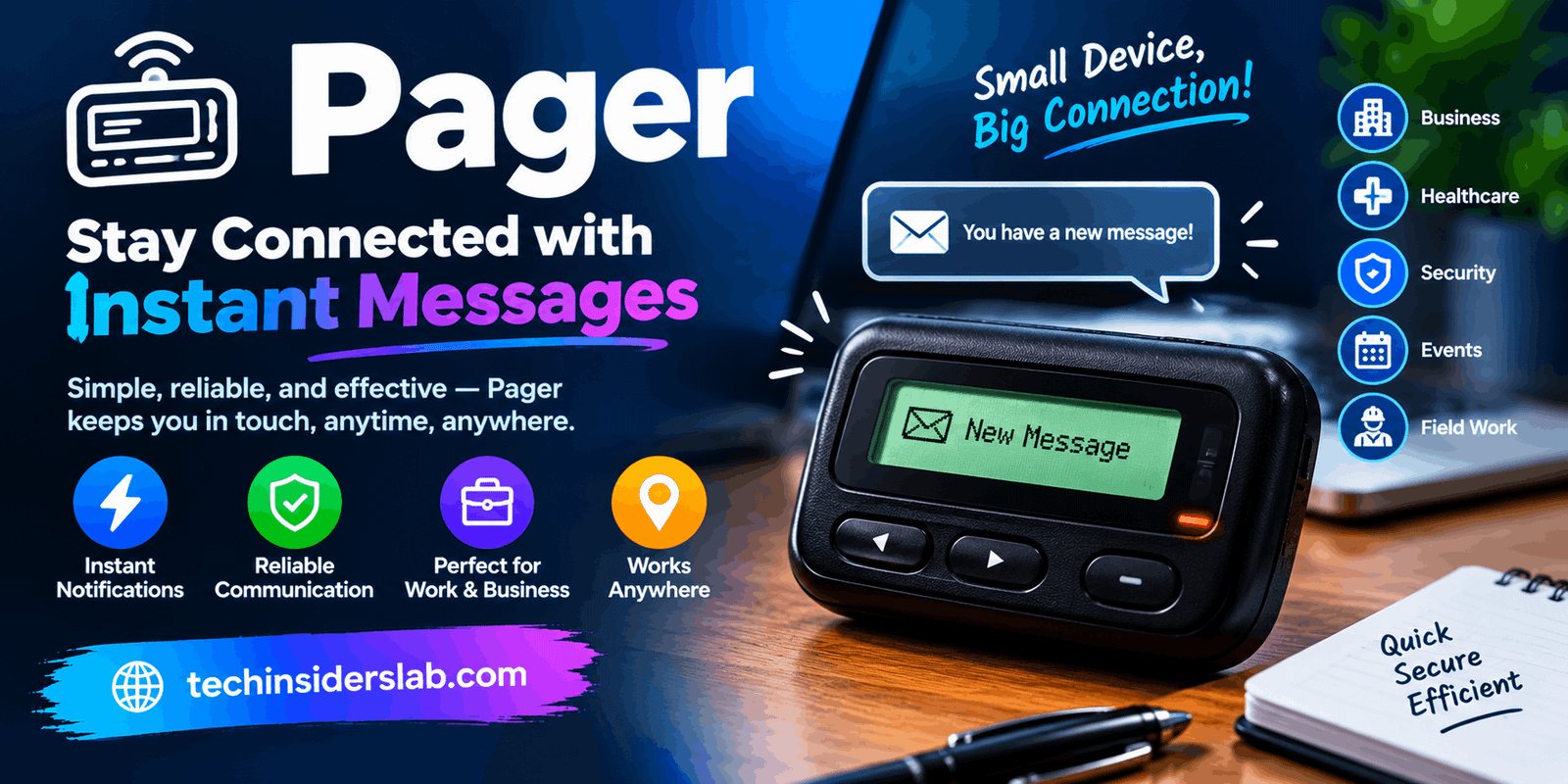
A pager is a compact electronic device that receives wireless signals from a paging network and alerts its user when a message arrives. Depending on the device, the notification may appear as a beep, vibration, flashing light, phone number, or short text message.
Traditional pagers were mainly designed to notify people that someone needed to contact them. For example, a doctor working in a hospital could receive an alert from another department and use a telephone to return the call.
Modern paging devices can offer more advanced notification features, including detailed text messages and, in some models, the ability to acknowledge or respond to incoming communications.
Unlike a smartphone, a traditional one-way pager does not need to send information back to the network. It mainly receives messages transmitted by a paging service. This simple design can provide excellent battery life and make the device useful in situations where continuous two-way communication is unnecessary.
How Does a Pager Work?
A pager operates through a communication system that sends messages over radio frequencies. Although the device itself is small, it depends on a network of equipment to deliver notifications.
The process generally involves the following steps.
1. A Message Is Created
A sender initiates a message using a compatible system. Depending on the paging service, the message may originate from a telephone, computer, dispatch console, automated monitoring platform, or dedicated paging terminal.
2. The Paging Network Processes the Message
The system receives the message and prepares it for transmission. It identifies the intended recipient and converts the information into a format supported by the paging network.
3. A Radio Transmitter Broadcasts the Signal
The paging network sends the encoded information through radio transmitters. Some systems use multiple transmitters to provide coverage across a large geographical area.
4. The Pager Receives the Signal
The pager continuously monitors its assigned radio channel or periodically checks for relevant transmissions, depending on its design. When it detects a message addressed to its unique receiver identifier, it processes the information.
5. The User Receives an Alert
The device produces a sound, vibration, or visual notification. If it has a display, it may show a telephone number, short text message, or other information.
The user can then follow the instructions or contact the sender using another communication method.
Paging systems commonly use protocols such as POCSAG and FLEX to format and transmit messages. These protocols help paging equipment communicate using compatible signal structures. <Cite refs={[“turn673912search0″,”turn673912search8”]}/>
Different Types of Pagers
Pagers have developed over time, and several types are available for different communication needs.
1. Tone-Only Pagers
Tone-only pagers are among the simplest types. They notify users through an audible tone or another basic alert without displaying a detailed message.
The sound may indicate that the user needs to contact someone or respond to an event. Because these devices have limited functionality, they are most suitable for simple notification tasks.
2. Numeric Pagers
Numeric pagers display numbers on a small electronic screen. A message might contain a telephone number, extension, or predefined numeric code.
For example, a hospital employee could receive a number and understand that a colleague needs a callback. Numeric pagers provide more information than tone-only devices while maintaining a simple design.
3. Alphanumeric Pagers
Alphanumeric pagers display both letters and numbers. This capability allows senders to communicate short written messages instead of relying exclusively on numerical codes.
They can be useful when recipients need brief instructions, location details, or information about an incident.
4. Two-Way Pagers
Traditional one-way pagers only receive messages. Two-way models add the ability to transmit a response, acknowledge a message, or communicate limited information back to the system.
This functionality can improve coordination because the sender may receive confirmation that a message has been acknowledged.
However, two-way pagers are more complex than basic receivers, and their capabilities depend on the particular device and network.
5. Voice Pagers
Voice paging devices receive spoken messages or audio-based notifications. Depending on the system, they may allow users to listen to a recorded announcement or transmitted voice message.
Voice paging can be useful when hearing an instruction is more convenient than reading a short message.
6. Restaurant and Staff Pagers
Restaurants, cafés, hospitals, and service businesses may use local paging systems to notify customers or employees.
For example, a restaurant can give a customer a small vibrating receiver while a table is being prepared. When the table becomes available, the receiver alerts the customer.
These systems usually operate within a limited area and serve a different purpose from wide-area emergency paging networks.
Common Uses of Pagers
Although smartphones have replaced pagers in many everyday situations, paging devices remain useful for specific professional tasks.
Healthcare and Hospitals
Healthcare is one of the best-known environments for pager use. Doctors, nurses, technicians, and on-call specialists may need to receive urgent notifications while moving between departments or working away from a desk.
A pager can deliver a concise alert without requiring the recipient to monitor a smartphone constantly. Some healthcare organizations also maintain paging systems as part of their communication redundancy plans.
However, sensitive patient information should not be sent through a paging system unless its security and privacy protections are appropriate for that information.
Emergency Services
Fire departments, emergency medical teams, and other public safety organizations may use paging technology to notify personnel about incidents and response requirements.
A paging network can distribute an alert to multiple recipients, making it useful for dispatching teams quickly.
Some public safety organizations continue to rely on paging because dedicated networks can provide valuable communication capabilities when other systems experience disruption. Actual reliability depends on the network, coverage, power arrangements, and local operating conditions. <Cite refs={[“turn673912search14″,”turn673912search0”]}/>
Industrial Operations
Factories, warehouses, and industrial facilities use different notification systems to coordinate employees and communicate operational alerts.
A pager may notify a technician about equipment problems, maintenance requests, or safety-related events. Integration with monitoring software can also allow automated systems to send alerts when predefined conditions occur.
Restaurants and Hospitality
Restaurants frequently use local guest pagers to reduce waiting-room congestion. Customers can move around a nearby area instead of standing beside the reception desk.
Staff paging systems can also help managers contact employees who are working in different parts of a building.
IT Departments and Technical Support
Information technology teams must monitor servers, networks, cloud services, and business applications. When a system fails, technical staff need to know quickly.
Pager-based alerting can notify an on-call engineer about an incident, especially when connected to monitoring and incident-management software. In this context, the term pager can refer to a physical device or, more broadly, a notification mechanism that alerts someone who must respond to an incident.
Advantages of Using a Pager
Pagers offer several benefits that make them suitable for specialized communication tasks.
Long Battery Life
Many traditional pagers consume relatively little power because they do not need to operate a large display, camera, or continuous mobile data connection. As a result, some models can run for extended periods on a single battery.
Actual battery life depends on the model, battery type, signal conditions, and frequency of incoming messages.
Simple Operation
Most pagers are straightforward to use. Their basic controls and limited features can make them practical for people who only need reliable alerts rather than a complete communication platform.
Dedicated Notifications
A pager is designed primarily to receive alerts. It does not usually compete with social media notifications, entertainment applications, and other distractions found on smartphones.
This can help users recognize important messages quickly.
Potential Network Resilience
Dedicated paging networks can provide an additional communication channel independent of some commercial mobile services. Certain networks also offer broad radio coverage and strong building penetration.
These advantages are not universal. A pager may still fail when its network loses power, coverage is inadequate, or the relevant service is unavailable.
Efficient Group Communication
Paging systems can send messages to individual receivers or groups of receivers. This is valuable when several staff members need to receive the same announcement or alert.
Limitations of Pagers
Despite their benefits, pagers have several important disadvantages.
Limited Messaging Features
Basic pagers cannot provide the rich communication features available through smartphones. They generally do not support video calls, web browsing, or sophisticated messaging applications.
No Universal Coverage
A pager only works where its supported paging network provides service. Users must check local coverage and device compatibility before relying on a particular system.
Restricted Replies
One-way pagers cannot directly respond to messages. Recipients may need a separate telephone or communication device to contact the sender.
Security and Privacy Concerns
Not every paging network encrypts its messages. Depending on the technology and configuration, transmissions may be vulnerable to interception.
Organizations handling confidential information should evaluate encryption, access controls, message content, retention policies, and applicable privacy requirements before adopting paging technology.
Declining Consumer Availability
Smartphones and internet-based messaging have reduced the need for traditional pagers in everyday life. Consequently, availability, service plans, replacement devices, and technical support can vary significantly by region.
Pager vs. Smartphone: What Is the Difference?
Pagers and smartphones are designed for different communication needs.
A pager focuses on receiving alerts and short messages through a dedicated paging system. A smartphone supports two-way communication through cellular networks, Wi-Fi, applications, and multiple messaging services.
Smartphones offer more flexibility, but they also require more complex hardware and software. Their battery life, connectivity, and notification behavior depend on usage and network conditions.
Pagers may be preferable when an organization needs a simple, dedicated alerting device or wants an additional communication channel. Smartphones are generally better for everyday communication, detailed conversations, and tasks requiring internet access.
Neither option is automatically more reliable in every situation. The right choice depends on coverage, security, operational requirements, and the consequences of a missed message.
Are Pagers Still Used Today?
Yes, pagers are still used in selected professional environments. Their presence is less visible than it was during the height of their consumer popularity, but their specialized functions remain relevant.
Hospitals may use paging to reach on-call personnel, while emergency organizations can maintain paging as part of a broader communications strategy. Businesses may also use local paging equipment to coordinate staff or notify customers.
The continuing value of pagers comes from their focused purpose rather than their ability to compete with smartphones feature for feature.
Some organizations combine paging with mobile applications, automated alerts, radio systems, and other communication channels. This approach allows them to use paging where it offers an operational advantage while relying on modern technology for more detailed communication.
What to Consider Before Choosing a Pager
If you are considering a pager for personal or professional use, evaluate the following factors.
- Coverage: Confirm that the paging service operates in your required locations.
- Message type: Decide whether you need tone alerts, numeric messages, text, voice, or two-way communication.
- Battery performance: Check expected battery life and charging or replacement requirements.
- Durability: Consider whether the device must withstand dust, moisture, drops, or demanding working conditions.
- Security: Review message encryption, access restrictions, and privacy requirements.
- Integration: Determine whether the system can connect to telephone services, monitoring platforms, or dispatch software.
- Support and cost: Compare equipment prices, recurring service charges, maintenance, and the availability of replacement parts.
For hospitals and emergency organizations, testing the complete communication system is particularly important. A device that works well in one location may not provide adequate coverage everywhere staff members need to travel.
The Future of Pager Technology
The future of paging is likely to focus on specialized communication rather than widespread consumer adoption. As mobile networks and notification software continue to improve, organizations may increasingly combine paging with other technologies.
Possible developments include better integration with incident-management platforms, more flexible alert routing, improved device monitoring, and stronger security controls where supported by the equipment.
Organizations may also use redundant notification channels to reduce the risk that an important alert goes unnoticed. For example, a critical incident could trigger a pager notification alongside a separate alerting mechanism.
Nevertheless, paging technology has limitations that cannot be solved simply by connecting it to modern software. Network availability, radio coverage, device maintenance, and secure message handling will continue to matter.
Conclusion
A pager is a wireless communication device that receives alerts, numbers, and short messages through a paging network. Although smartphones have replaced pagers in many everyday situations, paging technology remains useful in healthcare, emergency response, industrial operations, restaurants, and technical support.
Its main strengths include simple operation, dedicated notifications, potentially long battery life, and the ability to complement other communication systems. Its limitations include restricted messaging features, limited reply capabilities, network dependence, and possible security concerns.
For individuals, smartphones are generally more versatile. For organizations that need focused, dependable alerting, a pager may still be a practical option when supported by a suitable network and an appropriate operational plan.
Ultimately, pagers demonstrate that older technologies can remain valuable when they solve a specific problem effectively. Their role today is not to replace every modern communication device, but to provide a specialized way to deliver important messages when the situation calls for it.