D&D Classes: A Complete Guide to Dungeons & Dragons Classes
introduction
D&D Classes are one of the most important parts of creating a character in Dungeons & Dragons. A character’s class determines many of their abilities, combat options, magical powers, skills, and progression throughout an adventure. Choosing a class is therefore an important decision for both new and experienced players.
Dungeons & Dragons offers a variety of classes designed around different playstyles. Some characters specialize in physical combat, while others rely on magic, stealth, exploration, support abilities, or a combination of several approaches. This variety allows players to create characters that feel very different even when they are participating in the same campaign.
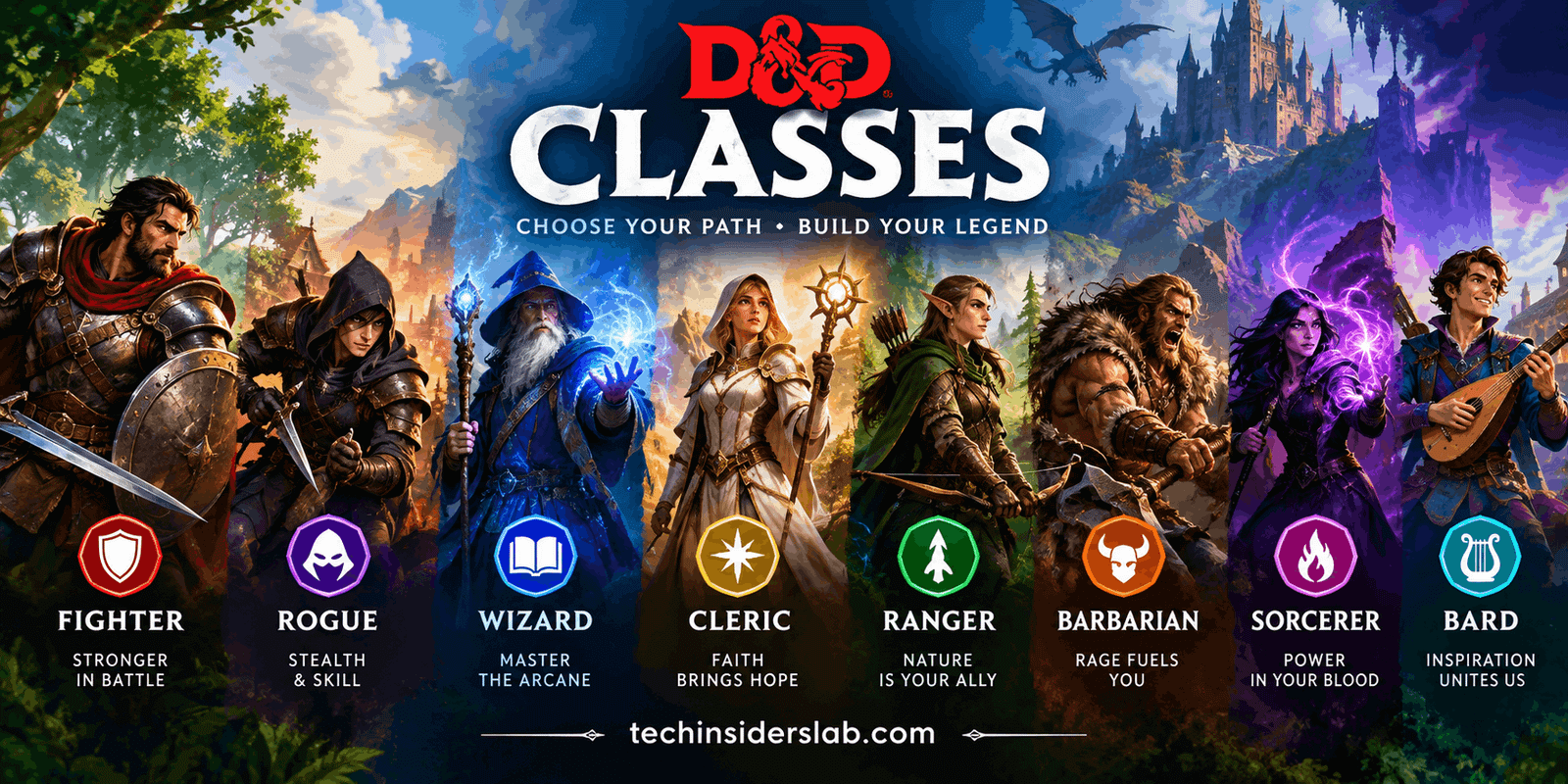
The current core rules feature twelve main classes: Barbarian, Bard, Cleric, Druid, Fighter, Monk, Paladin, Ranger, Rogue, Sorcerer, Warlock, and Wizard. Each class has its own strengths, abilities, progression system, and identity.
What Are D&D Classes?
A class is essentially the mechanical foundation of a D&D character. When a player creates a character, the class determines many of the abilities that character will gain as they level up.
For example, a Fighter is generally focused on weapons, armor, and martial combat. A Wizard specializes in studying and casting arcane spells. A Rogue relies heavily on agility, stealth, skills, and precise attacks.
However, a class does not completely define a character’s personality or story. Two characters can have the same class but be completely different individuals. Their backgrounds, personalities, goals, relationships, and experiences can make them unique.
Classes also work together as part of an adventuring party. Different characters can contribute different abilities, allowing a group to deal with combat encounters, exploration challenges, puzzles, social situations, and other obstacles.
The 12 Main D&D Classes
1. Barbarian
The Barbarian is a powerful martial class built around physical strength, endurance, and primal abilities. Barbarians are particularly effective in close-range combat and are capable of taking significant amounts of damage.
One of the defining features of the Barbarian is Rage. Rage enhances the character’s combat capabilities and represents the primal power that fuels the class.
Barbarians are often suitable for players who enjoy straightforward and aggressive combat. They can charge into dangerous situations, protect their allies, and deal considerable physical damage.
Strength is an important ability for many Barbarian builds, while Constitution is also valuable because it contributes to their durability.
A Barbarian does not have to be an angry or reckless character. Players can create thoughtful, disciplined, humorous, protective, or even intellectual Barbarians while still using the class’s mechanical abilities.
2. Bard
The Bard is one of the most versatile classes in D&D. Bards combine magic, performance, skills, knowledge, and social abilities.
Charisma is particularly important for Bards because many of their abilities and spells rely on their ability to influence others.
Bards can support their teammates through magical inspiration and can also use spells to control enemies, solve problems, create distractions, or provide utility outside combat.
One of the biggest advantages of playing a Bard is flexibility. A Bard can participate in combat while also being useful during conversations, investigations, exploration, and other situations.
A Bard could be a traveling musician, storyteller, performer, diplomat, historian, entertainer, or adventurer who uses creativity as their greatest weapon.
3. Cleric
The Cleric is a divine spellcasting class associated with powerful spiritual and magical abilities.
Many players associate Clerics primarily with healing, but the class can do much more. Clerics can support allies, damage enemies, provide defensive abilities, and use a wide range of magical effects.
Wisdom is the primary ability associated with Clerics.
The character’s connection to divine power can also become an important part of their story. A Cleric might serve a deity, follow a sacred tradition, protect a community, or pursue a personal spiritual mission.
Clerics can also be effective in combat, making them useful members of an adventuring party even when healing is not the main priority.
4. Druid
The Druid is a nature-focused class that combines spellcasting, exploration, survival abilities, and connections to the natural world.
Druids use Wisdom as their primary ability and have access to magical powers associated with nature and primal forces.
One of the most recognizable features associated with Druids is their ability to transform into animal forms. This can create interesting options during exploration and combat.
A Druid can be designed around forests, animals, natural forces, ancient traditions, or the protection of the wilderness.
Players who enjoy exploration and nature-themed characters may find the Druid particularly interesting.
5. Fighter
The Fighter is one of the most recognizable martial classes in D&D.
Fighters specialize in weapons, armor, and physical combat. They can be built around different fighting styles and can use a wide variety of equipment.
One advantage of the Fighter is its flexibility. A character can be designed as a heavily armored warrior, skilled archer, disciplined soldier, knight, mercenary, guard, or another type of combat specialist.
Fighters can be relatively easy for beginners to understand because their core abilities focus heavily on combat. At the same time, advanced character-building options provide plenty of room for experienced players to customize the class.
Depending on the build, Strength or Dexterity can be particularly important.
6. Monk
The Monk is a martial class based on discipline, agility, movement, and specialized combat techniques.
Monks can fight without relying heavily on traditional weapons or heavy armor. Instead, they use training and physical discipline to develop their abilities.
Dexterity and Wisdom are important abilities for the class.
Monks can be highly mobile characters, allowing them to move around battlefields and engage enemies in unique ways.
The class can support a variety of character concepts, including wandering martial artists, disciplined warriors, temple guardians, spiritual travelers, or adventurers who have developed extraordinary physical abilities through training.
7. Paladin
The Paladin combines martial combat with magical and sacred abilities.
Paladins are traditionally connected with powerful oaths, ideals, and divine or sacred forces. They can use weapons and armor while also gaining abilities that support allies and damage enemies.
Strength and Charisma are particularly important abilities for many Paladin builds.
A Paladin’s oath can become an important part of their character story. It can influence their goals, responsibilities, relationships, and decisions throughout a campaign.
Despite traditional images of heroic knights, Paladins can have many different personalities. The class provides a framework for their abilities, while the player determines the character’s individual identity.
8. Ranger
The Ranger combines martial abilities with exploration, survival skills, and nature-based magic.
Rangers are often associated with tracking, wilderness exploration, ranged weapons, and hunting.
Dexterity and Wisdom are important abilities for the class.
A Ranger can serve as a scout for the party, track enemies, explore dangerous environments, and contribute during combat.
The class is also flexible enough to support different character concepts. A Ranger might be a wilderness guardian, monster hunter, scout, traveler, guide, or explorer.
Rangers can be particularly interesting in campaigns where exploration and travel play a major role.
9. Rogue
The Rogue is a skill-focused class that emphasizes agility, stealth, precision, and clever problem-solving.
Dexterity is the primary ability for many Rogue characters.
Rogues can be excellent at sneaking, scouting, investigating, disarming traps, and making precise attacks. Their skills can also make them useful outside combat.
Although Rogues are often associated with thieves, the class does not require a character to be a criminal.
A Rogue could instead be an investigator, spy, treasure hunter, scout, detective, explorer, or professional adventurer.
Players who enjoy creative solutions and tactical movement may find the Rogue appealing.
10. Sorcerer
The Sorcerer is a magical class whose power comes from within the character rather than primarily from academic study.
Charisma is the primary ability associated with Sorcerers.
Their magical origins can be connected to supernatural ancestry, unusual events, powerful forces, or other circumstances. This creates opportunities for interesting character stories.
Unlike a Wizard, who generally studies magic systematically, a Sorcerer possesses an innate connection to magical power.
Sorcerers can be excellent choices for players who want their magical abilities to be a fundamental part of their character’s identity.
11. Warlock
The Warlock gains magical power through a relationship with an otherworldly patron.
Charisma is an important ability for the class.
The relationship between a Warlock and their patron can create interesting storytelling opportunities. A patron may have goals, expectations, secrets, or demands that become relevant during an adventure.
Warlocks can therefore combine magical gameplay with strong roleplaying potential.
The class can appeal to players who enjoy mysterious characters, supernatural stories, unusual magical powers, and complicated relationships with powerful entities.
12. Wizard
The Wizard is the classic scholarly spellcaster of Dungeons & Dragons.
Wizards develop their magical abilities through study, research, practice, and knowledge. Intelligence is their primary ability.
One of the defining characteristics of the Wizard is the wide variety of spells they can potentially learn and use.
Wizards can use magic for damage, defense, exploration, investigation, transportation, problem-solving, and many other purposes.
A Wizard might be an academic researcher, ancient scholar, magical investigator, eccentric experimenter, apprentice who became an adventurer, or master of arcane knowledge.
Because Wizards have many magical options, they can provide considerable versatility to an adventuring party.
Martial and Spellcasting Classes
D&D classes can also be broadly understood by looking at how they approach challenges.
Martial-focused classes generally depend more on weapons, physical abilities, movement, and combat techniques. Barbarian, Fighter, Monk, and Rogue are examples of classes with strong martial elements.
Spellcasting classes rely more heavily on magic. Wizard, Sorcerer, Warlock, Cleric, Druid, and Bard all have significant magical capabilities.
Some classes combine both approaches. Paladins and Rangers, for example, can use weapons and armor while also having access to magical abilities.
This is not an absolute division. Almost every class can contribute in different ways depending on the character’s build.
How to Choose a D&D Class
Choosing a D&D class becomes easier when you first think about the kind of gameplay you enjoy.
Players who like direct physical combat may want to explore Barbarian or Fighter. Players interested in fast movement and martial arts may enjoy Monk.
Those who prefer stealth, skills, and investigation can look toward Rogue or Ranger.
Players who enjoy magic have several choices. Wizards focus on magical study, Sorcerers use innate magical power, and Warlocks gain abilities through supernatural patrons.
Players who enjoy supporting their party can consider classes such as Cleric or Bard, while Druids and Paladins also offer combinations of support, combat, and magical abilities.
There is no requirement for a player to choose a class based only on combat. D&D is a roleplaying game, so character personality and storytelling can be just as important as mechanics.
Understanding Subclasses
A class is only the starting point for character customization.
As characters advance, they can gain access to a subclass. Subclasses provide additional abilities and help characters within the same class develop different identities.
For example, two Fighters can have different subclasses and therefore have different abilities and approaches to combat.
The same is true for Wizards, Clerics, Rogues, Warlocks, and other classes.
Subclasses are useful because they allow players to start with a familiar class while still developing a specialized character.
D&D Classes and Party Roles
A D&D party often includes characters with different strengths.
A Fighter may focus on frontline combat, while a Rogue provides skills and scouting. A Cleric can provide magical support, while a Wizard offers powerful and versatile spellcasting.
However, parties do not have to follow a specific formula.
A group can contain multiple characters with similar abilities or several different classes. The important thing is that players understand their characters and work together.
D&D is designed around cooperation, so communication between players can often be more important than having a perfectly balanced collection of classes.
Multiclassing in D&D
Multiclassing allows characters to gain levels in more than one class.
For example, a character could begin as a Fighter and later take levels in another class. This can create unusual combinations and provide access to abilities from different classes.
Multiclassing can also make character creation and advancement more complicated.
New players may prefer to learn one class before experimenting with multiple classes. More experienced players may enjoy multiclassing because it allows them to create highly customized characters.
When multiclassing, players should consider how the abilities of different classes interact and whether the combination supports their preferred playstyle.
Why D&D Classes Matter
D&D Classes provide the mechanical foundation for character development, but their importance goes beyond statistics.
A class can influence how a character behaves during combat, how they solve problems, and how they contribute to the party.
At the same time, the class does not determine the entire story.
A Wizard could be a serious academic or an adventurous treasure hunter. A Fighter could be a former soldier or someone who learned combat to protect their family. A Rogue could be a detective instead of a thief.
This freedom is one of the most interesting aspects of D&D character creation.
Conclusion
D&D Classes form the foundation of character creation in Dungeons & Dragons. The twelve main classes provide different approaches to combat, magic, exploration, skills, and roleplaying.
Barbarians and Fighters offer strong martial options, Rogues provide stealth and skills, Monks emphasize discipline and mobility, while Paladins and Rangers combine martial abilities with magical features.
Bards, Clerics, Druids, Sorcerers, Warlocks, and Wizards provide different approaches to spellcasting and support.
The best way to understand D&D Classes is to look beyond their basic descriptions and consider how each class fits the type of character you want to play. With subclasses, backgrounds, equipment, spells, and multiclassing providing additional customization, players have many ways to create distinctive characters.
Whether you are completely new to D&D or returning to the game after a long break, understanding the available classes gives you a strong starting point for building a character and enjoying the adventure.