Meta AI: Features, Uses, Benefits, & Future of Artificial Intelligence
introduction
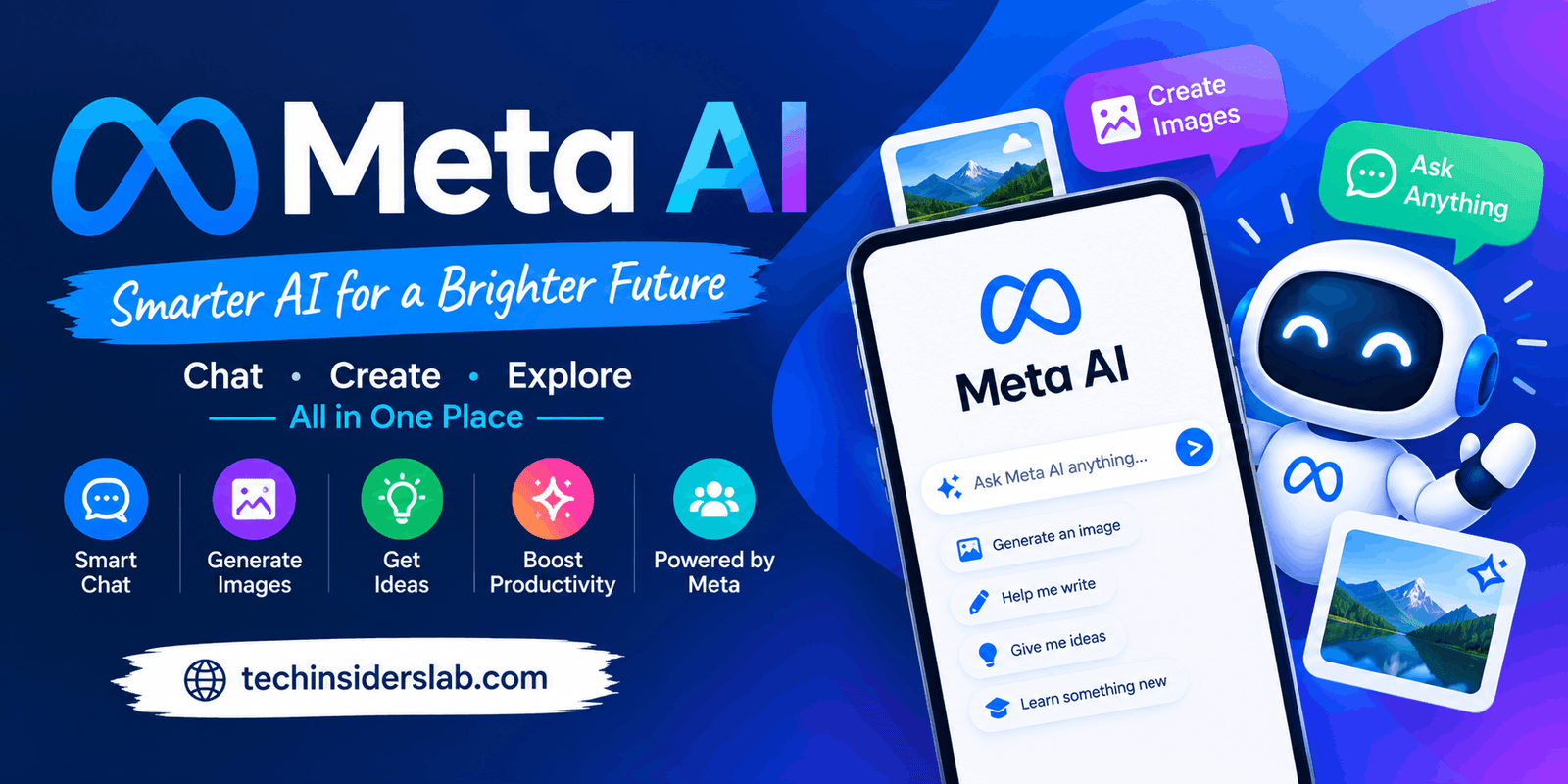
Artificial intelligence is becoming an important part of everyday technology, and Meta AI is one of the most recognizable AI assistants available today. Developed by Meta, the company behind Facebook, Instagram, WhatsApp, and Messenger, Meta AI is designed to help users answer questions, generate ideas, create images, perform research, communicate through voice, and complete a variety of everyday tasks.
Unlike some AI tools that operate mainly as independent chatbots, Meta AI is closely connected with the wider Meta ecosystem. Users can interact with it through Meta’s social platforms, dedicated AI experiences, and supported smart devices.
As artificial intelligence continues to evolve, Meta is expanding its AI technology beyond simple question-and-answer conversations. Modern Meta AI experiences are increasingly focused on multimodal interaction, personalization, creative generation, research, reasoning, and assistance with more complex tasks.
What Is Meta AI?
Meta AI is an artificial intelligence assistant created by Meta. It uses advanced AI models to understand natural-language instructions and provide conversational responses.
Users can ask Meta AI questions in a similar way to asking another person. The assistant can help with explanations, brainstorming, writing, research, recommendations, learning, and creative tasks.
Meta AI is also designed to work with different types of information. Depending on the feature and platform, users can interact with it through text, voice, and images.
One of the major advantages of Meta AI is its integration with popular Meta products. Instead of requiring users to learn a completely separate technology, Meta can bring AI assistance into platforms that millions of people already use.
How Does Meta AI Work?
Meta AI is powered by large artificial intelligence models developed by Meta. These models are trained to understand language and generate useful responses based on the information and instructions provided by users.
Meta has developed several generations of AI models, including its Llama family and newer AI technologies designed for more advanced reasoning and multimodal tasks.
When a user sends a question or instruction, the AI processes the input, identifies the user’s intent, and generates a response. For image-related tasks, the system can analyze visual information or generate new visual content based on a written description.
The technology behind Meta AI continues to evolve, with newer systems focusing on better reasoning, personalization, voice interaction, research capabilities, and the ability to work with multiple forms of information.
Main Features of Meta AI
1. AI Chat Assistant
The most basic and popular use of Meta AI is conversational assistance.
Users can ask questions about different subjects and receive answers in natural language. The assistant can also help users brainstorm ideas, explain complicated concepts, rewrite text, summarize information, and organize thoughts.
For example, someone writing an article can use Meta AI to generate topic ideas. A student can ask it to explain a difficult concept in simpler language. A professional can use it to brainstorm ideas for a presentation.
This makes Meta AI useful for both casual and productivity-related tasks.
2. AI Image Generation
Meta AI also provides AI-powered image generation capabilities.
Users can describe what they want to see, and the AI can generate visual content based on the description. This can be useful for social media creators, bloggers, marketers, students, and people who simply want to experiment with AI-generated artwork.
Users can create different types of visuals, including illustrations, creative scenes, conceptual images, posters, and social media graphics.
AI image tools can significantly reduce the time required to create an initial visual concept.
3. Image Editing and Transformation
Meta AI is not limited to generating images from scratch. AI-powered visual tools can also be used to modify existing images.
Depending on the available feature, users may be able to change the appearance of an image, apply different visual styles, or transform an existing picture into a new creative concept.
This makes Meta AI useful for people who want to experiment with visual content without requiring advanced graphic-design skills.
4. Voice Conversations
Voice interaction is another important part of the development of Meta AI.
Instead of typing every question, users can communicate with the assistant using their voice. This can make interactions faster and more natural.
Voice AI can be especially useful when users are:
- Traveling
- Cooking
- Working with their hands
- Brainstorming ideas
- Looking for quick information
- Practicing conversations
- Using compatible smart devices
As voice technology improves, AI assistants are becoming more conversational and easier to use.
5. Web Research
Meta AI can also assist users with research-oriented tasks.
Instead of manually searching for information across multiple sources, users can ask the AI to investigate a topic and summarize relevant information.
This can be useful when researching technology, products, destinations, educational subjects, or general questions.
However, AI-generated information should still be checked against reliable sources when accuracy is important. Artificial intelligence can sometimes misunderstand information or produce incorrect answers.
6. Multimodal Understanding
One of the biggest developments in modern AI is multimodal understanding.
Traditional software often works with one type of input at a time. Modern AI systems can work with combinations of text, images, and voice.
Meta AI is moving in this direction as well. Users can interact with AI using different types of information, allowing the assistant to understand more complex requests.
For example, a user may provide an image and ask a question about it. Instead of simply processing the text, the AI can use the visual information as part of its response.
7. Integration With Meta Platforms
Meta AI’s connection with Meta’s major platforms is one of its biggest advantages.
Meta has introduced AI experiences across products such as Facebook, Instagram, WhatsApp, and Messenger.
This integration allows users to access AI assistance while using applications they already know.
For many people, this makes AI more approachable because they do not necessarily need to download or learn an unfamiliar application before trying an AI assistant.
Meta AI for Students
Students can use Meta AI as a learning and study assistant.
It can help explain difficult subjects in simpler language, generate practice questions, summarize concepts, and provide ideas for projects.
For example, if a student does not understand a technical concept, they can ask Meta AI for a beginner-friendly explanation. They can then ask follow-up questions to explore the subject in more detail.
However, students should use AI as a learning tool rather than simply copying its answers. Understanding the subject remains more important than receiving a quick response.
Meta AI for Content Creators
Content creators can also benefit from Meta AI.
Creating regular content often requires ideas, writing, images, captions, and planning. AI can help reduce the time spent on these early stages.
Creators can use Meta AI to:
- Brainstorm content ideas
- Generate caption ideas
- Develop video concepts
- Create visual concepts
- Rewrite content
- Summarize information
- Explore different creative directions
For social media creators, the ability to combine AI assistance with Meta’s existing platforms can make content planning more convenient.
Meta AI for Businesses
Businesses are increasingly exploring artificial intelligence for productivity and customer communication.
Meta AI can potentially assist businesses with content creation, brainstorming, research, marketing ideas, customer interactions, and other digital tasks.
Small businesses may find AI particularly useful because it can help with tasks that traditionally require additional time or resources.
For example, a small business owner could use AI to brainstorm social media ideas, draft promotional content, create visual concepts, or research a new topic.
AI does not completely replace human decision-making, but it can help businesses complete repetitive or creative tasks more efficiently.
Personalization in Meta AI
Personalization is another area where AI assistants are becoming more advanced.
A personalized assistant can potentially provide more relevant responses by remembering certain information that a user chooses to share.
For example, an assistant that understands a user’s preferences may provide more useful recommendations or avoid repeatedly asking the same basic questions.
However, personalization also makes privacy important. Users should understand what information they are sharing with an AI system and avoid providing highly sensitive information unless they are comfortable with the applicable privacy controls.
Privacy and Meta AI
Privacy is an important consideration when using any AI assistant.
Users should avoid sharing passwords, banking information, authentication codes, private documents, or other extremely sensitive information.
AI services can process conversations and other information depending on the product and settings. Therefore, users should review available privacy options and understand how their information is handled.
Meta has also introduced private conversation experiences for users who want additional privacy when interacting with its AI systems.
Privacy settings and features can change over time, so users should always check the latest options available on their account and device.
Benefits of Meta AI
Meta AI provides several benefits for everyday users.
Easy to Use
Its conversational interface makes it accessible even to people who have limited experience with artificial intelligence.
Multiple Capabilities
Meta AI can assist with questions, writing, research, images, brainstorming, and other tasks.
Social Platform Integration
Integration with Meta’s popular applications makes AI assistance easier to access.
Creative Features
Image generation and editing can help users experiment with visual content.
Productivity Support
AI can reduce the time required for brainstorming, drafting, summarizing, and organizing information.
Voice Interaction
Voice capabilities make AI interaction more natural and useful in situations where typing is inconvenient.
Limitations of Meta AI
Although Meta AI has many useful features, it also has limitations.
The first limitation is accuracy. AI can sometimes generate information that sounds convincing but is incorrect.
Another issue is feature availability. Not every Meta AI feature is available to every user. Availability may depend on location, device, account, platform, and the current rollout of a feature.
Privacy is another important consideration. Users should be careful about the personal information they provide.
Finally, AI should not completely replace human judgment. Important decisions should be based on reliable information and, when necessary, professional advice.
Meta AI vs Traditional Search
Traditional search engines generally provide users with a collection of webpages that they can explore.
AI assistants provide a more conversational experience. Instead of searching for several pages and reading them individually, users can ask an AI assistant to explain a topic in a conversational format.
Both approaches have advantages.
AI can be useful for summarizing information and generating explanations, while traditional search remains valuable when users want to inspect original sources themselves.
The best approach often involves using AI for initial research and then verifying important information through trustworthy sources.
The Future of Meta AI
The future of Meta AI is likely to involve more advanced reasoning, personalization, multimodal interaction, and automation.
Meta has been developing AI technologies that go beyond basic chatbot conversations. Future AI assistants may be able to understand more complex instructions, research topics, create content, organize information, and perform multiple steps to complete a task.
AI glasses and other wearable devices could also make AI more connected to the physical world.
Instead of opening an application and typing a question, users may eventually be able to ask an AI assistant about something they are looking at in real time.
This could create new possibilities for travel, education, accessibility, productivity, and everyday assistance.
Who Can Benefit From Meta AI?
Meta AI can be useful for many different types of users.
Students can use it for learning, explanations, and brainstorming.
Content creators can use it for content ideas, captions, and visual concepts.
Professionals can use it for writing, research, planning, and productivity.
Businesses can explore AI for marketing, customer communication, and creative work.
Everyday users can use it for questions, recommendations, entertainment, and general assistance.
The usefulness of Meta AI ultimately depends on how effectively a person uses its capabilities.
Conclusion
Meta AI is becoming an important part of modern artificial intelligence by combining conversational assistance, image generation, voice interaction, research, and multimodal capabilities. Its integration with Meta’s popular platforms makes AI more accessible to everyday users, students, creators, and businesses. While it can improve productivity and creativity, users should still verify important information and remain careful with sensitive data. As Meta continues developing its AI technology, Meta AI is likely to play an even bigger role in how people communicate, create content, search for information, and interact with technology.