introduction
A Yamaha Keyboard is more than just an electronic version of a traditional piano. It is a versatile digital musical instrument designed for learning, practice, songwriting, live performance, home entertainment, and professional music production. Yamaha has developed a wide range of keyboards over the years, from simple portable models for beginners to sophisticated synthesizers and arranger workstations for experienced musicians.
Because Yamaha offers keyboards for different skill levels and musical purposes, choosing the right model can sometimes feel confusing. Some keyboards focus on learning, while others are designed around realistic instrument sounds, automatic accompaniment, sound creation, recording, or professional performance.
Yamaha’s keyboard history is also closely connected with the development of digital music technology. The company began moving its electronic keyboards toward digital technology during the 1970s and later introduced important instruments such as the DX7 synthesizer, which became highly influential in modern music production.
What Is a Yamaha Keyboard?
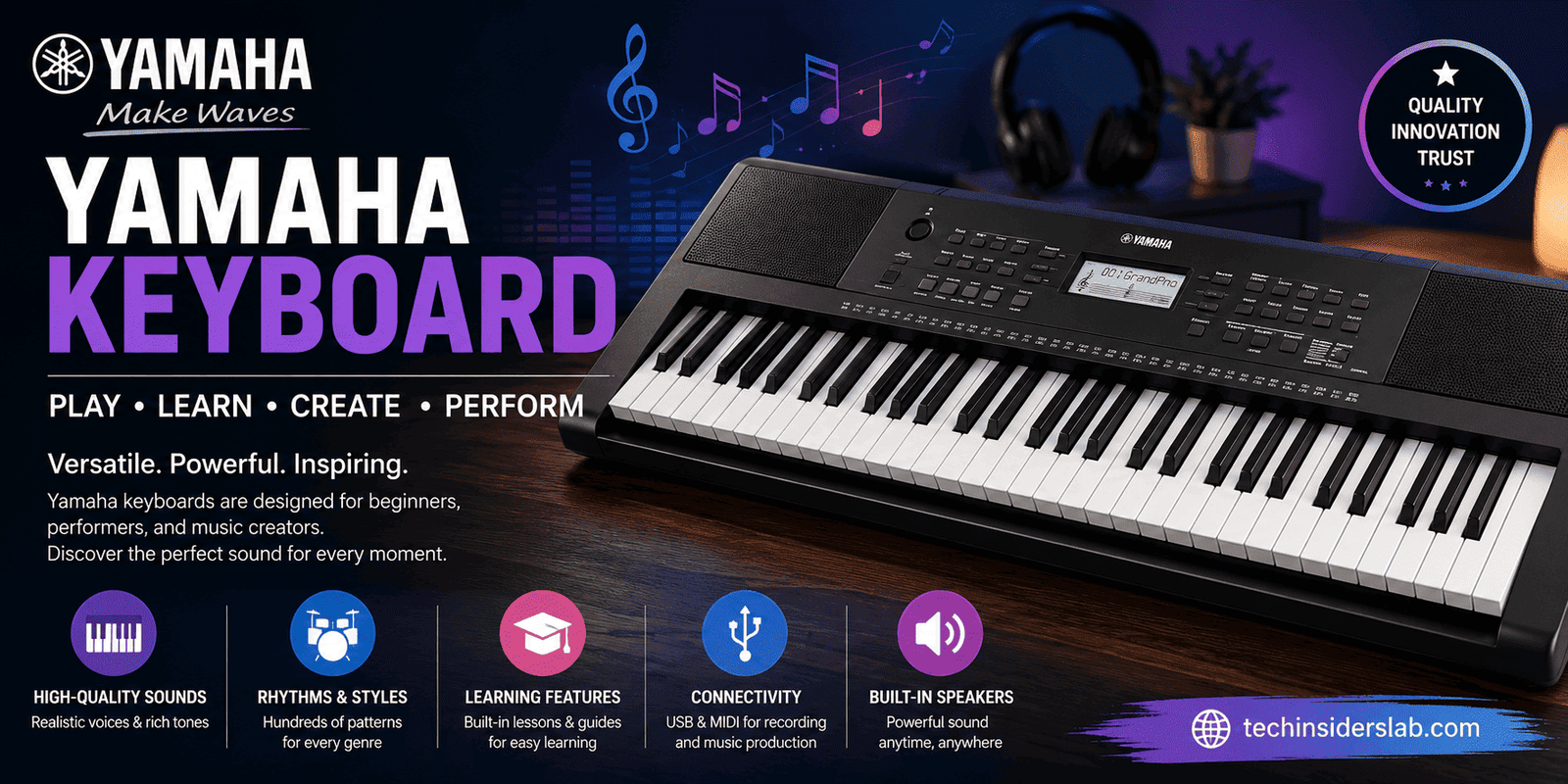
A Yamaha Keyboard is an electronic keyboard instrument manufactured by Yamaha. Depending on the model, it can reproduce piano, organ, strings, guitar, drums, synthesizer, brass, and many other sounds.
Unlike an acoustic piano, which primarily produces sound mechanically through strings and hammers, a digital keyboard uses electronic tone-generation technology. Pressing a key sends an electronic signal that tells the instrument what sound to produce.
This digital approach gives Yamaha keyboards several advantages. A single instrument can provide hundreds of sounds, rhythm patterns, effects, accompaniment styles, and learning functions. Some models can also connect to computers and other devices, making them useful for modern music production.
Yamaha’s current portable keyboard range includes families such as PSR-E, EZ, PSR-F, PSS, Piaggero, and Sonogenic, showing how the company targets different types of players.
A Brief History of Yamaha Keyboards
Yamaha’s contribution to electronic keyboard technology goes back decades. During the 1970s, improvements in semiconductor technology helped the company transition its electronic keyboards toward digital technology. Yamaha also introduced its first electric piano and synthesizer during this period.
One of Yamaha’s most important achievements came in the 1980s with the development of FM synthesis. Yamaha licensed and further developed Frequency Modulation synthesis technology and introduced the GS1 and GS2 before launching the famous DX7 in 1983.
The DX7 became a major milestone in synthesizer history. It offered FM sound generation, programmable sounds, an LCD interface, velocity and aftertouch capabilities, and MIDI support. Its distinctive sounds became strongly associated with the music of the 1980s.
This history explains why Yamaha keyboards are often associated not only with piano playing but also with synthesizers, electronic music, arranging, and professional music production.
Major Types of Yamaha Keyboards
One of the most important things to understand is that “Yamaha Keyboard” does not describe a single instrument. Yamaha produces several keyboard categories.
1. Portable Keyboards
Portable keyboards are designed for people who want a flexible and relatively easy-to-use instrument. Yamaha’s PSR-E series is an example of this category.
These keyboards can be suitable for beginners, hobby musicians, home practice, and performers who need portability. Current Yamaha portable models include 61-key and 76-key options, depending on the model.
Portable keyboards can include realistic instrument voices, rhythm patterns, effects, touch-sensitive keys, learning features, and connectivity options.
For someone purchasing their first keyboard, a portable Yamaha model can provide a useful combination of affordability, functionality, and simplicity.
2. Arranger Keyboards
Arranger keyboards are designed to help musicians build complete musical performances around what they play.
An arranger can automatically generate accompaniment based on chords played by the musician. This can create the feeling of playing with a virtual band.
These keyboards are especially useful for solo performers, entertainers, composers, and musicians who want backing patterns without hiring a complete band.
Yamaha’s keyboard lineup includes arranger-focused products and workstations that combine voices, styles, effects, and performance functions.
3. Synthesizers
Yamaha synthesizers are designed for musicians who want greater control over sound creation.
Instead of simply selecting a piano or guitar sound, a synthesizer can allow the musician to manipulate elements of a sound, depending on the model and synthesis system.
Yamaha’s DX7 is a historic example. Its FM synthesis system became one of the most influential digital synthesis technologies of its era.
Modern Yamaha synthesizers continue this tradition by providing musicians with tools for designing, modifying, layering, and performing electronic sounds.
4. Workstations
Keyboard workstations combine multiple music-making functions into one instrument.
A workstation may provide instrument voices, effects, sequencing, recording capabilities, performance controls, and other production tools. This makes the keyboard useful not only for playing but also for creating complete musical arrangements.
Yamaha describes its workstation category as providing realistic voices, styles, effects, and tools intended to support creative collaboration and music production.
Important Features of Yamaha Keyboards
The exact features vary from model to model, but several capabilities are commonly associated with Yamaha keyboards.
Realistic Instrument Sounds
One of the biggest attractions of a digital keyboard is the ability to access many different sounds from one instrument.
A musician may switch from piano to electric piano, organ, strings, brass, guitar, bass, or drums without changing instruments.
Higher-level models can offer increasingly sophisticated sound engines and effects.
Touch-Sensitive Keys
Some Yamaha keyboards use touch-sensitive keyboards that respond differently depending on how strongly the player presses the keys.
This provides greater musical expression. A gentle touch can produce a softer result, while stronger playing can produce a more powerful response.
For learners, touch sensitivity can also help develop better playing habits.
Automatic Accompaniment
Automatic accompaniment is one of the defining features of many Yamaha arranger and portable keyboards.
Instead of playing every instrument part manually, the musician can select a style and play chords. The keyboard can then provide accompanying rhythm and musical parts.
This makes practice more engaging and can help solo performers create fuller arrangements.
Learning Functions
Yamaha also produces keyboards designed specifically to make learning easier.
Its portable keyboard range includes models with Yamaha Education Suite learning functions, while some beginner-oriented instruments provide lesson-oriented features.
These features can be particularly helpful for students who are beginning to understand notes, chords, rhythms, and keyboard technique.
Connectivity
Modern digital keyboards can also function as part of a larger digital music setup.
Depending on the model, connectivity may include USB, MIDI, audio connections, or connections with computers and other devices.
Yamaha’s keyboard guidance notes that some portable keyboards provide USB connectivity for connecting to a computer and working with projects, samples, or songs.
Connectivity is especially valuable for musicians who want to combine keyboard playing with recording or computer-based music production.
Yamaha Keyboard for Beginners
A beginner does not necessarily need an expensive professional workstation.
For a first keyboard, important considerations include:
- Comfortable keyboard size
- Easy-to-understand controls
- Useful learning functions
- Good-quality basic sounds
- Built-in speakers
- Appropriate key response
- Portability
- Connectivity
- Budget
Yamaha’s current portable range includes entry-level PSR-E models designed for people starting their keyboard journey. The company describes models such as the PSR-E283 as entry-level instruments with a variety of sounds and functions for aspiring musicians.
A beginner should focus less on having the largest number of features and more on choosing an instrument that encourages regular practice.
Yamaha Keyboard for Advanced Players
Experienced musicians usually have different priorities.
A professional performer may care about sound quality, keyboard response, accompaniment styles, effects, control options, reliability, and stage usability.
A producer or sound designer may place greater importance on synthesis capabilities, sequencing, MIDI, editing, and computer connectivity.
A solo entertainer may prefer an arranger keyboard because automatic accompaniment can create a complete backing arrangement.
This is why there is no single “best Yamaha keyboard” for everyone. The right choice depends on the musician’s purpose.
Yamaha Keyboard for Music Production
Digital keyboards have become important tools in modern music production.
A keyboard can be used to enter melodies, chords, bass lines, drum patterns, and MIDI information into a digital audio workstation.
Yamaha’s history shows how important the company has been in this area. The DX7’s MIDI implementation helped musicians exchange digital performance information between compatible electronic instruments and sequencers.
For producers, a keyboard can therefore function as both an instrument and a music-production controller.
The advantage is speed. Instead of drawing every musical note with a mouse, producers can play ideas naturally on keys and then edit the recorded information later.
Yamaha Keyboard for Live Performance
Yamaha keyboards are also suitable for live musicians.
A portable keyboard can be easier to transport than a traditional piano, while an arranger can provide accompaniment for solo performances.
Professional musicians may also prefer specialized synthesizers or stage-oriented instruments depending on their musical style.
For live use, musicians should consider weight, power requirements, key response, sound selection speed, connectivity, speaker availability, and the number of controls needed during performance.
A keyboard that is excellent in a studio may not necessarily be the most convenient option for frequent stage use.
Advantages of Yamaha Keyboards
There are several reasons Yamaha keyboards remain popular.
Versatility
One instrument can provide access to numerous sounds and musical functions.
Beginner-Friendly Options
Yamaha offers models designed specifically for first-time players as well as instruments for experienced musicians.
Long Technology History
Yamaha has decades of experience developing electronic musical instruments, including influential digital synthesizer technologies.
Music Creation
Depending on the model, Yamaha keyboards can support playing, arranging, songwriting, recording, sound design, and performance.
Portability
Many portable models are easier to move between rooms, lessons, rehearsals, and performances than acoustic instruments.
Things to Consider Before Buying a Yamaha Keyboard
Before purchasing one, think about your actual needs.
First, decide whether the keyboard is mainly for learning, home entertainment, live performance, songwriting, or professional production.
Next, consider the number of keys. A 61-key instrument can offer a useful balance between range and portability, while a 76-key keyboard provides more playing range.
You should also consider whether you need weighted keys. If your primary goal is to develop traditional piano technique, a digital piano with a piano-oriented action may be more suitable than a lightweight portable keyboard.
Sound selection is another important factor. Beginners may be satisfied with a broad collection of basic voices, while producers and professional musicians may need more advanced synthesis and editing options.
Finally, consider connectivity. If you plan to work with a computer, recording software, or other MIDI equipment, make sure the model provides the connections you actually need.
Yamaha Keyboard vs. Digital Piano
Although these terms are sometimes used interchangeably, they are not always the same.
A typical portable keyboard emphasizes versatility. It may include numerous sounds, rhythms, accompaniment patterns, and learning functions.
A digital piano focuses more heavily on reproducing the experience and sound of an acoustic piano.
Yamaha itself distinguishes between different digital keyboard categories, including portable keyboards, digital pianos, synthesizers, and workstations.
Therefore, someone who primarily wants to learn classical piano may prefer a digital piano, while someone who wants multiple sounds and automatic accompaniment may find a portable keyboard more useful.
Maintaining a Yamaha Keyboard
Proper maintenance can help extend the life of a digital keyboard.
Keep the instrument away from excessive moisture, dust, extreme temperatures, and direct exposure to damaging environmental conditions.
Clean the exterior using appropriate methods recommended by the manufacturer. Avoid spilling liquids around the keys, controls, speakers, and connection ports.
When transporting the keyboard, use a suitable protective case or bag. Also avoid placing heavy objects on top of the instrument.
If a key, display, speaker, power connection, or control begins behaving unusually, professional inspection is generally safer than attempting an uncertain internal repair.
Why Yamaha Keyboard Remains Relevant
The continuing relevance of Yamaha keyboards comes from the combination of traditional musical knowledge and digital technology.
The company has moved from early electronic instruments to sophisticated synthesizers, digital pianos, portable keyboards, and workstations. Its history includes important milestones such as the DX7, which demonstrated how digital synthesis and MIDI could reshape music creation.
At the same time, Yamaha has not focused only on professional musicians. Its current portable lineup includes instruments aimed at beginners, hobbyists, performers, and more experienced players.
That broad range is one of the strongest reasons the Yamaha keyboard name continues to appear across classrooms, homes, studios, rehearsal spaces, and stages.
Conclusion
A Yamaha Keyboard can be an excellent choice for anyone who wants to explore digital music, whether they are completely new to keyboards or already experienced with professional music production.
The major advantage is variety. Yamaha offers portable keyboards for beginners and casual musicians, arranger-style instruments for performers, synthesizers for sound designers, and advanced workstations for broader music-production needs. Its long history in digital musical-instrument technology also gives the brand an important place in keyboard development.
The best Yamaha keyboard ultimately depends on the user’s goals. A beginner may value simple controls and learning features, while a performer may need accompaniment and portability. A producer may prioritize synthesis, MIDI, connectivity, and sound editing.
Rather than choosing a keyboard based only on its brand or number of features, buyers should first identify how they intend to use the instrument. Once that decision is clear, selecting the appropriate Yamaha keyboard becomes much easier.
For a technology-focused website, Yamaha Keyboard is best presented under the Technology category because modern Yamaha keyboards combine electronic hardware, digital sound technology, connectivity, software-oriented functions, and music-production capabilities.