Wordwall: A Modern Technology Platform Transforming Interactive
Introduction
Technology has changed the way teachers prepare lessons, communicate with students, and measure learning progress. Instead of relying only on textbooks, notebooks, and traditional classroom exercises, educators can now use digital platforms to make lessons more interactive and engaging. Wordwall is one such educational technology platform designed to help teachers create interactive learning activities with minimal preparation.
Wordwall combines digital games, quizzes, printable worksheets, student assignments, activity customization, and artificial intelligence tools in one platform. Its main purpose is to reduce the amount of time teachers spend preparing classroom resources while making learning activities more engaging for students. According to Wordwall’s current website, the platform has more than 30 activity types and a community library containing around 30 million ready-made resources.
From a technology perspective, Wordwall is best described as an EdTech (Educational Technology) platform. It uses web-based interactive tools, reusable templates, cloud-based resources, data tracking, and AI-assisted content creation to support modern teaching.
What Is Wordwall?
Wordwall is an online interactive activity maker primarily designed for teachers. Instead of requiring educators to build games or digital exercises from scratch, the platform provides ready-made templates where teachers can enter their own educational content.
The basic process is simple: a teacher selects an activity template, enters questions or learning material, and then launches the activity. Wordwall states that an activity can be created in approximately one minute, making the platform particularly useful when teachers need a quick classroom resource.
The platform supports both interactive activities and printable resources. Interactive activities can be used on computers, tablets, smartphones, or classroom interactive whiteboards. Teachers can also print activities or download them as PDFs for situations where students do not have access to digital devices.
This combination of online and offline functionality makes Wordwall more flexible than a tool that depends entirely on internet-connected devices.
Wordwall as Educational Technology
Wordwall fits naturally into the Technology → Educational Technology (EdTech) category because its core purpose is to use digital technology to improve teaching and learning.
One of its strongest technological features is its template-based system. Instead of learning complicated software, teachers can select an appropriate activity format and add their lesson content. This reduces the technical barrier for educators who may not have advanced digital skills.
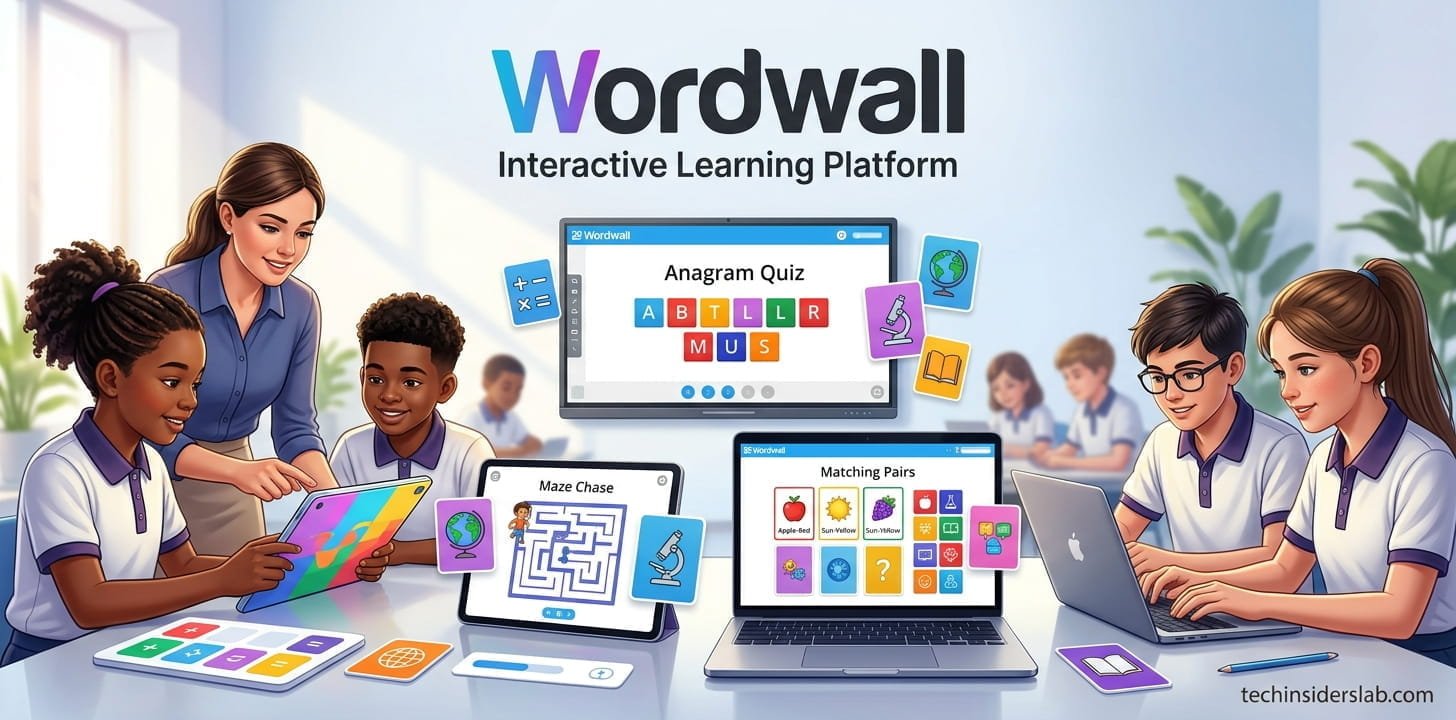
The platform also introduces elements of gamification. Activities such as quizzes, maze games, matching exercises, anagrams, and spin-the-wheel activities can turn ordinary revision into a more game-like experience. This approach can encourage students to participate more actively, particularly when lessons involve repetitive practice.
Wordwall also provides options for timers, scoring, visual styles, and gameplay settings. Teachers can therefore modify an activity according to the age, ability, and learning needs of their students.
Main Features of Wordwall
1. Interactive Activity Templates
Wordwall offers more than 30 activity types. Examples include quizzes, matching exercises, flash cards, group sorting, sentence completion, anagrams, word searches, and spin-the-wheel activities.
These templates allow the same educational content to be presented in different ways. For example, vocabulary words can be turned into a quiz for assessment, flash cards for revision, or a matching activity for practice.
This flexibility means teachers do not necessarily have to create completely different content for every classroom exercise.
2. Switching Between Templates
One particularly useful feature is the ability to change an existing activity into another compatible template. Wordwall explains that teachers can switch the format of an activity with a single click.
For example, a teacher might initially create a matching activity for a science lesson. The same content could potentially be converted into a quiz, word search, or another suitable activity.
This feature saves preparation time and encourages teachers to reuse educational material creatively.
3. Ready-Made Community Resources
Wordwall is not limited to activities created by an individual teacher. It also contains a large searchable community library where educators can discover resources created by other teachers.
The platform currently describes its library as containing approximately 30 million community resources. Teachers can search for activities by topic, subject, or age level and use existing resources as a starting point.
This community-based model is an important part of the platform’s technology ecosystem. Rather than every teacher working independently, educators can benefit from resources shared by other members.
4. Editing and Customization
Finding a ready-made activity does not mean teachers have to use it exactly as it appears. Wordwall allows users to edit activities and create a private copy when modifying another teacher’s public resource.
Teachers can adapt questions, answers, wording, visuals, and other content to better match their own curriculum.
This makes Wordwall useful for differentiated learning, because the same topic can be adjusted for students with different levels of ability.
5. Student Assignments and Results
Wordwall can also function as an assessment and homework tool. Teachers can create student assignments and provide students with a unique access link. Students can then complete the activity individually on their own devices.
Importantly, Wordwall records student results and makes them available to teachers through the results section.
This turns the platform from a simple classroom game generator into a basic digital assessment system. Teachers can use results to identify areas where students may need additional practice.
6. AI-Assisted Content Creation
Artificial intelligence has become an increasingly important part of educational technology, and Wordwall now includes AI-assisted lesson content generation in its paid plans.
According to its current pricing information, the Standard and Pro plans include the ability to generate lesson content instantly with AI.
This feature can potentially reduce the time required to develop initial activity content. However, teachers should still review AI-generated material for accuracy, age appropriateness, curriculum alignment, and clarity before giving it to students.
7. Printable Learning Materials
Although Wordwall is strongly focused on digital learning, it does not completely replace traditional classroom resources. Many activities can also be printed and used as worksheets.
This hybrid approach is useful for schools where every student does not have access to a personal device. It also allows teachers to combine screen-based activities with paper-based exercises.
8. Website Embedding
Wordwall activities can also be embedded into other websites using HTML. Teachers or schools can place activities inside a blog, school website, or virtual learning environment.
This is an important technology feature because it allows Wordwall content to become part of a larger digital learning environment rather than requiring students to visit a separate platform every time.
How Wordwall Can Be Used in Education
Wordwall can support different stages of the learning process. At the beginning of a lesson, a teacher can use a quick quiz or matching activity to introduce a topic. During the lesson, interactive games can provide practice and reinforcement. At the end, an assignment or quiz can be used to check understanding.
The platform can also support different subjects. Language teachers can use vocabulary, spelling, sentence-building, and grammar activities. Science teachers can create quizzes and classification exercises. Mathematics teachers can use question-based activities for revision. History, geography, computer science, and other subjects can also benefit from customized digital exercises.
Another advantage is that Wordwall can be used with different teaching formats. A teacher can display an activity on a classroom screen and allow students to participate together, or students can complete assignments individually on their own devices.
Benefits of Wordwall
The biggest advantage of Wordwall is time efficiency. Teachers can create activities quickly instead of spending a large amount of time designing digital games manually.
Another major benefit is engagement. Game-like formats can make revision and practice feel more interactive than conventional question-and-answer exercises.
Wordwall also offers flexibility. Teachers can switch templates, customize activities, use ready-made community resources, assign activities to individual students, or print worksheets.
The platform’s combination of interactive and printable resources is particularly valuable because technology access varies between classrooms and schools.
From a technology standpoint, Wordwall also demonstrates how cloud-based educational tools can combine content creation, sharing, assessment, and AI-assisted productivity within one service.
Limitations to Consider
Despite its advantages, Wordwall is not a complete replacement for a teacher or a full learning management system. Its strongest purpose is creating and delivering interactive activities rather than managing an entire school’s curriculum.
Another consideration is that some features depend on the user’s subscription plan. Wordwall currently offers a free Basic plan with limited activity creation and template access, while paid Standard and Pro plans provide broader functionality. The current listed individual prices include $7.20 per month for Standard and $10.80 per month for Pro when paid monthly, although pricing and plan features can change over time.
Teachers should also avoid assuming that gamification automatically produces better learning. An attractive game still needs meaningful questions, appropriate difficulty, and clear learning objectives. The quality of the educational content remains more important than the visual design of the activity.
Wordwall and the Future of EdTech
Wordwall represents a broader trend in educational technology: making sophisticated digital tools accessible to ordinary teachers without requiring programming or advanced technical knowledge.
The addition of AI-assisted content creation is another indication of where EdTech is moving. Instead of technology simply providing a digital version of a worksheet, modern platforms are increasingly helping teachers create, customize, deliver, and evaluate learning activities.
Wordwall’s community model is also significant. Its large collection of teacher-created resources demonstrates how digital education platforms can create ecosystems where educators contribute resources that other educators can discover and adapt.
As classrooms become increasingly digital, tools such as Wordwall can occupy a useful middle ground between traditional teaching materials and more complex learning management systems.
Conclusion
Wordwall is more than a collection of online classroom games. It is a modern Educational Technology (EdTech) platform that combines interactive activity creation, gamification, printable resources, community sharing, student assignments, performance tracking, customization, and AI-assisted content generation.
Its biggest strength is simplicity. Teachers can take existing lesson content and quickly transform it into interactive activities without needing specialized technical skills. At the same time, students can access activities through computers, tablets, smartphones, or classroom displays, while printable options provide an alternative when digital devices are unavailable.
For anyone categorizing Wordwall, the most accurate placement is Technology → Educational Technology (EdTech). Its purpose is specifically connected to the use of technology in education, making it a strong example of how digital platforms are changing classroom preparation, student engagement, and learning assessment.
Overall, Wordwall stands out because it focuses on a practical problem: how teachers can create engaging learning activities without spending excessive time preparing them. By bringing activity creation, sharing, customization, assessment, and AI tools together, it provides a flexible technology solution for modern educators.