introduction
Action cameras have become an important tool for travelers, cyclists, vloggers, divers, and adventure enthusiasts who want to record moments without carrying a large camera setup. Among the cameras designed for this purpose, the DJI Osmo Action 4 stands out because it combines a relatively compact body with strong stabilization, high-resolution recording, waterproof construction, and features aimed at both casual users and content creators.
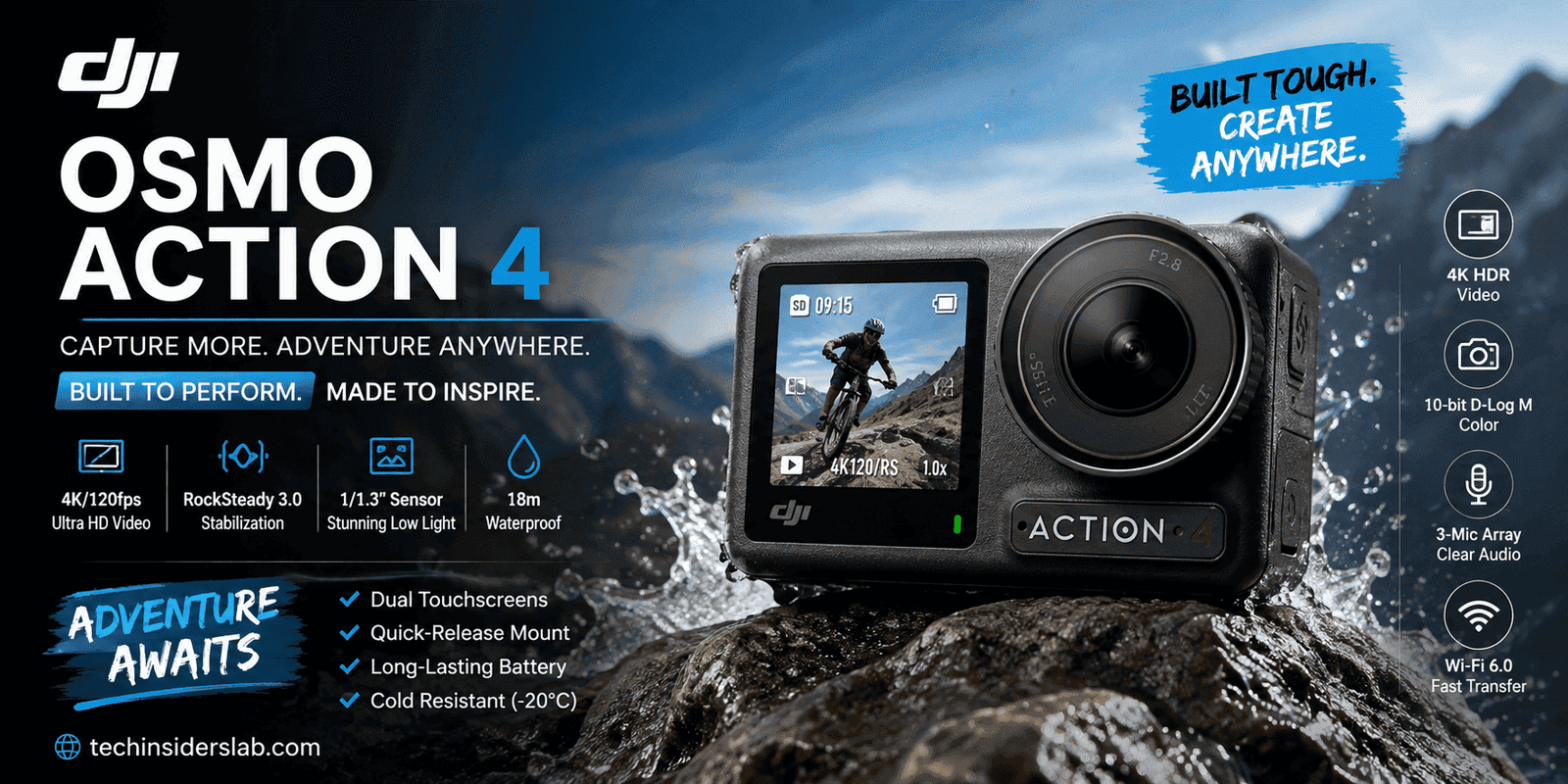
The camera is designed around a 1/1.3-inch sensor and can record video at up to 4K and 120 frames per second. DJI also includes 10-bit D-Log M, RockSteady stabilization, HorizonSteady, dual touchscreens, magnetic mounting, and native vertical shooting.
But specifications alone do not explain who should actually consider this camera. This guide explores its most important features, real-world strengths, limitations, and the types of users who can get the most from it.
What Is DJI Osmo Action 4?
The DJI Osmo Action 4 is a compact action camera developed for recording activities where a conventional smartphone or mirrorless camera may be inconvenient. It is particularly suitable for cycling, hiking, skiing, water sports, travel, motorcycling, and first-person video.
One of its biggest advantages is its combination of portability and durability. The camera weighs approximately 145 grams and measures 70.5 × 44.2 × 32.8 mm. It also has front and rear color touchscreens, allowing users to frame shots from either side.
Unlike a smartphone, the Action 4 can be attached to helmets, handlebars, chest mounts, vehicles, and other accessories. Its magnetic quick-release system also makes it easier to move the camera between mounting positions.
1/1.3-Inch Sensor and Low-Light Performance
One of the most important features of the DJI Osmo Action 4 is its 1/1.3-inch image sensor. DJI pairs this sensor with an f/2.8 aperture and a 2.4 μm-equivalent pixel size. The larger sensor design is particularly useful when shooting in challenging lighting conditions.
Action cameras are often used outdoors during bright daylight, but adventure footage is not always captured under perfect conditions. Users may record during sunset, inside forests, on cloudy days, or in dimly lit environments.
The Action 4’s sensor helps it produce cleaner-looking footage in lower light compared with many small-sensor action cameras. Independent testing has also found the camera capable of maintaining useful image quality as lighting becomes more difficult, although image-processing limitations can still appear in very dark scenes.
This makes the camera particularly interesting for travelers and creators who do not want to stop recording whenever the lighting changes.
4K Video at Up to 120fps
Video recording is at the heart of the Action 4. The camera supports 4K recording at up to 120fps, which provides plenty of flexibility for both normal footage and slow-motion sequences. It also supports multiple frame rates at 4K, 2.7K, and 1080p resolutions.
Recording at 120fps is especially useful for sports and action footage. When appropriate footage is played back at a lower frame rate, fast movements can be slowed down to reveal details that may otherwise happen too quickly.
For example, cyclists can capture jumps, skiers can record turns, and travelers can create smooth slow-motion clips of water or moving scenery.
The camera can also capture 1080p video at up to 240fps, providing an even slower-motion option when resolution requirements are lower.
RockSteady 3.0 and HorizonSteady Stabilization
One of the biggest reasons to buy an action camera is stabilization. Simply mounting a small camera to a bicycle or helmet is not enough; without effective stabilization, vibrations can make footage uncomfortable to watch.
DJI addresses this with RockSteady 3.0, RockSteady 3.0+, HorizonBalancing, and HorizonSteady. The camera uses electronic image stabilization to analyze captured frames and compensate for movement.
HorizonSteady is particularly useful for activities where the camera may rotate or tilt. DJI says the technology can correct horizontal rotation and keep the horizon level, making it useful for cycling, karting, and other moving activities.
However, users should remember that stabilization involves image processing and cropping. Some advanced stabilization modes are also restricted to particular resolutions and frame rates.
10-Bit D-Log M for Content Creators
The Action 4 is not limited to automatic shooting. It also provides features for people who want more control during post-production.
Its 10-bit D-Log M color mode is designed to preserve a wider range of color information and dynamic range. DJI says the 10-bit system can capture more than one billion colors, giving creators greater flexibility during color grading.
This feature can be particularly valuable for YouTubers, filmmakers, travel creators, and photographers who edit their footage using professional software.
For casual users, standard color modes may be easier because they require less editing. But for creators who want to develop a consistent visual style, D-Log M provides additional room for color correction.
155° Ultra-Wide Field of View
The DJI Osmo Action 4 offers a 155-degree ultra-wide field of view. This is useful for action-camera shooting because it allows users to capture more of the surrounding environment.
A wide perspective works especially well for:
- Cycling videos
- Hiking footage
- Motorcycle rides
- Skiing
- Vlogging
- Travel videos
- Water sports
- POV recordings
The camera also offers a Standard (Dewarp) option for users who prefer a less exaggerated perspective.
Waterproof Design
Water resistance is another major advantage of an action camera. The DJI Osmo Action 4 can be used underwater to a depth of 18 meters without a waterproof case. With DJI’s Waterproof Case, the supported depth increases to 60 meters.
This makes the camera suitable for activities such as swimming, snorkeling, surfing, kayaking, and diving when used appropriately.
However, waterproofing does not mean users should ignore maintenance. DJI recommends checking the lens cover and closing the battery and USB-C covers properly before underwater use. For extended underwater shooting or higher water pressure, the waterproof case is recommended.
Battery Life and Cold-Weather Performance
Battery life is critical for action cameras because adventure activities can last several hours.
DJI lists up to 160 minutes of operating time under specific test conditions: 1080p/24fps, RockSteady enabled, Wi-Fi disabled, and screens off at room temperature.
DJI also designed the battery for cold environments. The company states that the camera can record for around 150 minutes at temperatures as low as -20°C under its specified test conditions. Fast charging can bring the battery to 80% in approximately 18 minutes.
Actual battery life will naturally vary. Recording 4K/120fps, using stabilization, keeping the displays active, and operating wireless connections can consume more power.
Therefore, serious travelers and creators may still want spare batteries, particularly when spending a full day away from a charging source.
Dual Touchscreens Make Framing Easier
The Action 4 features a 1.4-inch front touchscreen and a 2.25-inch rear touchscreen.
The front screen is especially useful for vloggers and solo creators. Instead of guessing whether their face is correctly positioned, users can see themselves while recording.
The rear screen provides a larger interface for adjusting settings, reviewing footage, and composing shots.
Both screens are designed to work in situations where users may encounter water or wet hands, which makes the camera more practical for outdoor activities.
Magnetic Quick-Release System
Another practical feature is the magnetic quick-release mounting system.
Instead of permanently attaching the camera to one setup, users can quickly move it between different mounting positions. This can be useful during travel when a creator wants to switch between a chest mount, selfie stick, bicycle mount, or handheld configuration.
The camera also supports native vertical shooting when used with the appropriate Horizontal-Vertical Protective Frame, making it more convenient for short-form content intended for platforms that favor vertical video.
Audio and Connectivity
Video quality is only one part of a good vlog. Audio also matters.
The Action 4 has three built-in microphones and supports wireless connectivity. DJI’s current product information also notes direct compatibility with DJI Mic 2 and DJI Mic Mini transmitters without requiring a receiver in supported setups.
Users can transfer footage through the DJI Mimo app, a microSD card, or USB-C depending on their workflow and device compatibility.
For creators who frequently move footage from camera to phone, this flexibility can make the editing process more convenient.
Who Should Buy DJI Osmo Action 4?
The Action 4 makes the most sense for people who need a small camera that can survive demanding environments.
It is especially suitable for:
Travelers: Its compact design and waterproof construction make it convenient for trips.
Cyclists and motorcyclists: Stabilization helps reduce the impact of vibration and movement.
Vloggers: The front screen and wide field of view are useful for self-recording.
Divers and water-sports users: Its waterproof body provides additional flexibility around water.
Content creators: 4K/120fps and 10-bit D-Log M offer useful creative options.
Winter sports enthusiasts: Cold-weather battery performance is an important advantage.
What Are the Limitations?
Despite its impressive feature set, the Action 4 is not a replacement for every type of camera.
The lens is fixed, so users cannot change focal lengths like they can with interchangeable-lens cameras. DJI’s FAQ confirms that the lens cannot be replaced.
Low-light performance is improved by the larger sensor, but a compact action camera still has physical limitations compared with larger cameras equipped with bigger sensors and interchangeable lenses.
Another consideration is heat. DJI notes that recording at high resolutions and frame rates such as 4K/120fps requires significant processing power, which can cause the camera body to become warm during extended recording.
Finally, some advanced stabilization features are unavailable at every resolution and frame rate, so users should select their recording settings according to the type of footage they need
Conclusion
The DJI Osmo Action 4 is a versatile action camera built for users who want high-quality video without carrying a large camera setup. Its 4K/120fps recording, strong stabilization, 1/1.3-inch sensor, 10-bit D-Log M, dual touchscreens, and waterproof design make it suitable for travel, sports, vlogging, cycling, and underwater adventures.
Although it has some limitations, such as a fixed lens and the possibility of heating during demanding recording modes, its overall combination of portability, durability, image quality, and useful creator features makes it a strong choice in the action-camera category. For anyone looking for a compact camera capable of handling both everyday content and adventurous shooting conditions, the DJI Osmo Action 4 is worth considering.