Introduction
Every great fantasy adventure begins with a character who has a story to tell. In Dungeons & Dragons (D&D), you might become a fearless warrior protecting a forgotten kingdom, a clever rogue searching for hidden treasures, or a powerful wizard trying to uncover ancient secrets. Your character influences how you explore the world, solve problems, fight enemies, and interact with other adventurers.
A D&D character creator helps turn these ideas into a playable character. Instead of struggling with complicated rules and calculations, players can organize their choices through a structured character-building process. They can select a class, choose a species and background, distribute ability scores, and prepare the equipment needed for their journey.
Character creation is not simply about choosing powerful abilities. It is also about designing someone who feels believable within a fantasy world. The most interesting characters have strengths, weaknesses, personal ambitions, and reasons to join an adventure.
Whether you are new to tabletop role-playing games or an experienced player looking for a fresh build, understanding how character creators work can make the entire process more enjoyable.
What Is a D&D Character Creator?
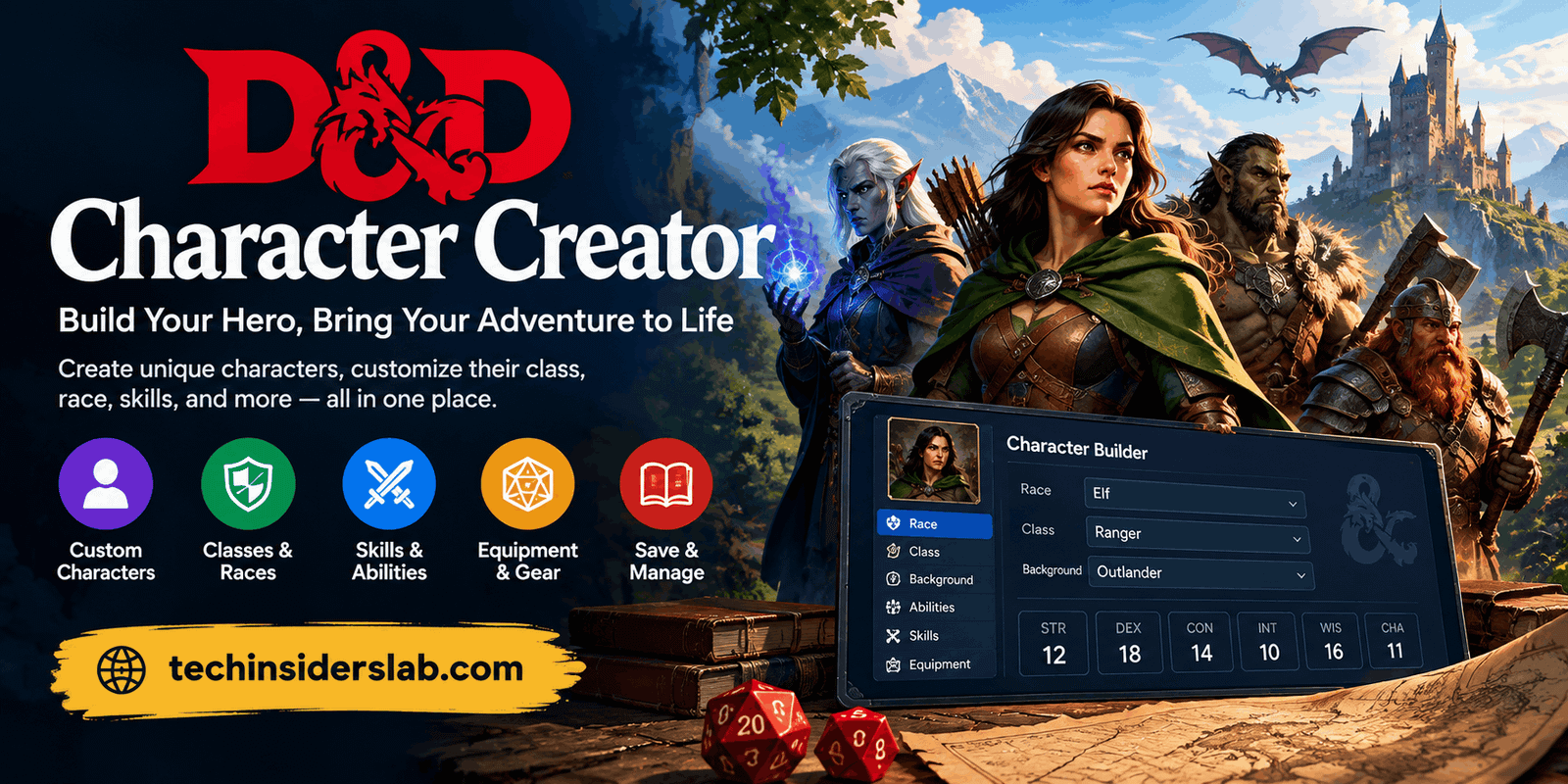
A D&D character creator is a digital tool or character-building system that helps players create heroes for Dungeons & Dragons. It brings essential character information together, including abilities, class features, skills, equipment, spells, and combat statistics.
Traditionally, players could build characters using printed rulebooks, dice, pencils, and paper character sheets. Although this method remains popular, digital character creators offer a more organized alternative. Many tools guide users through the process and calculate supported statistics automatically.
Imagine creating a character named Kael, a young adventurer who wants to recover a magical artifact stolen from his family. A character creator helps you select a suitable class, assign abilities, choose equipment, and record the details required to play him.
The tool manages the mechanical side of the process, while you decide who Kael is, what he fears, and why he continues his dangerous journey.
Different platforms support different editions, options, and customization features. Therefore, players should choose a creator that matches the rules used by their Dungeon Master.
Why D&D Character Creators Are Useful
Creating a character involves more than selecting a name and appearance. Players must understand how different abilities work together and how their choices affect gameplay.
Simplifies the Creation Process
A character creator divides the process into manageable stages. Beginners can work through each decision without needing to understand every rule immediately. This makes it easier to learn the basics while building a playable character.
Helps Reduce Calculation Errors
Many digital builders calculate supported values such as ability modifiers and proficiency bonuses. Depending on the platform, they may also update other statistics when you change an ability or advance to a new level.
Keeps Character Details Organized
During an adventure, players may need to check their armor class, hit points, weapon attacks, spell descriptions, or inventory. A digital character sheet keeps these details together instead of spreading them across multiple pages.
Supports Different Playstyles
Some players enjoy close-range combat, while others prefer magic, stealth, healing, exploration, or social interaction. A character creator makes it easier to compare available options and develop a character around a preferred style.
Encourages Creative Experimentation
You can explore different character concepts before committing to one. For example, you might compare a heavily armored fighter with a spellcasting bard or experiment with different skill combinations to see which concept suits your campaign.
The Essential Elements of a D&D Character
Understanding the main components of a character will help you make better decisions when using a character creator.
1. Class: Define Your Character’s Role
Your class determines many of your character’s abilities and establishes their general approach to adventure.
- Fighter: A versatile combatant who relies on weapons, training, and tactical decisions.
- Wizard: A spellcaster who studies magic and uses knowledge to overcome challenges.
- Rogue: A skilled adventurer who excels at stealth, precision, and specialized tasks.
- Cleric: A character who combines divine magic with support and other capabilities.
- Barbarian: A powerful warrior built around physical strength and durability.
- Bard: A flexible character who combines magic, social abilities, and support.
- Druid: A nature-focused spellcaster with abilities connected to the natural world.
- Ranger: An adventurer associated with exploration, tracking, and combat.
- Paladin: A warrior who combines martial skills with sacred magic.
- Monk: A mobile martial artist who uses disciplined combat techniques.
- Sorcerer: A spellcaster whose magic comes from an innate or extraordinary source.
- Warlock: A character whose magical abilities are connected to a supernatural pact.
The best class depends on how you want to experience the game. If you enjoy making strategic decisions through spells, a wizard may suit you. If you prefer straightforward weapon combat, a fighter could be a better starting point.
2. Species: Give Your Character a Fantasy Identity
Species represents your character’s fantasy ancestry and the traits associated with it under the selected rules.
Elves, dwarves, humans, halflings, and other fantasy peoples can offer different character concepts. However, the available choices and their mechanical benefits depend on the rules edition and content supported by the creator.
Think about more than appearance when choosing a species. Consider how your character’s community, traditions, and experiences might influence their personality and place in the world.
3. Background: Decide Where Your Hero Comes From
A background describes your character’s life before becoming an adventurer. Perhaps they were a soldier who left the army, an artisan who discovered a mysterious map, or a scholar who became fascinated by forbidden knowledge.
A good background provides a reason for your character to travel, cooperate with others, and face dangerous situations.
It can also influence gameplay through skills and other benefits defined by the applicable rules. Choose a background that complements your concept without making the character’s entire personality predictable.
4. Ability Scores: Establish Strengths and Weaknesses
D&D uses six core abilities to describe different aspects of a character.
| Ability | What It Represents |
| Strength | Physical power and force |
| Dexterity | Agility and coordination |
| Constitution | Endurance and resilience |
| Intelligence | Reasoning and learned knowledge |
| Wisdom | Awareness and judgment |
| Charisma | Personality and social influence |
Your class helps determine which abilities deserve the most attention. A character who relies on physical attacks may prioritize Strength or Dexterity, while a wizard generally benefits from Intelligence.
Avoid making every ability equally important without considering your intended role. At the same time, remember that weaker abilities can create interesting role-playing opportunities rather than simply being disadvantages.
5. Skills, Equipment, and Spells
Skills help characters handle challenges such as investigating mysteries, persuading strangers, sneaking past guards, and surviving in the wilderness.
Equipment provides practical resources for adventures. Weapons and armor support combat, while tools and other items may help solve problems outside battle.
Spells introduce additional possibilities for characters with spellcasting abilities. Depending on the spell, magic might damage an enemy, protect an ally, reveal information, or change how the party approaches a challenge.
A strong character build balances these choices with the needs of the campaign.
How to Create a Memorable D&D Character
Using a character creator effectively requires both mechanical planning and imagination. Follow these steps to develop a character that works well in a campaign.
Step 1: Start With a Story Idea
Before selecting statistics, imagine the kind of person you want to play.
For example, your character could be a former royal guard who lost faith in the kingdom, a curious scholar searching for a vanished civilization, or a wandering healer who helps strangers for a personal reason.
A simple concept gives your later decisions a clear direction.
Step 2: Choose a Suitable Class
Select a class that supports the character you imagined. A former guard might become a fighter, while a scholar searching for magical knowledge could be a wizard.
Your story does not have to follow stereotypes. A bard can be quiet and thoughtful, and a fighter can be diplomatic. The important thing is that you enjoy the way the character plays.
Step 3: Select Species and Background
Choose a species that fits your world and a background that explains your character’s earlier experiences.
Think about what they learned before adventuring, which people influenced them, and what event changed their life. These details make the character feel connected to the campaign setting.
Step 4: Assign Ability Scores
Use the ability-generation method approved by your Dungeon Master. Common methods include standard array, point buy, and rolling dice where permitted.
Prioritize the abilities that support your class and chosen role. Review any class-specific requirements or rules before finalizing your scores.
Step 5: Select Skills and Special Abilities
Choose options that reflect how you want to contribute to the party. A character focused on investigation might benefit from relevant knowledge-based skills, while an explorer may prefer abilities suited to wilderness challenges.
For spellcasters, review available spells carefully. A selection that provides different kinds of utility can be more useful than choosing several options that all serve the same purpose.
Step 6: Choose Equipment
Review the starting equipment allowed by your character’s rules. Consider the weapons, armor, tools, and adventuring items that make sense for your role.
Avoid assuming that the most expensive or impressive equipment is always the best choice. Practicality, proficiency, and campaign rules matter.
Step 7: Complete Your Character Sheet
Enter your character’s name, level, abilities, skills, equipment, attacks, and other required information. Check calculated statistics and confirm that your character follows the campaign’s rules.
Step 8: Add Personality and Motivation
Give your character a goal that can influence their decisions. They might want to restore their family’s reputation, uncover a secret, repay a debt, or protect someone who cannot defend themselves.
You can also add a flaw or fear. A brave warrior who struggles to trust others or a brilliant wizard who becomes distracted by forbidden knowledge can create interesting moments during gameplay.
Choosing the Right D&D Character Creator
Different tools serve different needs, so it helps to compare their strengths before starting.
D&D Beyond
D&D Beyond is the official digital toolset for Dungeons & Dragons. It offers character-building features and digital character sheets that help players organize their statistics and gameplay information.
It is a useful choice for players who prefer a guided process. However, access to certain character options and published content may depend on the account, available entitlements, or purchases.
Aidedd
Aidedd provides independent online tools for D&D character creation. Depending on the available features, players can explore character options and build characters using supported rules.
It may appeal to players seeking a browser-based alternative. Confirm the supported edition and current capabilities before using a character for an ongoing campaign.
Roll20
Roll20 provides virtual tabletop tools for online role-playing games. Its character-related features can be useful for groups that already use the platform to organize and run sessions.
Before choosing it, check whether the required character sheet and rules content are supported for your game.
Manual Character Sheets
A paper sheet or editable document remains a practical option. Manual character creation provides flexibility and can help players understand how character statistics work.
The trade-off is that players may need to calculate values themselves and update their sheets whenever their characters gain new abilities.
Common Mistakes to Avoid
Even a well-designed character creator cannot make every decision for you. Keep these mistakes in mind:
- Ignoring the rules edition: Options available in one edition may work differently or be unavailable in another.
- Choosing abilities without a plan: Build around your intended role instead of selecting options randomly.
- Forgetting teamwork: Consider how your character can help the group outside their strongest area.
- Overcomplicating your first build: Begin with a manageable character and learn additional mechanics as you play.
- Neglecting the story: Statistics help determine what your character can do, but personality and motivation explain why they do it.
- Failing to update the sheet: Review your character whenever they gain levels, acquire equipment, or receive new features.
Your first character does not have to be perfect. Playing the game is one of the best ways to discover which mechanics and character concepts you enjoy.
Conclusion
A D&D character creator is more than a convenient way to organize statistics. It is a starting point for building a hero who can explore strange lands, overcome difficult challenges, and become part of an unforgettable story.
By choosing a suitable class, selecting abilities carefully, and developing a meaningful background, you can create a character that feels both effective and distinctive. Use digital tools to simplify the technical details, but leave room for imagination, unexpected decisions, and character growth.
The best D&D character is not necessarily the one with the highest statistics. It is the one whose choices, struggles, and adventures make you excited to return to the game.