introduction
As e-commerce continues to grow, managing product and supplier information has become increasingly important. When sellers or buyers deal with multiple products, suppliers, prices, quantities, and orders, keeping everything organized manually can become difficult. This is where a spreadsheet can provide a simple yet powerful solution.
DHgate Spreadsheet generally refers to using a spreadsheet to organize and manage information related to products, suppliers, prices, orders, inventory, and other data associated with DHgate. Instead of keeping product information scattered across browser tabs, notes, or different files, users can place important details into rows and columns for easier comparison and analysis.
For online sellers, product researchers, and wholesale buyers, this approach can make research more structured and manageable.
What Is DHgate?
DHgate is a global online marketplace where different suppliers and sellers offer a wide range of products. The platform includes categories such as electronics, accessories, clothing, home products, tools, and many other consumer goods.
Because a marketplace can contain products from many different sellers, buyers may need to compare several listings before making a purchasing decision. Checking every product individually can become time-consuming, especially when researching a large number of products.
A spreadsheet can solve part of this problem by allowing users to record important information in one organized location.
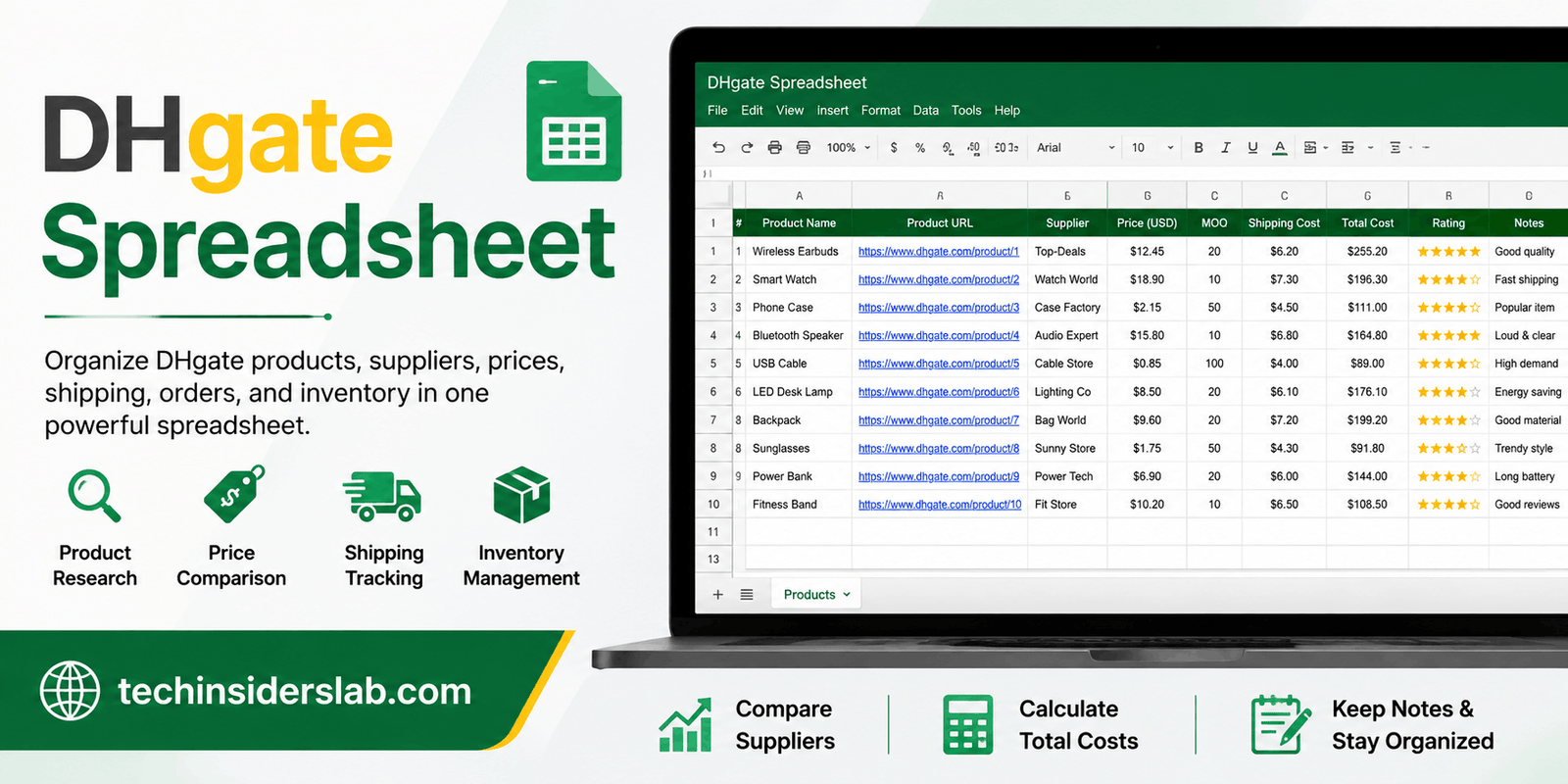
For example, if someone is researching 50 products, they can create a spreadsheet containing the product name, seller, price, minimum order quantity, shipping information, rating, and personal notes.
What Does DHgate Spreadsheet Mean?
The term DHgate Spreadsheet does not necessarily refer to a specific official spreadsheet application or software product. In many cases, it describes a spreadsheet created to organize DHgate-related product and supplier information.
A basic spreadsheet might include columns such as:
- Product Name
- Product URL
- Seller Name
- Product Price
- Minimum Order Quantity
- Shipping Cost
- Product Rating
- Order Quantity
- Estimated Total Cost
- Inventory Status
- Supplier Notes
This structure allows users to keep product research organized and makes it easier to compare different options.
Why Use a Spreadsheet for DHgate Research?
One of the biggest challenges in online product research is information overload. A search can produce many different listings, and remembering the details of every product is difficult.
A spreadsheet creates a central place where important information can be stored.
For example, if you are comparing ten suppliers, you can enter their prices, shipping costs, ratings, and other details into the same spreadsheet. You can then sort or filter the information to identify potentially suitable options.
A DHgate-related spreadsheet can be useful for people who:
- Research products
- Compare suppliers
- Track inventory
- Manage e-commerce businesses
- Evaluate wholesale products
- Calculate product costs
- Maintain order records
Important Columns for a DHgate Spreadsheet
An effective spreadsheet does not need to contain every possible detail. It should focus on information that supports your specific research or business goal.
1. Product Name
The product name should be recorded clearly so that it can be identified easily later. Consistent product naming also makes sorting and filtering more convenient.
2. Product Link
Saving the product URL is extremely useful. Instead of searching for the same listing again, users can access the saved link directly.
3. Seller Information
The seller or supplier name can be stored in a separate column. This makes it easier to identify which supplier offers a particular product.
4. Product Price
Price is one of the most important fields in a product research spreadsheet. Recording prices from different sellers allows users to make more informed comparisons.
5. Minimum Order Quantity
Minimum order quantity, commonly known as MOQ, can be particularly important for wholesale buyers. A product may have an attractive unit price, but a high minimum order requirement can significantly increase the initial investment.
6. Shipping Cost
Shipping should also be recorded because the product price alone may not represent the total purchasing cost.
7. Quantity
If you are planning to purchase products in bulk, adding an expected order quantity can help with cost calculations and inventory planning.
8. Notes
A notes column can be used to record product specifications, supplier communication, quality observations, or other research information.
How to Calculate Total Product Cost
One major advantage of using a spreadsheet is the ability to perform automatic calculations.
Suppose you want to purchase 20 units of a product. You can multiply the unit price by the quantity to calculate the product subtotal.
Product Cost = Unit Price × Quantity
If shipping is included, the estimated total can be calculated as:
Estimated Total Cost = Product Cost + Shipping Cost
Additional expenses, such as applicable taxes, platform fees, or other charges, can also be recorded separately when relevant.
This type of calculation gives buyers a better understanding of their potential expenses before placing an order.
Using Spreadsheets for Supplier Comparison
Supplier comparison is another area where a DHgate spreadsheet can be particularly useful.
Imagine that five different sellers offer similar products. Each seller may have different prices, shipping options, ratings, and order requirements.
Instead of checking each listing repeatedly, you can record the information in a spreadsheet and compare it side by side.
Important comparison factors may include:
Price: How much does the product cost?
MOQ: What is the minimum quantity required?
Shipping: What shipping options and costs are available?
Rating: What information is available about the seller’s marketplace performance?
Product Details: Does the product meet your required specifications?
This approach helps prevent purchasing decisions from being based solely on the lowest advertised price.
DHgate Spreadsheet for Inventory Management
Inventory management can become complicated when products are sourced from multiple suppliers. A spreadsheet can provide a simple way to keep track of stock levels.
You can add inventory-related columns such as:
- Product Name
- SKU
- Supplier
- Current Stock
- Ordered Quantity
- Sold Quantity
- Remaining Stock
- Reorder Level
For example, if the stock of a particular product falls below a predetermined level, the spreadsheet can help identify that product for potential reordering.
For small businesses that do not yet require specialized inventory management software, this can be a practical starting point.
DHgate Spreadsheet for Product Research
Product research is an important part of many e-commerce businesses. Choosing a suitable product often requires evaluating several factors rather than looking at price alone.
A spreadsheet can make this research process more structured.
You can create separate sections for different products and record details such as price, supplier, shipping cost, MOQ, rating, and notes.
| Research Factor | Spreadsheet Purpose |
| Product | Identify the product |
| Price | Compare costs |
| Supplier | Track sellers |
| MOQ | Understand bulk requirements |
| Shipping | Estimate delivery costs |
| Rating | Evaluate available seller information |
| Notes | Store additional research |
Keeping this information together makes it easier to review your research later.
Benefits of DHgate Spreadsheet
Better Organization
A spreadsheet turns scattered product information into a structured format. This can make large amounts of data easier to manage.
Easy Comparison
Multiple products and suppliers can be compared side by side, making differences easier to identify.
Faster Calculations
Spreadsheet formulas can automatically calculate quantities, subtotals, estimated costs, and other values.
Improved Record Keeping
Previous product research can be saved and reviewed later instead of repeating the same research.
Budget Management
Tracking product prices and shipping expenses can help users estimate their purchasing budget.
Simple Collaboration
Cloud-based spreadsheet platforms can allow multiple people to access and work with the same document, depending on the platform and its sharing settings.
Common Mistakes to Avoid
Creating a spreadsheet is simple, but poor organization can eventually make it difficult to use.
Adding Too Many Columns
Including every possible piece of information can make a spreadsheet unnecessarily complicated. Focus on data that is actually useful.
Using Outdated Prices
Marketplace prices can change. Old information should not automatically be treated as current pricing.
Ignoring Shipping Costs
Comparing products based only on their listed prices can produce an incomplete picture of the actual cost.
Not Recording Supplier Notes
Important observations about suppliers or products can be forgotten if they are not documented.
Not Backing Up Important Data
Important business information should be protected through appropriate backups or cloud storage rather than relying on a single local copy.
DHgate Spreadsheet: Google Sheets vs. Excel
Both Google Sheets and Microsoft Excel can be useful for managing DHgate-related information.
Google Sheets is convenient for cloud-based access and collaboration. Multiple users can work with the same spreadsheet when appropriate sharing permissions are enabled.
Microsoft Excel provides extensive spreadsheet functions, formulas, filtering, sorting, and data-analysis capabilities.
The best choice depends on the user’s needs. For basic product research, either option can provide the necessary functionality.
How to Create an Effective DHgate Spreadsheet
The first step is to determine the purpose of your spreadsheet.
If your main goal is supplier research, focus on supplier-related information. If you are managing inventory, prioritize stock, SKU, order, and reorder information.
A simple structure could look like:
Product → Supplier → Price → MOQ → Shipping → Quantity → Total Cost → Rating → Notes
Once the structure is created, formulas can be added to automate calculations.
It is also important to keep the spreadsheet updated. If a product price, shipping charge, supplier detail, or availability changes, the corresponding information should be reviewed and updated.
Is a DHgate Spreadsheet Worth Using?
For someone purchasing only one or two products occasionally, a spreadsheet may not be necessary. However, users researching dozens of products or suppliers can benefit significantly from having a structured data-management system.
The biggest advantage is simplicity. You do not necessarily need specialized software to start organizing product research. Basic spreadsheet skills can be enough to create tables, calculate costs, sort information, and filter results.
As the amount of research increases, a well-designed spreadsheet can become a valuable part of an e-commerce workflow.
Tips for Maintaining a Better DHgate Spreadsheet
To get the most value from your spreadsheet, consistency is important.
Use the same format for prices, quantities, dates, and product names. Keep URLs organized and avoid unnecessary duplicate entries.
You can also use spreadsheet features such as:
- Filters
- Sorting
- Basic formulas
- Conditional formatting
- Separate worksheets
- Drop-down lists
- Data validation
These features can make a large spreadsheet easier to navigate.
For example, one worksheet could be used for Product Research, another for Suppliers, and another for Inventory. Separating information in this way can make a growing e-commerce database easier to manage.
Conclusion
DHgate Spreadsheet provides a simple and practical approach to managing information related to DHgate products and suppliers. By recording product names, prices, shipping costs, minimum order quantities, supplier details, inventory, and notes in one organized location, users can make product research and comparison more efficient.
Whether you are researching wholesale products, comparing suppliers, planning purchases, or tracking inventory, a spreadsheet can help keep important information structured and accessible. With basic formulas, filters, and sorting features, even a simple spreadsheet can become a useful tool for managing e-commerce data.
For anyone working with a large number of products or suppliers, creating a clear and regularly updated DHgate spreadsheet can save time, improve organization, and support more informed purchasing and business decisions.