i-Ready: Guide to Personalized Reading and Math Learning
Introduction
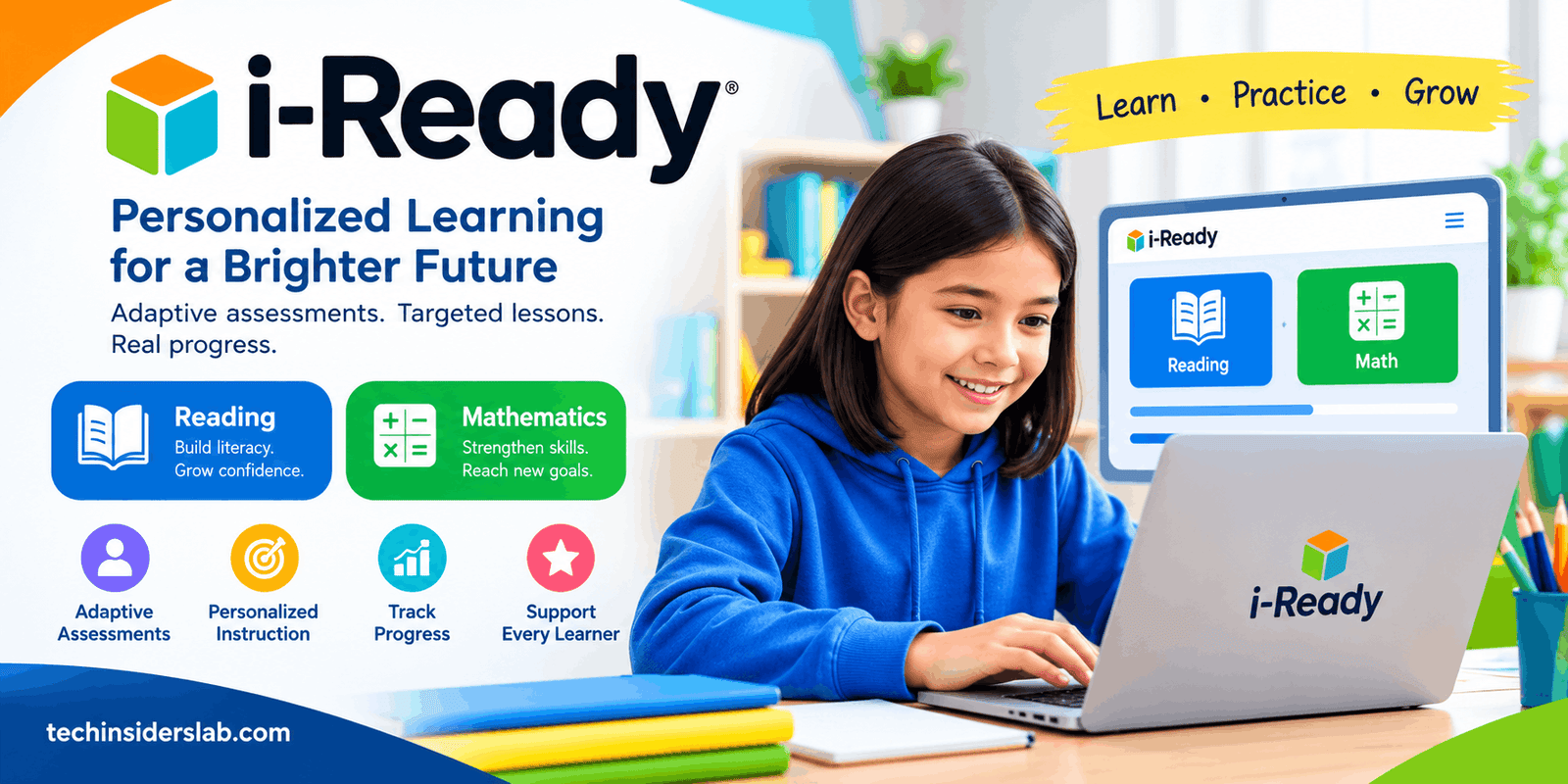
Education is becoming increasingly personalized, and digital learning platforms are playing an important role in helping students build stronger academic skills. One platform that has become widely used in schools across the United States is i-Ready. Developed by Curriculum Associates, i-Ready combines assessment technology with personalized instruction to help educators understand what students know, identify learning gaps, and provide lessons based on individual needs.
Unlike a traditional online learning website where every student follows exactly the same material, i-Ready is designed to adjust learning activities according to a student’s performance. Its primary focus is reading and mathematics, making it a useful resource for students who need additional practice as well as those who are ready for more challenging material.
The platform is generally used as a supplement to classroom teaching rather than as a replacement for teachers. Its assessment data can help educators decide which skills require additional attention, while its personalized lessons give students opportunities to practice those skills independently.
What Is i-Ready?
i-Ready is an educational technology platform designed to support student assessment and personalized learning. It is part of the broader educational portfolio created by Curriculum Associates and is primarily used in K–8 education.
The platform combines two important elements: assessment and instruction. The assessment component helps determine a student’s current academic level, while Personalized Instruction provides digital lessons designed around the student’s identified needs.
This approach allows schools to move away from a one-size-fits-all model. Two students in the same grade may have very different strengths and weaknesses, and i-Ready is designed to recognize those differences.
The system can provide information about specific skills instead of simply giving students an overall score. This can help teachers understand where a student is performing well and where additional instruction may be useful.
How Does i-Ready Work?
The i-Ready experience generally begins with an adaptive assessment. Instead of giving every student exactly the same sequence of questions, an adaptive assessment changes the difficulty of questions according to how the student responds.
For example, if a student demonstrates strong understanding of a particular skill, the assessment can move toward more challenging material. If the student’s responses indicate difficulty, the system can gather additional information at an appropriate level.
i-Ready’s assessment is typically administered during different points of the school year. Curriculum Associates describes fall, winter, and spring assessment periods as part of the recommended approach. The resulting information can help teachers monitor progress and identify areas for intervention or enrichment.
After assessment, students can receive personalized lessons. These lessons are intended to address skills connected to their learning needs rather than simply providing random practice.
i-Ready Reading
Reading is one of the major areas supported by i-Ready. The platform can help students work on different aspects of literacy, depending on their grade level and individual needs.
Reading instruction may involve areas such as vocabulary, comprehension, phonics, and other foundational or advanced literacy skills. Personalized activities are designed to give students targeted practice while allowing teachers to monitor their development.
For younger learners, foundational reading skills can be particularly important. Students who need additional practice with sound-letter relationships or early reading concepts can receive activities that target those areas.
Older students may encounter lessons focused more heavily on comprehension, vocabulary, and understanding increasingly complex texts.
The goal is not simply to make students complete more reading exercises. Instead, the platform attempts to connect practice with the specific skills identified through assessment.
i-Ready Mathematics
Mathematics is the other major instructional area covered by i-Ready. Students can receive lessons designed around their mathematical strengths and areas for improvement.
Depending on grade level and performance, mathematics learning can involve concepts such as number sense, operations, algebraic thinking, geometry, measurement, and problem-solving.
One advantage of personalized mathematics instruction is that students do not necessarily have to spend the same amount of time practicing every topic. A student who has already mastered a concept can move forward, while another student can spend additional time developing the foundational skills required to understand more advanced material.
This can be particularly useful when students in the same classroom have significantly different levels of mathematical understanding.
The Role of Teachers
Although i-Ready uses technology to personalize learning, teachers remain an important part of the process.
Assessment results can provide educators with information about student performance, but teachers are responsible for interpreting that information within the broader classroom context. They can use the data to organize groups, identify students who need intervention, determine what concepts should be retaught, or provide additional enrichment.
Curriculum Associates emphasizes that i-Ready is designed to complement teacher-led instruction rather than replace it. Its recommended model combines assessment data, personalized lessons, and educator decision-making.
This distinction is important because technology alone cannot address every learning challenge. Students may need explanations, discussion, encouragement, hands-on activities, or direct support from an educator.
Major Benefits of i-Ready
1. Personalized Learning
One of the most important advantages of i-Ready is personalization. Students can receive activities based on their individual learning needs instead of automatically following identical lessons.
2. Identification of Learning Gaps
Assessment information can help educators identify specific areas where students need support. This can make intervention more targeted.
3. Progress Monitoring
Repeated assessment and lesson data can help teachers observe changes in student performance over time. This gives schools another source of information when evaluating academic progress.
4. Independent Practice
Students can complete personalized activities independently, giving them additional opportunities to practice skills outside direct teacher instruction.
5. Support for Different Learners
Research on i-Ready includes analyses involving English learners, students with disabilities, economically disadvantaged students, and other student groups.
6. Reading and Math in One Platform
Instead of requiring completely separate systems for major academic subjects, i-Ready provides support for both reading and mathematics within its broader learning environment.
What Does Research Say About i-Ready?
Research surrounding i-Ready has expanded considerably. Curriculum Associates reports more than 50 published efficacy studies and more than a dozen independent third-party studies examining the program.
A 2020 analysis involving more than one million students examined students who used i-Ready during the 2017–2018 school year. The study reported greater learning gains among students who used the platform for an average of at least 45 minutes per subject per week for at least 18 weeks, after accounting for prior achievement.
More recent research has also examined the relationship between i-Ready use and state assessment performance. A 2025 pooled analysis covered more than 964,000 students in Grades 3–8 across more than 400 districts and found a positive association between recommended use and state assessment performance. The reported differences ranged from 0.14 to 0.24 standard deviations.
There is also newer independent evidence. In August 2026, Curriculum Associates reported on a peer-reviewed study by researchers at Georgia State University that examined nearly 28,000 students across 131 schools. The study found significantly greater achievement growth in reading and mathematics among i-Ready users compared with comparable peers.
However, it is important to interpret these findings carefully. Much of the i-Ready evidence base uses quasi-experimental or observational approaches rather than relying primarily on randomized controlled trials. This means positive associations should not automatically be interpreted as proof that the software alone caused every observed improvement.
Recommended Use Matters
More screen time does not automatically mean better learning. i-Ready’s own research emphasizes purposeful and consistent use rather than simply maximizing the number of minutes students spend online.
Curriculum Associates reports that students using the program according to recommended guidelines—generally around 30–49 minutes per subject each week, combined with appropriate lesson performance—showed stronger gains than students with lower or less consistent usage.
This highlights an important point: i-Ready works best when it is integrated into a broader educational plan. Students should not be expected to rely on the platform as their only form of instruction.
Is i-Ready Useful for Parents?
Parents can also benefit from understanding how i-Ready fits into their child’s education. Instead of viewing an i-Ready score as a simple judgment of intelligence or ability, parents can treat it as one piece of information about academic progress.
If a child is struggling with a particular area, parents can discuss the results with teachers and ask what skills should be practiced at home.
Parents should also remember that online learning works best when children have appropriate support. A quiet study environment, regular schedule, encouragement, and communication with teachers can make digital learning more productive.
Potential Limitations
Despite its benefits, i-Ready is not perfect for every situation.
First, digital learning can become frustrating if students spend too much time completing lessons without enough interaction with teachers or classmates. Technology should support instruction rather than dominate it.
Second, assessment results need context. A test score cannot describe every aspect of a student’s abilities, creativity, motivation, or learning style.
Third, students may have different reactions to digital lessons. Some children enjoy interactive learning, while others may prefer books, group activities, written practice, or direct teacher explanations.
Finally, successful implementation depends on how schools use the platform. Research indicates that recommended and consistent implementation is associated with stronger outcomes, meaning simply providing students with access is not necessarily enough.
i-Ready and Classroom Learning
The strongest role for i-Ready is arguably as a bridge between assessment and instruction. Teachers can use information from assessments to better understand student needs, while personalized lessons provide additional practice.
For example, a teacher may discover that several students are struggling with the same mathematical concept. Instead of giving every student the same generic worksheet, the teacher can use available data to identify the skill and provide targeted instruction.
Similarly, a student who has already demonstrated mastery can receive opportunities for further development instead of repeatedly practicing concepts they already understand.
This approach can help teachers make instructional decisions using more detailed information.
Who Can Benefit Most From i-Ready?
i-Ready can be useful for a wide range of learners, particularly students who need additional support in reading or mathematics.
Students who have unfinished learning may benefit from targeted practice. Students performing near grade level can use the platform to strengthen specific skills, while students who are progressing quickly may benefit from appropriately challenging activities.
Teachers and schools can also benefit because the platform provides a structured way to collect and organize academic information.
However, the platform should be viewed as one component of a larger educational strategy rather than a complete replacement for curriculum, instruction, or teacher expertise.
Conclusion
i-Ready is a useful educational platform that combines adaptive assessment with personalized reading and mathematics instruction. By identifying individual learning needs and providing targeted practice, it can help students strengthen important academic skills while giving teachers valuable information about student progress. Its greatest value comes when it is used alongside effective classroom teaching, teacher guidance, and regular progress monitoring. Although i-Ready should not replace traditional instruction, it can be a valuable digital resource for creating a more personalized and data-informed learning experience.