Introduction
As businesses continue moving their operations to cloud platforms, online applications, and artificial intelligence tools, protecting sensitive information has become more important than ever. Organizations manage enormous amounts of digital data, including customer records, financial documents, employee information, business strategies, and confidential communications. Keeping this information secure across different platforms can be challenging, especially when employees share files or use AI-powered applications in their daily work.
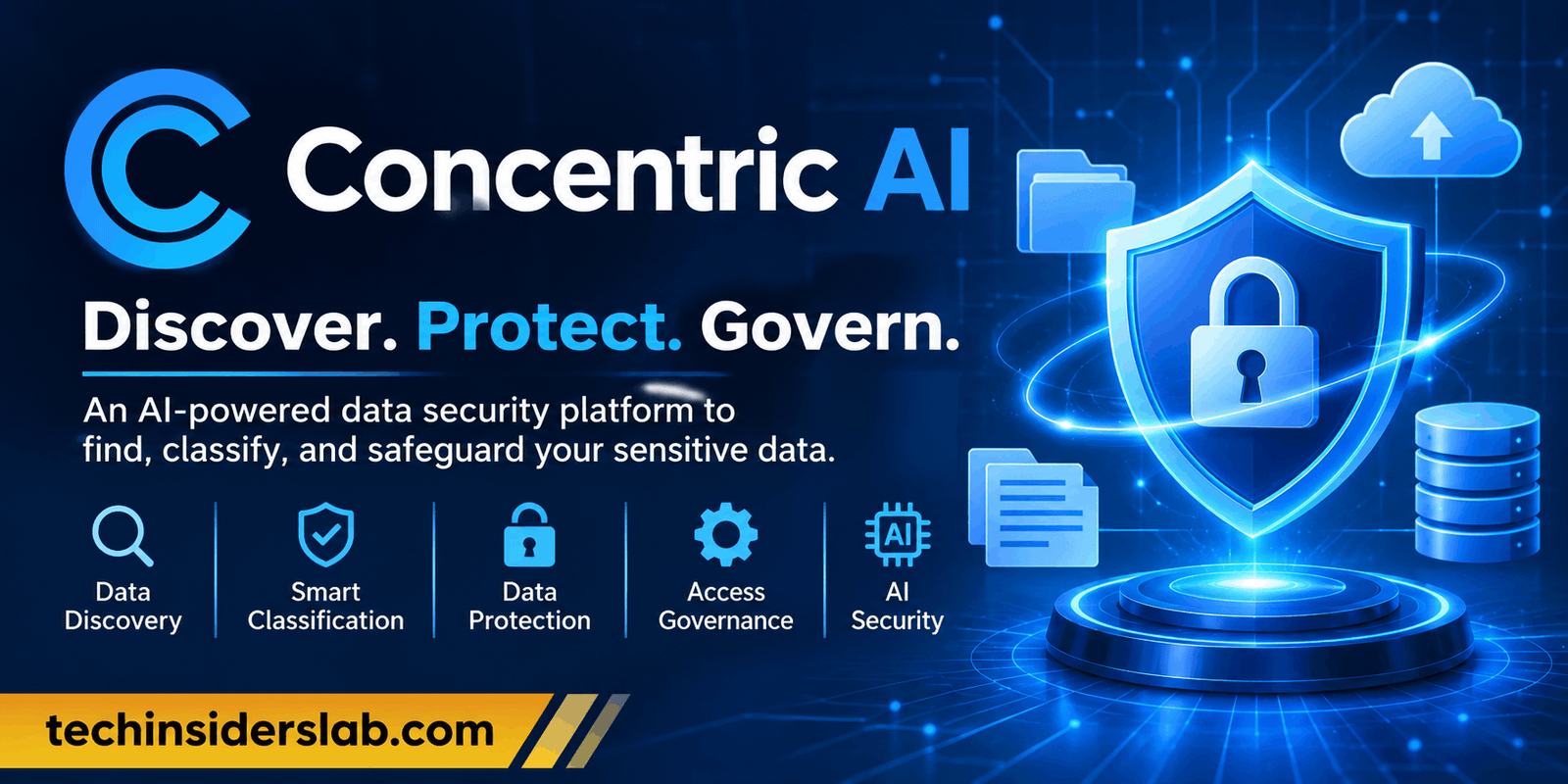
Concentric AI is a data security and governance platform designed to help organizations discover, understand, manage, and protect sensitive information. It uses artificial intelligence and semantic intelligence to identify valuable business data, detect potential security risks, and improve data protection across cloud, hybrid, and on-premises environments.
Unlike traditional security solutions that mainly depend on predefined rules and keyword matching, Concentric AI focuses on understanding the meaning and context of information. This approach helps businesses identify sensitive documents and discover security problems that might otherwise remain unnoticed.
In this article, we will explore what Concentric AI is, how it works, its major features, benefits, practical applications, and the reasons businesses may consider using it.
What Is Concentric AI?
Concentric AI is an enterprise data security governance platform that helps organizations protect confidential information throughout their digital environments. Its technology is designed to identify sensitive data, understand how that information is used, monitor access permissions, and reduce unnecessary exposure.
The platform focuses on data security posture management (DSPM), data access governance, data loss prevention, and AI security. These capabilities help businesses maintain better control over information stored in cloud services, collaboration platforms, databases, and internal systems.
One of its central technologies is Semantic Intelligence. This technology analyzes the meaning and business context of information rather than depending entirely on simple patterns or manually created classification rules.
For example, an organization may have thousands of documents containing customer information. Some documents might include sensitive financial details, while others contain ordinary business information. Concentric AI aims to understand these differences and help security teams identify which files require additional protection.
The platform is particularly relevant for organizations adopting generative AI tools because sensitive business information can become exposed when employees use AI applications without appropriate security controls.
According to its official website, Concentric AI brings data discovery, governance, and protection together within a unified platform.
How Does Concentric AI Work?
Concentric AI works by analyzing enterprise information and identifying potential security problems based on the content, context, ownership, and access patterns associated with data.
Its general workflow can be understood through several important stages.
1. Data Discovery
The first step is discovering where business information is stored. Large organizations often keep information across multiple cloud applications, databases, file servers, and collaboration tools.
Concentric AI helps identify sensitive and business-critical information across supported environments. This gives security teams better visibility into data that might otherwise be difficult to locate.
2. Contextual Data Classification
After discovering information, the platform analyzes its content and meaning to determine its business importance and sensitivity.
For example, it may help distinguish confidential contracts from ordinary documents or identify information that requires restricted access.
This contextual approach is designed to make classification more meaningful than relying exclusively on keywords.
3. Risk Identification
The platform evaluates potential data exposure by examining factors such as sharing activity, access permissions, data sensitivity, and ownership.
It can help organizations identify situations where confidential documents are accessible to unnecessary users or shared inappropriately.
4. Risk Remediation
Once security issues are identified, organizations can use available remediation capabilities to address them.
Depending on the situation and configured policies, actions may include correcting permissions, changing classifications, restricting access, and resolving inappropriate sharing.
This process helps businesses reduce exposure and improve their overall data security posture.
Key Features of Concentric AI
Concentric AI offers several capabilities designed to support enterprise data protection. Here are some of its most important features.
1. AI-Powered Data Discovery
Finding sensitive information across a large organization can be a complicated task. Employees may store documents in different locations, and businesses may not always know where their most valuable information exists.
Concentric AI helps discover business-critical and compliance-sensitive data across supported systems.
Its AI-based analysis can help security teams understand the type of information they manage and identify documents that require additional protection.
This feature is useful for organizations that maintain large document collections and want better visibility into their information assets.
2. Intelligent Data Classification
Data classification is an important part of information security because different types of information require different levels of protection.
Concentric AI uses semantic analysis to understand document content and business context. This can help identify confidential, sensitive, and internal business information.
For example, a company may need to protect customer records more carefully than general marketing documents. Intelligent classification helps security teams organize information according to its importance.
3. Data Security Posture Management
Data Security Posture Management, commonly known as DSPM, focuses on discovering sensitive information and understanding its security condition.
Concentric AI provides DSPM capabilities that help organizations identify where sensitive information exists and whether it is exposed through unnecessary access or inappropriate sharing.
This visibility allows security teams to prioritize risks instead of manually reviewing every document and storage location.
4. Data Access Governance
Controlling who can access business information is essential for preventing unauthorized exposure.
Concentric AI helps organizations understand data access, identify excessive permissions, and improve governance across their environments.
For example, if an employee has access to confidential files that are unrelated to their responsibilities, the organization can investigate and correct those permissions.
Better access governance can reduce the chances of accidental information exposure and unauthorized data access.
5. Data Loss Prevention
Data Loss Prevention (DLP) helps organizations prevent sensitive information from being shared or transferred inappropriately.
Concentric AI brings data loss prevention capabilities into its broader data security platform. Its context-aware approach helps organizations understand the sensitivity of information and apply appropriate protection policies.
This is particularly important when employees collaborate through cloud applications or interact with external AI services.
6. AI Security and Shadow AI Detection
The growing popularity of generative AI has introduced new challenges for businesses.
Employees may use public AI applications to summarize documents, write reports, or analyze information. However, sharing confidential company data with unauthorized AI tools can create serious security concerns.
Concentric AI provides capabilities for identifying and governing AI usage, including shadow AI security.
It also supports security governance for enterprise AI applications such as ChatGPT, Claude, and Microsoft Copilot.
These capabilities help organizations understand how business information interacts with AI tools and establish appropriate security controls.
7. Automated Risk Remediation
Identifying security problems is only part of the process. Organizations also need practical ways to resolve them.
Concentric AI supports remediation workflows that help security teams address issues such as inappropriate sharing, excessive permissions, and incorrect data classifications.
Automation can reduce repetitive administrative work and allow security professionals to focus on more complicated security challenges.
Benefits of Using Concentric AI
Concentric AI offers several potential advantages for organizations that want to improve their information security practices.
Better Visibility Into Business Data
One major benefit is improved visibility. Businesses often manage information across multiple systems, making it difficult to understand where sensitive documents are stored.
Concentric AI helps bring information together through data discovery and contextual analysis. This makes it easier for security teams to understand their data environment.
Reduced Data Exposure
Unnecessary file sharing and excessive access permissions can increase security risks.
By identifying potentially exposed information, Concentric AI helps organizations understand where improvements are needed.
Businesses can then review permissions, update sharing settings, and strengthen their information protection policies.
Improved AI Adoption
Artificial intelligence can improve productivity, but businesses must consider the security of the information used by AI applications.
Concentric AI helps organizations establish better visibility and governance around enterprise AI usage.
This can support more responsible AI adoption while helping companies protect confidential information.
Less Manual Security Work
Traditional data security processes may require employees to review documents, create classification rules, and investigate access issues manually.
AI-powered analysis and automated remediation capabilities can reduce some of this repetitive work.
This allows security teams to spend more time on strategic activities and complex investigations.
Stronger Data Governance
Organizations need consistent processes for managing sensitive information.
Concentric AI supports data classification, access governance, risk monitoring, and compliance-related activities. These capabilities can help businesses establish more organized information security practices.
Who Can Benefit From Concentric AI?
Concentric AI is primarily designed for organizations that manage significant amounts of business information and require advanced data security controls.
Some of its potential users include:
Large Enterprises: Large companies often manage confidential documents across departments and locations. Concentric AI can help them improve visibility and manage data access.
Healthcare Organizations: Healthcare businesses handle sensitive patient and administrative information. Better data discovery and governance can support their information protection efforts.
Financial Institutions: Banks and financial companies manage confidential customer records, financial documents, and internal reports. Data classification and access governance can help protect these assets.
Technology Companies: Software businesses frequently manage source code, product strategies, customer information, and technical documentation. These organizations may benefit from improved data discovery and monitoring.
Security Teams: IT administrators, security analysts, and information governance professionals can use data security capabilities to identify risks and improve organizational policies.
Concentric AI Integrations and Compatibility
A modern security platform needs to work with the applications and infrastructure businesses already use.
Concentric AI supports integrations across several enterprise environments, including cloud services, collaboration applications, databases, and AI platforms.
Its official website lists integrations and supported technologies such as:
- Microsoft 365
- Google Workspace
- Salesforce
- Slack
- Confluence
- Amazon S3
- Snowflake
- Microsoft Exchange
- Microsoft Copilot
- ChatGPT
- Claude
- NetApp
These integrations help organizations improve visibility into information across different business systems.
However, available functionality can vary depending on the specific integration and configuration. Businesses should review the current compatibility information before selecting a deployment.
Is Concentric AI Easy to Use?
Concentric AI is designed to simplify enterprise data security through automated discovery, contextual analysis, and centralized governance capabilities.
Its approach can reduce the need for security teams to create and maintain large numbers of manual classification rules.
However, ease of use depends on an organization’s existing infrastructure, data environment, security policies, and technical requirements.
Smaller teams may need additional assistance when connecting enterprise systems or configuring governance policies. Larger organizations may also require coordination between IT administrators, security professionals, and compliance teams.
Before implementation, businesses should identify their most important data sources and decide which security problems they want to address first.
Concentric AI Pricing
One important consideration before adopting any enterprise security platform is pricing.
Concentric AI does not prominently publish a universal self-service subscription price on its official website. Its platform is positioned toward organizations that need enterprise-level data protection and governance.
Pricing may depend on factors such as organizational requirements, deployment scope, supported environments, and selected capabilities.
Businesses interested in using the platform should contact the provider for a personalized demonstration and pricing information.
It is also useful to discuss implementation requirements, integration availability, support services, and any additional costs before making a purchasing decision.
Limitations of Concentric AI
Although Concentric AI offers useful data security capabilities, it may not be the right solution for every user or organization.
Enterprise Focus: The platform is primarily designed for business environments. Individual users looking for a basic file protection application may find it more advanced than necessary.
Implementation Planning: Connecting different data environments and establishing appropriate security policies may require technical expertise.
Pricing Transparency: Organizations may need to contact the provider to understand the cost of their required configuration.
Existing Security Infrastructure: Businesses should evaluate how the platform fits with their current security tools and workflows before adopting it.
Human Oversight: AI-powered analysis can support security operations, but organizations should still review important decisions and maintain appropriate governance procedures.
Understanding these considerations can help businesses decide whether the platform matches their actual requirements.
Concentric AI vs Traditional Data Security Tools
Traditional data security tools often depend on predefined rules, keywords, regular expressions, and manually configured classification systems.
These approaches can be effective for identifying specific information patterns, but they may struggle to understand the meaning of complex business documents.
Concentric AI takes a context-based approach by using semantic intelligence to analyze what information means and why it matters.
For example, two documents may contain similar words but have completely different levels of sensitivity. Contextual analysis can help distinguish between them.
Another important difference is its broader approach to data governance. Rather than focusing on only one security task, Concentric AI brings discovery, classification, access governance, data protection, and AI security capabilities together.
This makes it particularly relevant for businesses that want to manage information security across modern cloud and AI environments.
Is Concentric AI Worth Considering?
Concentric AI is worth considering for organizations that need better visibility and control over sensitive business information.
Its combination of semantic intelligence, data discovery, classification, access governance, and AI security addresses several important challenges faced by modern enterprises.
Businesses adopting generative AI may find its data governance capabilities especially relevant because protecting confidential information is an important part of responsible AI implementation.
However, the platform is not necessarily suitable for individuals or small businesses that only need basic security software.
Organizations should evaluate their data protection requirements, available integrations, implementation needs, and overall budget before making a final decision.
Conclusion
Concentric AI is an enterprise-focused data security platform that uses artificial intelligence to help organizations discover, classify, monitor, and protect sensitive information. Its semantic intelligence approach aims to understand the meaning and context of business data, making it useful for identifying potential security risks that traditional methods may overlook.
With capabilities covering data security posture management, data access governance, data loss prevention, and AI security, the platform provides organizations with a broader approach to information protection.
Although its enterprise focus and implementation requirements may not suit every user, Concentric AI is a relevant option for businesses managing complex data environments.
As organizations continue adopting cloud technologies and generative AI, platforms that improve data visibility and governance will play an increasingly important role in maintaining digital security.