
Introduction
Artificial intelligence has changed the way people write essays, research papers, blog posts, and other forms of digital content. AI writing assistants can help users organize ideas, improve grammar, and generate text quickly. However, their growing popularity has also raised questions about originality, academic integrity, and how educators can evaluate written assignments.
This is where Turnitin’s AI writing detection feature becomes relevant. It helps educational institutions identify text that its detection model considers likely to have been generated by artificial intelligence. The tool provides an additional source of information that educators can use when reviewing submitted work.
Turnitin is widely associated with similarity checking, but its AI writing detection feature serves a different purpose. Similarity checking identifies matching text in available sources, while AI detection estimates whether qualifying passages may have been generated or modified using AI.
Understanding how Turnitin works is important for students, teachers, researchers, and academic institutions. Although its reports can provide useful insights, the results must be interpreted carefully because no automated detector can determine authorship with complete certainty.
What Is AI Detector Turnitin?
AI Detector Turnitin refers to Turnitin’s AI writing detection capability, which is designed to help educators identify passages that may have originated from generative AI systems.
Unlike a conventional grammar checker, this feature does not primarily focus on spelling, punctuation, sentence structure, or writing quality. Instead, it analyzes qualifying text and estimates whether the writing resembles content produced by AI language models.
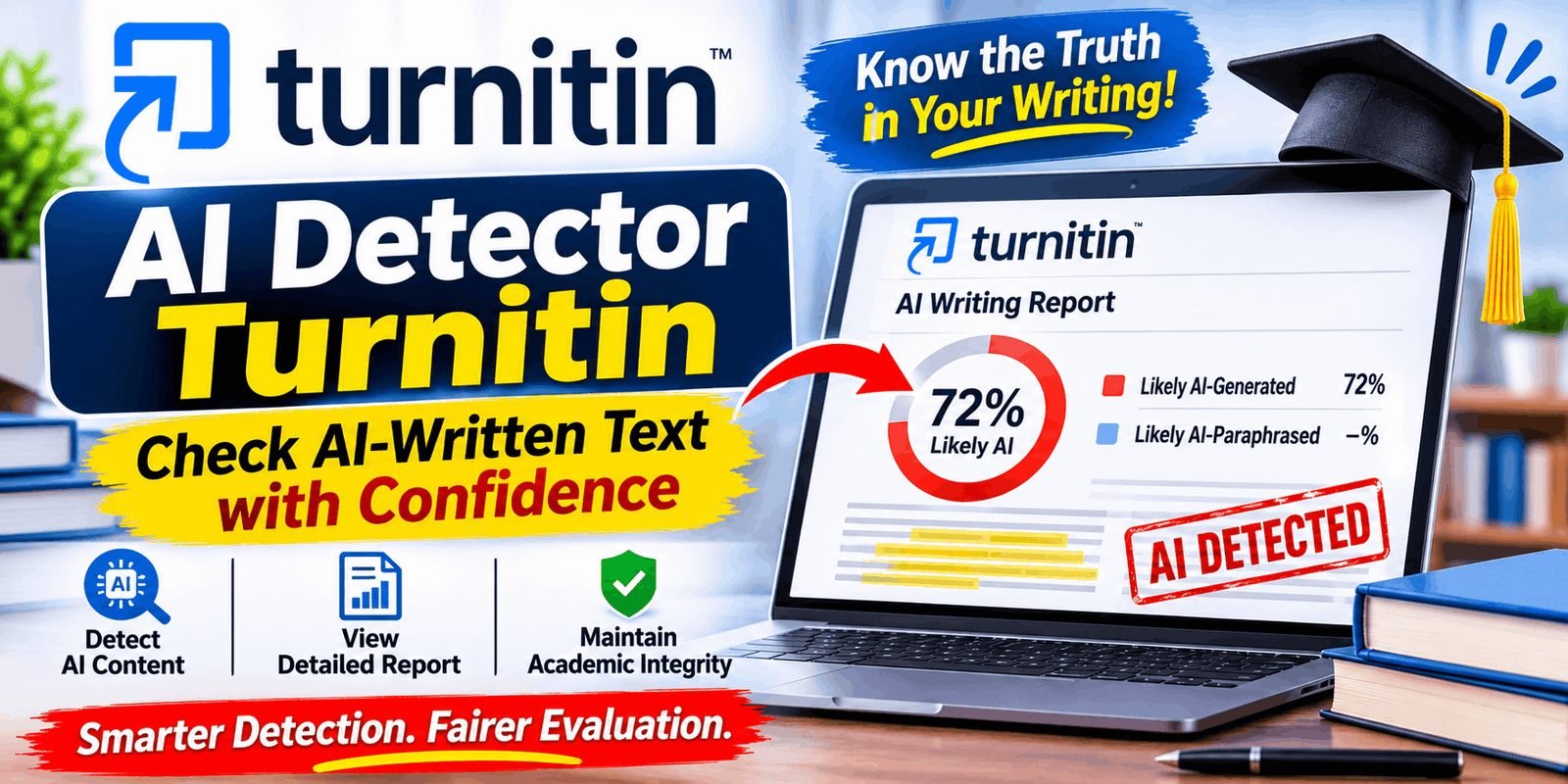
When the feature is available and enabled by an institution, a processed submission may include an AI Writing Report. This report displays an overall percentage for qualifying text identified as likely AI-generated, along with highlighted passages that indicate the model’s predictions.
Turnitin’s documentation explains that its system can also identify text it considers likely to have been AI-generated and subsequently modified using certain AI paraphrasing tools.
It is important to understand that an AI detection result is a prediction, not definitive proof that a student used an AI tool. Human-written text can be incorrectly flagged, and AI-generated text may not always be identified.
How Does Turnitin AI Detection Work?
Turnitin uses a machine-learning detection model to analyze qualifying writing. Its internal technical implementation is more complex than a simple word-matching system, but the general purpose is to estimate whether parts of a submission are likely to have been produced by generative AI.
1. Text Submission
A document is submitted through a Turnitin-enabled educational platform. Whether AI detection is available depends on the institution’s subscription, configuration, and supported submission requirements.
2. Analysis of Qualifying Text
The system processes eligible text from the submitted document. Turnitin’s AI writing detection is designed primarily for longer-form prose, such as paragraphs in essays and research papers, rather than every possible type of text.
Lists, short fragments, and other non-qualifying content may not be analyzed in the same way.
3. AI Likelihood Estimation
The detection model evaluates linguistic patterns and other learned characteristics to estimate whether qualifying text is likely to have been generated by AI. The system does not simply search for a hidden label identifying which writing application produced the content.
As a result, it generally cannot establish with certainty which particular AI tool, if any, was used to write a passage.
4. Report Generation
When processing is successful, Turnitin may provide an AI Writing Report containing a percentage and highlighted sections. The report helps educators identify areas that may warrant closer review.
5. Human Review
An instructor interprets the results alongside other evidence, including the assignment requirements, the student’s writing process, and applicable academic policies.
Turnitin specifically advises that AI detection results should not be used as the sole basis for adverse decisions about students.
Key Features of Turnitin AI Detector
Turnitin’s AI writing detection offers several features intended to support academic review and help educators understand submitted writing.
AI Writing Percentage
The report displays a percentage representing the portion of qualifying text that the model identifies as likely AI-generated or likely AI-generated and subsequently AI-paraphrased. This helps instructors see how much of the eligible text has been flagged.
The percentage is not the probability that the entire document was written by AI, and it is not a plagiarism score.
Turnitin also suppresses exact percentages and text highlights for AI detection results between 1% and 19% in current reports. Instead, these results are represented as *%. This approach is intended to reduce the risk of interpreting uncertain, low-level results as definitive evidence.
Highlighted Text
The AI Writing Report highlights passages that the model identifies as potentially AI-generated. In reports that distinguish between AI-generated and AI-paraphrased writing, the categories help educators understand the types of text the model has flagged.
Highlighted passages can guide further review, but they do not establish who actually wrote the text.
AI-Generated and AI-Paraphrased Categories
Turnitin’s reporting can distinguish between text predicted to have been generated by an AI language model and text predicted to have been AI-generated before being modified by an AI paraphrasing tool.
This distinction provides additional information for academic review. However, the report does not necessarily identify the specific tool used, and the classification remains a model prediction.
Integration with Academic Workflows
Turnitin’s AI detection can be accessed through supported institutional workflows and reporting interfaces. Educators may be able to review AI detection information alongside other submission details, depending on their institution’s setup.
This integration can make it easier for instructors to investigate concerns without relying entirely on separate, standalone detection websites.
Support for Academic Integrity
The feature gives educators another way to review written assignments and start discussions about responsible AI use. It can be particularly useful when an institution has clear rules about acceptable AI assistance, disclosure, and original work.
Turnitin AI Detector vs. Plagiarism Checker
Although these features may be available within Turnitin’s broader academic review environment, they answer different questions.
| Feature | AI writing detection | Similarity checking |
| Main purpose | Estimates whether text may be AI-generated | Identifies text matching available sources |
| Results | AI detection percentage and highlighted passages | Similarity percentage and matching sources |
| Main concern | Possible AI involvement in writing | Text overlap with existing material |
| Proof of misconduct | No, not by itself | No, not by itself |
| Human review | Essential | Essential |
Similarity checking identifies matching text from sources in its comparison database, which may include web pages, publications, and previously submitted student work. The resulting similarity percentage does not automatically mean plagiarism has occurred. Properly quoted and cited material can also produce matches.
Similarly, a high AI writing percentage does not automatically establish academic misconduct. Each result needs to be considered in context.
For example, a student may submit original work that contains common technical expressions and receive an unexpected AI detection result. Another student may submit AI-generated text that is not flagged. Neither possibility should be ignored when evaluating a report.
How Accurate Is Turnitin AI Detector?
Accuracy is one of the most important considerations when evaluating any AI detector.
Turnitin continues to update its detection model. Its official release notes document improvements to English AI writing detection, including an update released on October 14, 2026, intended to improve detection while minimizing false positives.
Turnitin Guides
However, improvements do not eliminate every error. AI writing detection involves estimating the origin of text from linguistic patterns, and different writing styles, subject areas, and document types can affect the result.
False Positives
A false positive occurs when human-written content is incorrectly identified as AI-generated. This can create difficulties for students whose writing style is formal, predictable, or formulaic.
False Negatives
A false negative occurs when AI-generated writing is not identified by the detector. Consequently, a low score cannot prove that a document was written entirely by a person.
Context Matters
The meaning of a detection score depends on the assignment, the writing process, the institution’s policies, and other available evidence. Educators should avoid treating a percentage as a standalone verdict.
The most responsible interpretation is to use Turnitin as one source of information within a broader review process, rather than as an infallible authorship test.
Benefits of Using Turnitin AI Detector
Helps Educators Review Assignments
Teachers can use AI detection reports to identify passages that may deserve additional attention. This can help structure conversations about how students researched, drafted, and revised their assignments.
Encourages Responsible AI Use
AI tools can be valuable for brainstorming, outlining, and language support. However, acceptable use varies between institutions and assignments. Detection reports can support discussions about when AI assistance should be disclosed.
Provides Additional Information
AI detection offers a different perspective from similarity checking. When used appropriately, it gives educators another piece of information to consider when reviewing academic work.
Supports Institutional Workflows
For institutions that already use Turnitin, integrated reporting may be more convenient than managing several unrelated systems. Availability depends on the institution’s plan and configuration.
Encourages Better Writing Practices
Understanding academic integrity requirements can encourage students to maintain drafts, record research sources, revise their own work, and follow appropriate citation practices.
These habits are useful regardless of whether an institution uses an AI detector.
Limitations of Turnitin AI Detector
Despite its benefits, Turnitin’s AI writing detection has several limitations.
- It can make mistakes. Human-written text may be flagged, while AI-generated text may go undetected.
- Access may be restricted. AI writing reports are generally provided through supported institutional accounts and may not be available to individual users.
- It does not identify every AI tool. A report does not necessarily establish which application generated a particular passage.
- It is not a plagiarism checker. AI detection and similarity checking evaluate different aspects of written work.
- It cannot determine intent. A percentage alone cannot establish whether a student violated an institution’s rules.
- Its coverage has limits. Only qualifying text is analyzed for AI detection, so not every part of a submission necessarily contributes to the result.
Students should therefore focus on following their institution’s rules and documenting their writing process rather than relying on a detector score as a guarantee of acceptance.
How to Access Turnitin AI Detector
Turnitin AI detection is not necessarily available to everyone who visits the Turnitin website. Access usually depends on an educational institution’s account and whether the AI detection feature is enabled.
Here is the general process:
- Check institutional access: Ask your school, college, or university whether it provides Turnitin AI writing detection.
- Submit your document: Follow the submission instructions provided by your instructor or institution.
- Wait for processing: The report must be generated successfully before results can be reviewed.
- Open the report: If your account has the required permissions, navigate to the AI Writing Report or the relevant report indicator.
- Review the findings: Read the highlighted passages and percentage carefully, keeping the tool’s limitations in mind.
Students may be able to submit assignments without having permission to view the AI Writing Report themselves. In some institutions, only instructors and administrators can access these results.
Tips for Students Using AI Writing Tools
Students can use AI responsibly while maintaining ownership of their academic work.
- Understand your institution’s rules: Some assignments prohibit generative AI, while others allow specific forms of assistance.
- Write from your own understanding: Develop your arguments using your research, reasoning, and subject knowledge.
- Keep your drafts: Notes, outlines, revision history, and earlier versions can help demonstrate how your work developed.
- Verify your sources: Check that quotations, citations, statistics, and references are genuine and accurate.
- Disclose AI assistance when required: Follow your instructor’s guidance on acknowledging the use of AI tools.
- Do not rely on detector scores alone: A detector cannot guarantee that writing will be classified correctly.
These practices help students produce stronger work and explain their writing process if questions arise.
Is Turnitin AI Detector Free?
Turnitin’s AI writing detection is generally offered through institutional access rather than as a universally available free public checker. Whether a student can use the feature depends on their institution’s subscription and settings.
Students should check with their instructor or university before paying for third-party services that claim to provide access to Turnitin AI detection.
Conclusion
AI Detector Turnitin is a useful academic review tool designed to help educators identify text that may have been generated or modified using artificial intelligence. Its AI Writing Report provides percentage estimates and highlighted passages that can support a closer examination of submitted work.
However, the tool has important limitations. False positives and false negatives are possible, and its AI detection percentage is different from the similarity score used for source matching. Neither result should be treated as definitive proof of academic misconduct.
For students, the best approach is to understand institutional policies, develop original arguments, verify sources, and maintain a record of the writing process. For educators, Turnitin’s reports are most useful when combined with professional judgment and other relevant evidence.
Ultimately, Turnitin AI Detector should be viewed as a supporting resource for academic integrity, not a replacement for human evaluation.