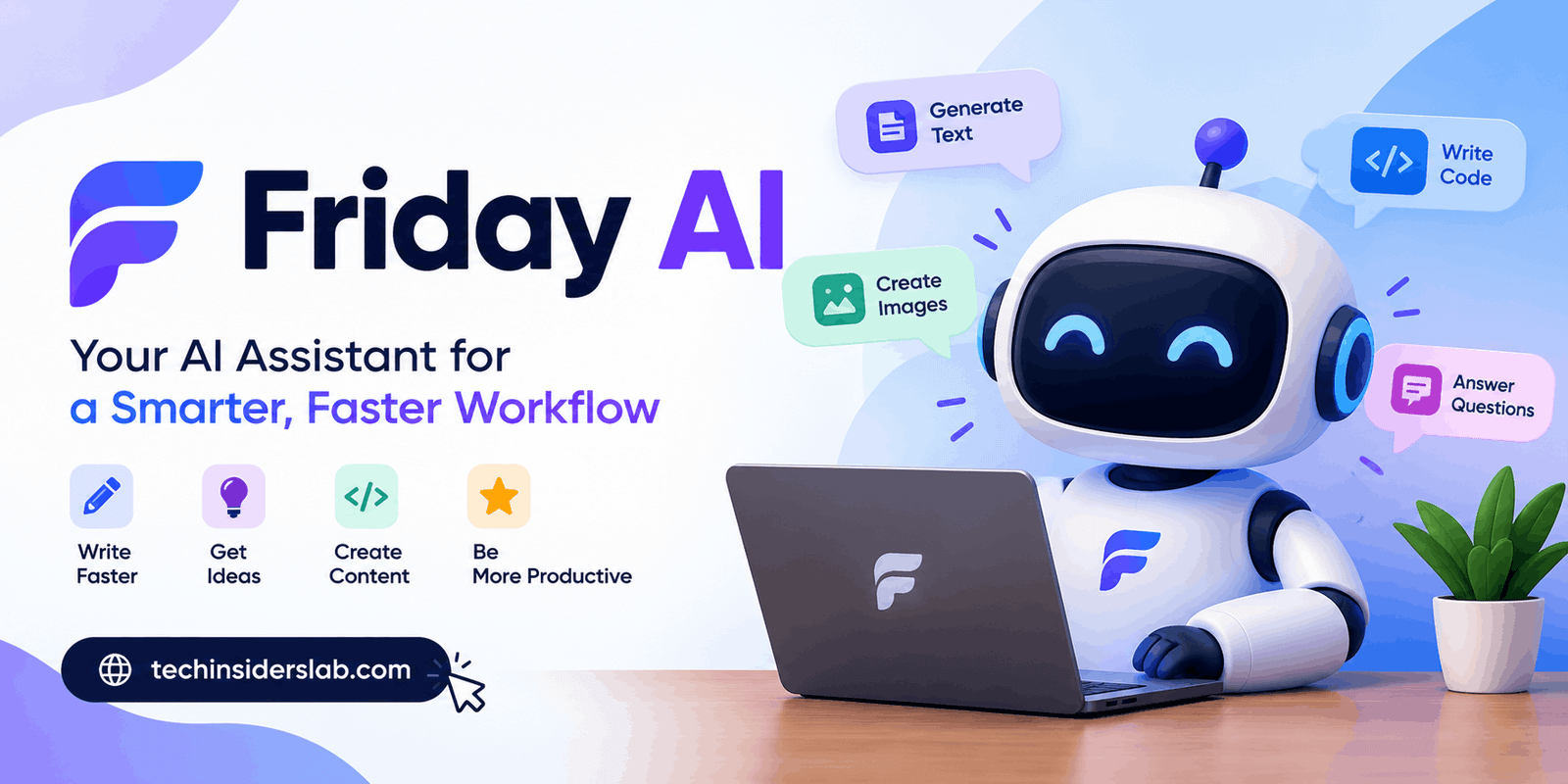
Friday AI:Guide to the AI Agent and App-Building Platform
introduction
Artificial intelligence is changing the way people create software, manage research, automate repetitive work, and launch digital products. Instead of using a separate application for coding, another for research, another for design, and another for automation, modern AI platforms are trying to bring these capabilities into one workspace. Friday AI is one such platform designed to help users turn ideas and instructions into working software and automated workflows.
Friday AI is positioned as an AI agent and app-building environment for founders, developers, product managers, designers, startups, students, and other people who want to create software without spending all their time on traditional development tasks. The platform allows users to describe what they want in natural language and then lets AI handle planning, coding, research, integrations, testing, and other parts of the workflow.
Unlike a simple chatbot that primarily responds to individual prompts, Friday AI is designed around completing larger tasks. Users can start with an idea, allow Friday to plan the work, and then continue refining the result through natural-language instructions. The platform also supports integrations, databases, backends, automation, and application publishing.
What Is Friday AI?
Friday AI is an AI-powered workspace that combines an AI assistant, coding agent, research capabilities, application development tools, and automation features. Its main purpose is to reduce the amount of manual technical work required to turn an idea into a usable digital product.
For example, instead of beginning a project by manually setting up a development environment, creating files, installing dependencies, designing an interface, and connecting a database, a user can describe the desired application and ask Friday to build it.
The platform is designed to understand natural-language instructions and use different AI models and tools depending on the task. Friday currently promotes access to a large collection of AI models, along with skills, plugins, and integrations that extend what the agent can accomplish.
This makes Friday AI particularly interesting for people who have software ideas but may not want to handle every technical detail themselves.
How Does Friday AI Work?
The basic workflow is relatively straightforward. A user starts with an idea or task and describes it in everyday language. Friday then plans the required work, uses appropriate tools, and produces a result that can be reviewed and modified.
The process can generally be understood in three stages:
1. Describe Your Idea
The first step is explaining what you want to build or accomplish. You might describe a business dashboard, client portal, landing page, internal tool, automation workflow, or another application.
Natural-language interaction means users do not necessarily need to translate their idea into detailed technical instructions before getting started.
2. Let Friday Handle the Work
Friday can plan tasks and use connected tools to move the project forward. Depending on the job, this may involve writing code, researching information, connecting services, creating application components, or working with data.
The platform describes itself as an AI agent rather than simply an AI chat interface because it is intended to perform multi-step work rather than only generate answers.
3. Review and Improve
After Friday produces an initial result, users can continue giving instructions. This makes the development process iterative.
For example, a user might ask the agent to change the design, add authentication, modify a database structure, fix an error, improve a page, or connect another service.
This conversational approach can make software development more accessible to people who are comfortable explaining what they want but may not be experts in programming.
Key Features of Friday AI
Friday AI includes several capabilities that distinguish it from basic AI chatbots.
AI-Powered App Building
One of Friday’s central features is application development. Users can describe an application and allow the AI to handle much of the engineering work.
The platform supports different types of projects, including web applications, business tools, internal dashboards, client portals, startup MVPs, automation tools, and other software projects.
This can be useful during the early stages of a project when speed and experimentation are more important than manually writing every component.
Multiple AI Models
Friday brings multiple AI models into one workspace. According to the platform, users can choose different models for different tasks instead of constantly switching between separate AI applications.
This model-agnostic approach can be useful because different models may perform differently for coding, reasoning, writing, image generation, research, or other workloads. Friday also supports OpenRouter, allowing users to connect access to additional models.
AI Coding Agent
Friday can work as an AI coding agent capable of writing, reviewing, and modifying software.
Its developer-focused capabilities include integrations with GitHub and Vercel, allowing coding workflows to extend from development into code review and deployment. The platform also describes support for multi-file projects and large codebases.
This can save developers time on repetitive coding tasks, debugging, refactoring, documentation, and other development activities.
Research and Analysis
Friday is not limited to programming. Research is another important part of its broader agent workflow.
The platform can be used for tasks such as competitor research, information gathering, analysis, and producing structured outputs. For startups and businesses, this can make it possible to combine research and implementation within the same workspace.
Integrations
Integrations allow Friday to work with services that users already rely on. Its platform currently highlights connections such as GitHub, Figma, Supabase, Vercel, Slack, Gmail, Google Docs, and Firecrawl.
These integrations can turn Friday from a standalone AI assistant into a central workspace for multiple business and development activities.
Automation
Automation is another major part of Friday AI. Repetitive workflows can potentially be converted into agent-driven processes.
For example, businesses may use AI agents to research information, prepare content, communicate with team members, or perform repeated operational tasks. The platform also promotes scheduled and multi-step automation capabilities.
Parallel Agents
For complex projects, Friday can divide work between multiple sub-agents. Instead of completing every task sequentially, independent parts of a project can be handled in parallel.
This approach can be useful for larger assignments such as researching multiple companies, analyzing different sources, preparing several pieces of content, or handling development and research simultaneously.
Friday AI for Developers
Developers can use Friday AI as an additional development partner rather than replacing their entire workflow.
It can assist with writing new features, reviewing code, refactoring existing projects, fixing bugs, and preparing changes for deployment. GitHub integration can also help connect AI-generated development work with repositories and pull requests.
One notable advantage is that an AI coding agent can handle larger tasks than traditional autocomplete tools. Instead of suggesting a few lines of code, an agent can work across multiple files and consider how different parts of a project interact.
However, developers should still review AI-generated code. Automated coding can introduce bugs, security problems, incorrect assumptions, or unnecessary complexity. Human review remains important, particularly for production applications.
Friday AI for Startups
Startups often need to move quickly while working with limited resources. Friday AI can be useful in this environment because one AI workspace can assist with research, software development, outreach, and content production.
A startup could use Friday to research competitors, build an MVP, prepare marketing material, automate communications, and connect services used by the team.
The platform specifically promotes startup workflows involving competitive intelligence, autonomous coding, outreach, media generation, and parallel agents.
This does not mean that Friday completely replaces developers, marketers, researchers, or designers. Instead, it can reduce the amount of repetitive work required from those people.
Friday AI for Non-Developers
One of the most interesting aspects of Friday AI is its focus on people who have ideas but may not have extensive programming experience.
Because the interaction is based heavily on natural language, users can begin by explaining the desired outcome rather than immediately thinking about programming languages, frameworks, or infrastructure.
For example, someone could describe a simple customer-management dashboard and then ask Friday to add features gradually.
This approach is especially useful for prototypes and early-stage experiments. A founder can test an idea before investing heavily in a traditional development process.
Still, non-developers should understand that AI-generated applications may require technical review before being used for sensitive or large-scale production workloads.
Friday AI Integrations and Connected Workflows
Modern software rarely works alone. A typical business may use email, project management tools, cloud databases, design software, communication platforms, and deployment services.
Friday’s integrations are designed to connect these systems into a more unified workflow.
For example, GitHub can be useful for software development, Figma for design, Supabase for application data, Vercel for deployment, Slack for communication, and Gmail for email workflows. Friday lists these and other services among its supported integrations.
The major benefit is reduced context switching. Instead of manually transferring information between multiple applications, an AI agent can potentially coordinate parts of the workflow.
Friday AI Pricing
Friday AI offers different plans depending on usage requirements. Its current pricing page lists a Pro plan at $20 per month and a Max plan at $100 per month, with differences in credits, automation limits, models, media capabilities, and advanced features.
The platform also provides a free starting option, allowing users to explore the product before committing to a paid plan. Pricing and included capabilities can change over time, so users should check the latest plan information before making a purchasing decision.
For casual experimentation, the free option may be sufficient. Developers, businesses, and heavy users may need a paid plan depending on how frequently they use AI agents and automation.
Advantages of Friday AI
Friday AI offers several potential advantages:
- Natural-language development: Users can explain ideas without writing every technical instruction manually.
- Multiple AI models: Different models can be used for different types of work.
- Application building: It can assist with creating complete software projects.
- Automation: Repetitive workflows can be turned into agent-driven processes.
- Integrations: Popular development, communication, design, and cloud services can be connected.
- Research capabilities: The same workspace can assist with information gathering and analysis.
- Parallel agents: Complex jobs can be divided into smaller tasks.
- Desktop availability: Friday is available for Windows and macOS according to its current download information.
Limitations to Consider
Despite its capabilities, Friday AI is not a replacement for human expertise.
AI agents can misunderstand requirements, generate incorrect code, make poor architectural decisions, or produce results that need significant editing. Users working on important applications should review generated code and outputs carefully.
There is also a learning curve associated with agent-based tools. Getting better results often depends on providing clear instructions, defining requirements, reviewing intermediate results, and understanding the tools connected to the agent.
Cost is another consideration for heavy users. Advanced AI models and frequent agent runs can consume credits, so users should choose a plan according to their actual workload.
Privacy and security should also be considered whenever an AI agent is connected to email, source code, databases, documents, or other sensitive services. Users should understand permissions before connecting business or personal accounts.
Is Friday AI Worth Using?
Friday AI can be a useful choice for people who want more than a traditional chatbot. Its strongest appeal is the combination of AI agents, application development, research, automation, integrations, and multiple AI models within one workspace.
For developers, it can reduce repetitive coding and project-management tasks. For founders, it can accelerate experimentation and MVP development. For product managers and designers, it can help turn ideas into working prototypes. For non-developers, it offers a way to explore software development through natural-language instructions.
The best results will come from treating Friday as a capable AI collaborator rather than an infallible replacement for human judgment.
Conclusion
Friday AI represents a broader shift in how people interact with software development and productivity tools. Instead of requiring users to manually operate every application and perform every technical step, an AI agent can coordinate multiple tasks from a single instruction.
Its combination of coding, research, automation, integrations, application building, and multiple AI models makes it more than a conventional chatbot. The platform is particularly interesting for developers, startups, founders, product teams, and creators who want to move from an idea to a working digital product more quickly.
At the same time, users should approach AI-generated software responsibly. Reviewing code, protecting sensitive information, checking factual results, and maintaining human oversight remain important.
Overall, Friday AI is a promising option for anyone interested in AI-assisted software development and automated workflows. As agent-based technology continues to evolve, tools like Friday could make building and managing digital products faster, more accessible, and more conversational.