ChatGPT: A Complete Guide to the AI Assistant
introduction
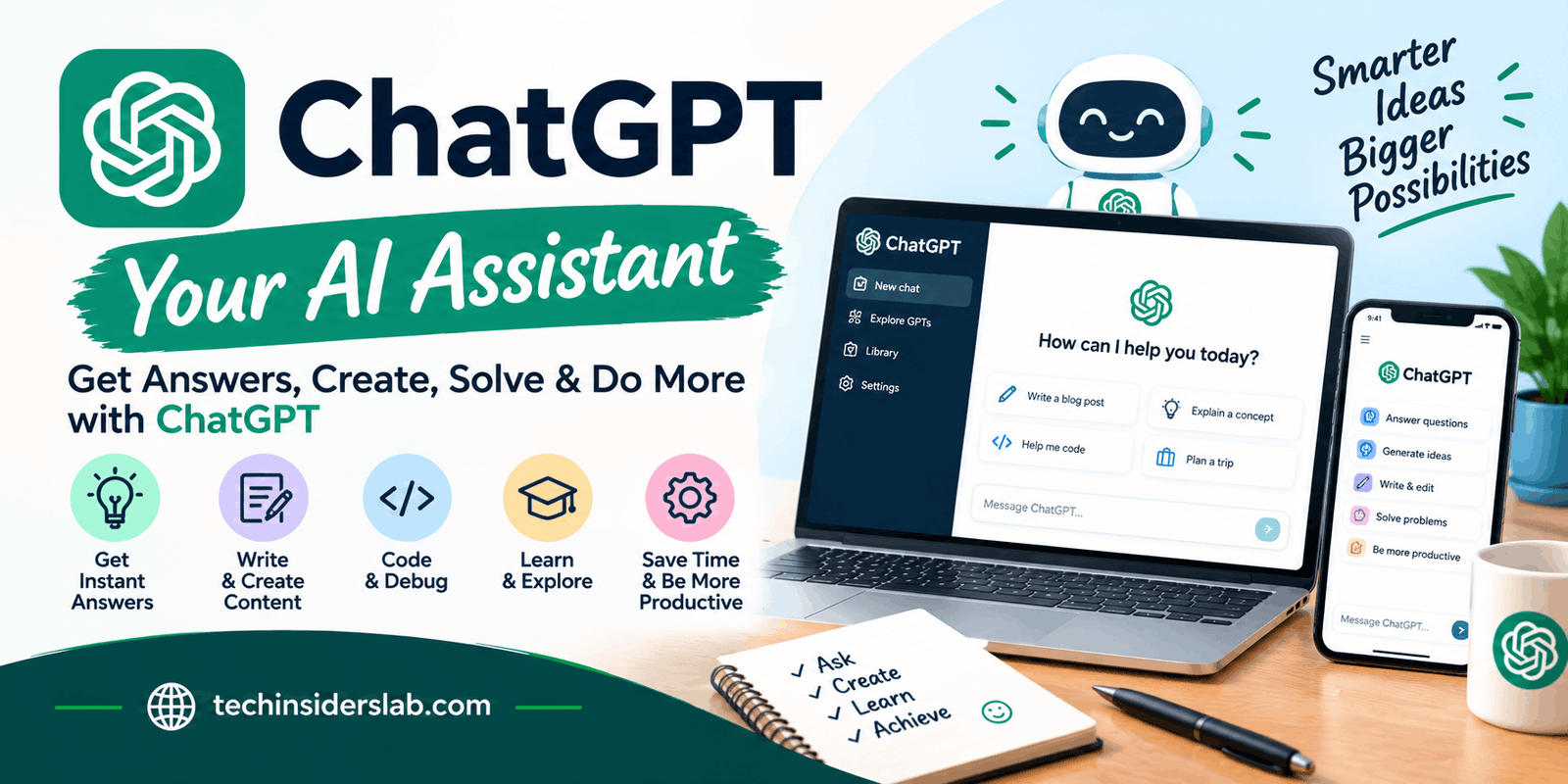
Artificial intelligence has changed the way people search for information, write content, study, solve problems, and complete everyday digital tasks. Among the most recognizable AI tools available today is ChatGPT, an AI assistant developed by OpenAI. What started primarily as a conversational chatbot has evolved into a broader platform that can help with writing, research, coding, learning, planning, image analysis, file analysis, web search, and many other activities.
ChatGPT is designed to understand natural-language instructions and respond conversationally. Instead of learning complicated commands, users can describe what they need in ordinary language and then continue refining the result through follow-up messages. This makes the platform useful for beginners as well as professionals who want an AI assistant for more advanced workflows.
What Is ChatGPT?
ChatGPT is an artificial intelligence assistant developed by OpenAI. It is designed to understand user instructions and generate responses that can help with a wide variety of tasks, including brainstorming, writing, studying, planning, mathematics, coding, and analyzing images or files.
The platform is available through the web and mobile applications for iOS and Android. Users can start a conversation simply by entering a question, instruction, or request into the chat interface.
One of ChatGPT’s important characteristics is its conversational design. Users do not necessarily have to explain everything again after every response. They can ask follow-up questions, request changes, or provide additional context to gradually improve the result.
How ChatGPT Works
ChatGPT is powered by large language models that are trained to process and generate natural language. When a user enters a prompt, the system analyzes the request and generates a response based on the available context, model capabilities, and tools being used.
The quality of the result often depends on the quality of the instruction. A short question can produce a short answer, while a detailed prompt can establish a specific audience, tone, format, objective, or set of constraints.
For example, instead of asking only for “an article,” a user can explain the topic, target audience, desired length, tone, headings, and SEO requirements. This gives the AI more useful context for producing an appropriate response.
Main Features of ChatGPT
1. Writing and Content Creation
Writing is one of the most common ways people use ChatGPT. It can help users create drafts, rewrite existing text, improve grammar, summarize information, brainstorm ideas, and adapt content for different audiences.
Students can use it to understand difficult topics, while businesses can use it for emails, product descriptions, reports, marketing ideas, and internal documentation.
The important advantage is flexibility. Users can ask ChatGPT to make content shorter, clearer, more professional, more conversational, or more detailed without starting from scratch.
However, AI-generated writing should still be reviewed before publication, especially when accuracy, originality, or professional standards are important.
2. Research and Web Search
ChatGPT can also help users research current information. Its web-search capabilities can retrieve information from online sources and provide citations when web research is used.
For more complicated research tasks, ChatGPT’s Deep Research capability can search and synthesize information from multiple sources into a structured report. OpenAI describes Deep Research as a tool for complex, multi-step research where users want documented results with citations or source links.
This makes ChatGPT useful for tasks such as comparing products, researching industries, investigating technical subjects, preparing reports, and collecting information from multiple websites.
Users should still check important facts against the original sources, particularly for legal, financial, medical, or other high-stakes information.
3. Coding Assistance
ChatGPT can assist with many programming-related tasks. Developers can use it to explain code, identify potential problems, create examples, generate functions, understand programming concepts, and troubleshoot errors.
It can work with programming languages and technical concepts through natural-language conversations. Instead of simply asking for code, developers can explain the desired behavior and then ask the AI to improve or modify the solution.
For beginners, this can make programming concepts easier to understand because explanations can be adjusted according to their level of knowledge.
Experienced developers can also use AI assistance for repetitive tasks, documentation, debugging ideas, and exploring possible implementation approaches.
4. Studying and Learning
ChatGPT can act as an interactive learning assistant. Students can ask it to explain difficult concepts in simpler language, generate practice questions, create study plans, or provide step-by-step explanations.
One advantage of conversational learning is that users can immediately ask follow-up questions when something is unclear.
For example, a student might ask for a simple explanation of a scientific concept and then request an analogy, examples, practice questions, and a short quiz.
The platform can therefore support different learning styles, although students should use it as a learning aid rather than blindly copying answers.
5. Image Understanding and Generation
ChatGPT is not limited to text. OpenAI’s current capabilities documentation describes image input and generation features. Users can upload images, diagrams, screenshots, or charts for analysis and can also request creative visual content.
Image analysis can be useful when users need help interpreting a screenshot, extracting information from a visual, understanding a diagram, or discussing what appears in an image.
Image generation provides another creative use case. Users can describe a visual concept using natural language and request an illustration, mockup, graphic, or other image.
This combination of text and visual capabilities makes ChatGPT more versatile than a traditional text-only chatbot.
6. File Analysis
ChatGPT can work with uploaded documents and other supported files. According to OpenAI’s capabilities documentation, users can upload files such as PDFs, presentations, and plain-text documents for tasks including summarization, information extraction, and question answering.
This can save time when working with lengthy documents. Instead of manually reading every section to find a specific piece of information, users can ask targeted questions about the uploaded material.
Businesses can use this capability for reports and documentation, while students can use it for study materials and research documents.
7. Projects
For longer-running work, ChatGPT provides Projects. OpenAI describes Projects as workspaces where users can keep related chats, reference files, and custom instructions together.
This is particularly useful for ongoing activities such as content production, research, planning, or business projects.
Keeping related information together can help maintain context and reduce the need to repeatedly explain the same background information.
Projects are available across Free and paid subscription types, while some collaboration capabilities vary by plan.
ChatGPT for Businesses
ChatGPT can also be used in professional environments. Organizations can use AI assistance for writing, research, brainstorming, analysis, coding, documentation, and other workflows.
OpenAI offers ChatGPT Business for teams, providing a shared workspace, centralized billing, administrative controls, and access to ChatGPT-related tools.
Business environments also have different data-handling policies from personal accounts. OpenAI states that ChatGPT Business data is excluded from model training by default.
For organizations, administrators can also manage access and control which services and features are available to users.
ChatGPT and Productivity
One of ChatGPT’s biggest benefits is its ability to reduce repetitive work.
A user can start with a rough idea and ask ChatGPT to turn it into a structured document. They can then request revisions, summaries, bullet points, headlines, social-media copy, or alternative versions.
This workflow can be useful for:
- Content writing
- Email drafting
- Research summaries
- Meeting preparation
- Brainstorming
- Study planning
- Technical explanations
- Business documentation
- Marketing ideas
- Data and file analysis
Rather than replacing every existing application, ChatGPT can work as an intelligent layer that helps users complete tasks more efficiently.
ChatGPT for Content Creators
Content creators can use ChatGPT throughout the content-production process. It can help generate topic ideas, organize article structures, create outlines, rewrite sections, develop social-media concepts, and improve readability.
SEO professionals can also use it for brainstorming keywords, developing content structures, generating FAQ ideas, and creating drafts.
However, good content should not depend entirely on AI-generated text. Human editing, fact-checking, original insights, and genuine expertise remain important for creating useful and trustworthy content.
Privacy and Data Controls
Because users may enter personal or business information into AI systems, understanding data controls is important.
For personal ChatGPT accounts, OpenAI states that content may be used to improve models unless users opt out. The “Improve the model for everyone” setting can be turned off through ChatGPT’s Data Controls, after which new conversations are not used for model training.
Temporary Chat provides another option for certain conversations. OpenAI says Temporary Chats do not appear in history, do not create or use memories, and are not used to train models.
Business and enterprise environments have separate privacy commitments, so organizations should review the applicable policies before using ChatGPT with sensitive company information.
Advantages of ChatGPT
ChatGPT offers several advantages that make it useful for everyday users and professionals:
- Natural-language interaction
- Wide range of use cases
- Writing and editing assistance
- Coding support
- Study and learning help
- Web research capabilities
- Image analysis and generation
- File analysis
- Long-term project organization
- Mobile and web availability
- Conversational follow-up
- Different plans for different usage needs
Its biggest strength is flexibility. The same platform can help someone write an email in the morning, understand a programming problem in the afternoon, and research a business topic later in the day.
Limitations of ChatGPT
Despite its capabilities, ChatGPT should not be treated as an infallible source of information.
AI systems can produce incorrect or incomplete answers. A response can sound convincing while still containing factual errors. This is why important information should be verified against reliable primary sources.
Another limitation is that capabilities, usage limits, and available features can vary depending on the user’s plan and the current product configuration. OpenAI notes that message limits and feature availability can change over time.
Users should also avoid entering highly sensitive information unless they understand the applicable privacy and data-control settings.
Tips for Getting Better Results
The best way to use ChatGPT is to provide clear instructions.
A strong prompt can include:
- The exact task
- Relevant background information
- Target audience
- Desired tone
- Output format
- Length requirements
- Important restrictions
- Examples when appropriate
Instead of asking, “Write about AI,” a more useful instruction might specify the audience, article length, purpose, tone, headings, and key topics.
Users should also treat the conversation as an iterative process. If the first response is not exactly right, they can explain what needs to change and request a revised version.
The Future of ChatGPT
AI assistants are moving beyond simple question-and-answer experiences toward broader productivity platforms. OpenAI’s current product direction includes tools for research, longer tasks, connected apps and files, and creation of finished documents, spreadsheets, presentations, reports, and other outputs.
This suggests that the future role of AI assistants may be less about answering isolated questions and more about helping users complete complete workflows.
For individuals and businesses, this could mean using AI as a central workspace for researching information, organizing projects, creating content, analyzing files, and completing repetitive tasks.
Conclusion
ChatGPT has developed into a versatile AI assistant that can support a wide range of personal, educational, creative, and professional activities. Its conversational interface makes advanced AI capabilities accessible through ordinary language, while features such as web search, Deep Research, image generation, file analysis, coding assistance, and Projects expand what users can accomplish.
The platform is particularly valuable when used as a collaborative assistant rather than an unquestioned authority. Users can provide context, review responses, request improvements, and verify important information.
For students, creators, developers, professionals, entrepreneurs, and everyday users, ChatGPT can become a practical productivity tool. As AI capabilities continue to develop, its usefulness will increasingly depend not only on what the technology can generate, but also on how effectively people guide, review, and apply its results.