Steam Machine Release Date: Everything You Need to Know
introduction
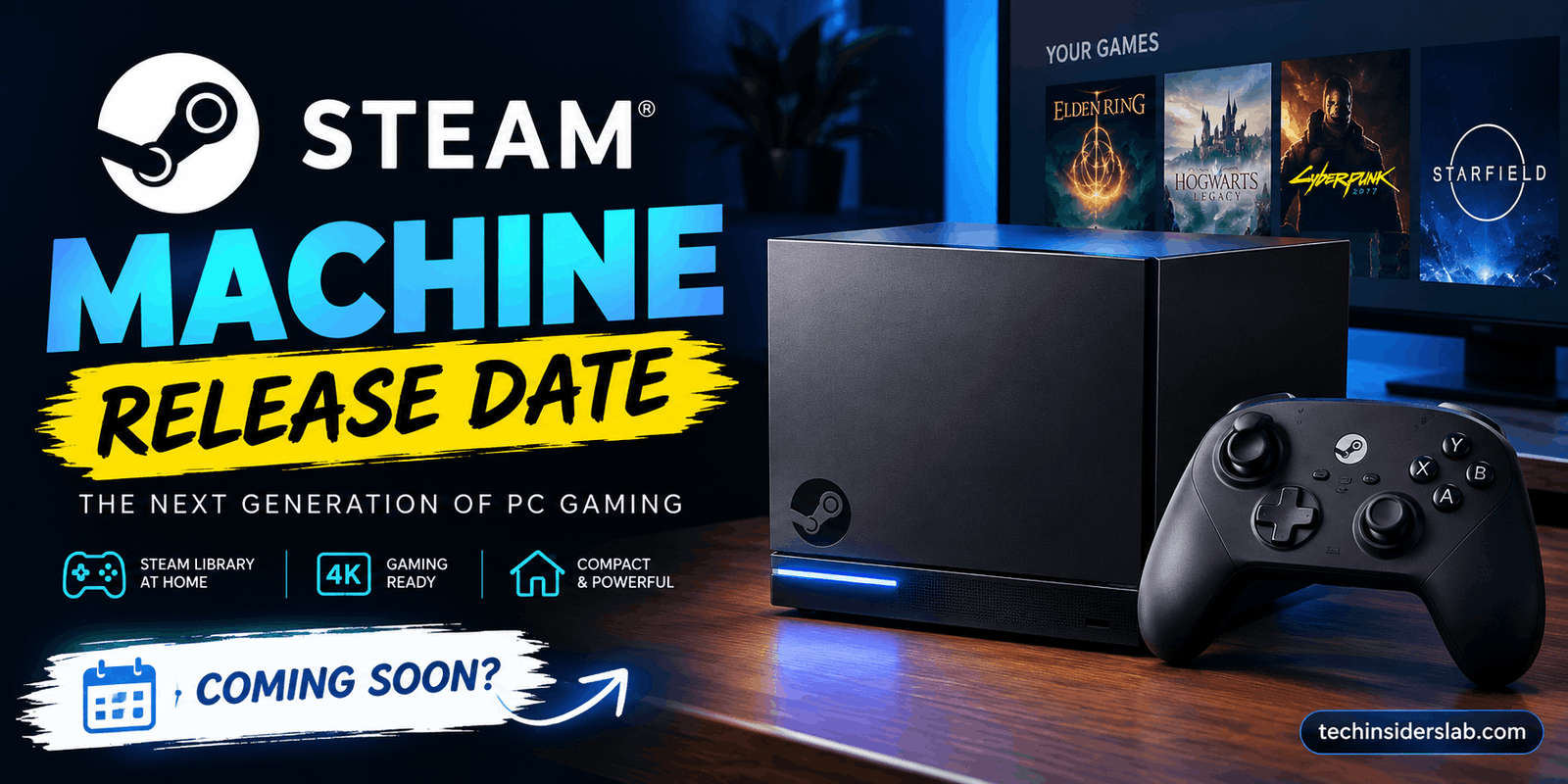
The Steam Machine release date became one of the most anticipated topics in PC gaming after Valve announced its return to the living-room gaming PC market. Unlike a traditional game console, Steam Machine is designed as a compact PC that combines the flexibility of desktop gaming with the simplicity of a console.
Valve originally announced the new Steam Machine as part of a broader hardware lineup that also included a new Steam Controller and Steam Frame. While the company initially planned to release the Steam Machine during 2026, hardware supply problems and rising memory and storage costs created uncertainty around the exact launch schedule. Valve later confirmed the final launch timing.
The Steam Machine officially launched on June 30, 2026, with the base configuration starting at $1,049. A higher-capacity version with 2TB storage and additional accessories was also introduced.
What Is the Steam Machine?
Steam Machine is essentially a compact gaming PC designed to bring the Steam experience into the living room. Instead of requiring users to build or configure a traditional desktop computer, Valve designed the device around a simple console-like experience.
The machine runs SteamOS, Valve’s Linux-based operating system. SteamOS provides a controller-friendly interface, access to the Steam library, Steam Cloud, game recording and other Steam features.
At the same time, Steam Machine remains a PC. Users are not limited to a traditional console-style environment because SteamOS provides access to a desktop mode and allows compatible software and other game launchers to be installed.
Valve describes Steam Machine as a PC running SteamOS that is specifically designed to make playing PC games on a television easier. The company also says that its hardware is roughly six times as powerful as Steam Deck.
Steam Machine Release Date
The official Steam Machine release date was June 30, 2026.
Before the final date was announced, Valve had only confirmed that the machine would arrive during 2026. Later, the company indicated that Steam Machine would ship during the summer, and the exact launch date was eventually confirmed.
The release schedule was affected by significant changes in the computer hardware market. Memory and storage prices increased, making it harder for Valve to finalize pricing and production plans. Earlier in 2026, Valve said that it needed additional time to determine pricing and shipping dates because of shortages and changing component costs.
This delay was important because Valve wanted to launch the product at a price and schedule that it could realistically maintain rather than announcing an early date that might change again.
By June, Valve had finalized the launch details and began accepting reservations for the first production batch. The first Steam Machines started shipping around the official launch period.
Steam Machine Price
One of the biggest surprises surrounding Steam Machine was its price.
The base Steam Machine with 512GB of storage was priced at $1,049. A more expensive 2TB configuration was also offered, giving users substantially more storage for large PC game libraries.
The pricing was higher than many early expectations. When Valve initially revealed the machine, many gamers expected it to compete more directly with traditional consoles from Sony and Microsoft. However, the final pricing places Steam Machine closer to the territory of dedicated gaming PCs.
The 2TB version was listed at a higher price, while buyers could also purchase the Steam Controller separately or choose a bundle. One announced configuration paired the 2TB Steam Machine with a controller and additional faceplates for $1,428.
For buyers, this means the Steam Machine is not positioned simply as a cheap console alternative. Instead, Valve is targeting people who want PC gaming performance and the Steam ecosystem in a small, living-room-friendly device.
Steam Machine Specifications
The hardware inside Steam Machine is considerably more powerful than Steam Deck.
The system uses a semi-custom AMD platform featuring a 6-core, 12-thread Zen 4 CPU. Graphics are handled by a semi-custom AMD RDNA 3 GPU with 28 compute units and dedicated graphics memory.
The major specifications include:
- AMD Zen 4 6-core / 12-thread processor
- Semi-custom AMD RDNA 3 graphics
- 28 GPU compute units
- 16GB DDR5 system memory
- 8GB GDDR6 VRAM
- 512GB or 2TB NVMe SSD options
- MicroSD card support
- Wi-Fi 6E
- Bluetooth
- Gigabit Ethernet
- DisplayPort and HDMI connectivity
- Compact small-form-factor design
- SteamOS
These specifications make the Steam Machine fundamentally different from Steam Deck. Steam Deck focuses on portable gaming, while Steam Machine is designed primarily for higher-performance gaming on a television or desktop display.
How Powerful Is Steam Machine?
Performance is one of the most important reasons gamers are interested in Steam Machine.
Valve has stated that the hardware is approximately six times as powerful as Steam Deck. That does not mean every game will automatically run at six times the frame rate, because actual performance depends on resolution, graphics settings, game optimization and other factors.
Valve has also said that the majority of Steam titles perform well at 4K and 60 frames per second with FSR in its testing. This makes the machine particularly interesting for users who want to connect a PC directly to a 4K television.
Upscaling technology such as AMD’s FidelityFX Super Resolution can help improve performance by rendering games at a lower internal resolution and reconstructing the image for a higher-resolution display.
However, gamers should not assume that every demanding modern title will maintain native 4K at 60 FPS. Performance can vary significantly between games.
SteamOS on Steam Machine
SteamOS is one of the most important parts of the Steam Machine experience.
Unlike Windows-based gaming PCs, Steam Machine uses Valve’s Linux-based SteamOS. The operating system is designed around gaming and controller navigation, making it easier to use from a couch.
SteamOS also uses Proton to allow many Windows games to run on Linux without requiring developers to create completely separate Linux versions.
Valve has spent years improving SteamOS through Steam Deck, and Steam Machine benefits from much of that work.
The operating system also provides a desktop mode, which gives users more flexibility than a traditional closed gaming console. SteamOS is therefore somewhere between a console operating system and a conventional PC operating system.
Steam Machine Verified Program
Game compatibility is another important part of the Steam Machine experience.
Valve expanded its Verified program to Steam Machine so users can understand how games are expected to perform without requiring manual configuration.
The Steam Machine Verified system focuses on the out-of-box experience. This includes factors such as controller functionality and whether default graphics settings provide an acceptable level of performance.
Valve says that if a game already runs well on Steam Deck, it should generally work well on Steam Machine without additional developer work. Games that struggled on Steam Deck because of CPU or GPU limitations may perform much better on the more powerful Steam Machine.
This approach could make Steam Machine easier for less technical users because they do not necessarily need to understand PC graphics settings before starting a game.
Steam Machine vs Steam Deck
Although Steam Machine and Steam Deck share SteamOS, they are designed for different purposes.
Steam Deck is primarily a portable gaming computer. Its biggest advantage is that users can take their Steam library with them.
Steam Machine, on the other hand, is a stationary gaming PC designed for a television, monitor or living-room setup.
Steam Machine offers considerably more hardware performance, more graphical power and stronger desktop-style gaming capabilities. Steam Deck is more attractive for portability, while Steam Machine is better suited for users who want a console-like PC gaming experience at home.
Both products benefit from Valve’s SteamOS ecosystem, which makes the transition between the two platforms more familiar.
Is Steam Machine a Console or a PC?
The simplest answer is that Steam Machine is a PC designed to behave more like a console.
Traditional consoles generally use highly controlled operating systems and hardware ecosystems. Steam Machine provides much more flexibility.
Users can access the Steam library, use desktop mode and take advantage of the capabilities of a PC. At the same time, the SteamOS interface is designed to make gaming from a controller simple.
This hybrid approach is one of the biggest attractions of the product.
Why Is Steam Machine Important?
Steam Machine could be important for the future of PC gaming because it attempts to remove some of the complexity associated with gaming PCs.
Building a gaming PC can require choosing a CPU, GPU, motherboard, RAM, storage, power supply and case. Users also need to install an operating system, drivers and game launchers.
Steam Machine packages much of that experience into one compact system.
For gamers who already own a large Steam library but prefer playing on a television, Steam Machine provides a more straightforward solution.
It also demonstrates Valve’s continued interest in expanding Steam beyond conventional Windows PCs and portable gaming.
Who Should Buy Steam Machine?
Steam Machine may be a good choice for several types of gamers.
It can be attractive to people who:
- Want PC gaming on a television
- Already have a large Steam library
- Prefer a console-style interface
- Want more performance than Steam Deck
- Do not want to build a gaming PC
- Prefer SteamOS over Windows
- Want a compact gaming computer
- Need a system capable of higher-resolution gaming
However, the price should be considered carefully.
Gamers who want maximum performance per dollar may find that building a custom gaming PC provides more upgrade flexibility. Likewise, users who primarily play casual or older games may not need the power of Steam Machine.
What Makes Steam Machine Different?
The biggest difference is the combination of PC flexibility and console convenience.
A traditional gaming console offers simplicity but usually limits the user to a controlled ecosystem. A gaming PC offers flexibility but can involve more configuration.
Steam Machine attempts to sit between these two worlds.
Its small form factor, SteamOS interface, controller support, Steam library integration and powerful AMD hardware make it a unique option for people who want PC gaming without placing a large desktop tower beside their television.
Conclusion
The Steam Machine release date of June 30, 2026 represents an important step in Valve’s efforts to bring PC gaming closer to the traditional console experience. With powerful AMD hardware, SteamOS, a compact design, and access to a large Steam library, the device offers an interesting option for gamers who want PC gaming on a TV.
Although its starting price is higher than many traditional consoles, Steam Machine provides the flexibility of a PC along with the simplicity of a console-style gaming system. For gamers who already have a large Steam library and want a powerful living-room gaming setup, Steam Machine could be a compelling choice.