Galaxy Watch: A Complete Guide to Samsung’s Smartwatch
introduction
Galaxy Watch is Samsung’s smartwatch series that combines traditional watch functions with modern technology. It is designed to help users stay connected, track fitness activities, monitor sleep, receive notifications, and access useful features directly from their wrist. Over the years, Samsung has continued to improve the Galaxy Watch lineup with better displays, faster processors, advanced sensors, improved battery performance, and new health and fitness features.
Modern Galaxy Watch models are built around Samsung’s wearable ecosystem and use Wear OS powered by Samsung. This gives users access to applications, notifications, GPS, health tracking, fitness tools, communication features, and customization options.
What Is Galaxy Watch?
Galaxy Watch is a family of smartwatches developed by Samsung. Unlike a traditional watch that mainly tells time, Galaxy Watch can perform many smartphone-like functions in a compact wearable device.
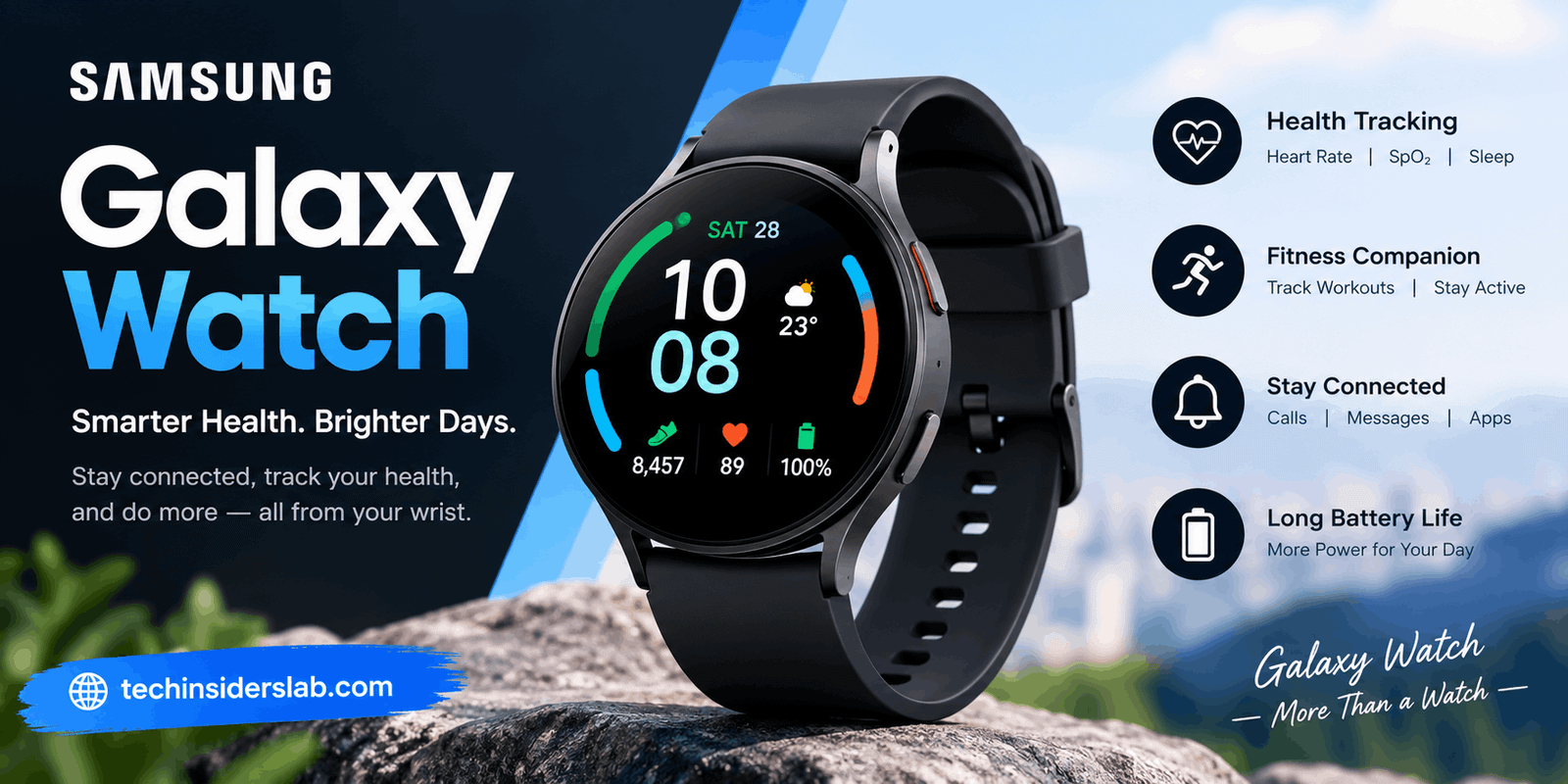
Depending on the model, users can check notifications, answer or manage calls, track workouts, monitor sleep, measure heart rate, use GPS, control music, check weather information, and interact with different applications.
Samsung offers different Galaxy Watch models for different types of users. Standard Galaxy Watch models are designed for everyday use, fitness, and general wellness. The Galaxy Watch Ultra is designed for users who want a larger and more durable smartwatch with additional outdoor-focused capabilities.
Design and Display
The design of Galaxy Watch has changed over different generations, but the familiar round smartwatch shape remains an important part of the product’s identity.
Recent Galaxy Watch models feature Super AMOLED displays that provide sharp images, vibrant colors, and good visibility. The touchscreen makes it easy to navigate menus, read notifications, view health information, and control applications.
Different sizes are available, allowing users to choose a watch that matches their wrist size and personal preference. Smaller models can feel lighter and more comfortable during sleep, while larger models provide more screen space for reading information and interacting with apps.
Galaxy Watch models also support interchangeable bands. This means users can change the appearance of the watch according to their style, workout requirements, or daily activities.
Performance and Software
Modern Galaxy Watch devices use Wear OS powered by Samsung. This software combines Google’s smartwatch platform with Samsung’s user interface and ecosystem.
Newer Galaxy Watch models feature improved processors that provide smoother navigation and faster application performance. Samsung has also introduced updated versions of One UI Watch, which make it easier to access information and customize the smartwatch experience.
The software allows users to install compatible applications and access features directly from the watch. Instead of constantly taking out a smartphone, users can perform many small tasks from their wrist.
This can be especially useful for checking notifications, setting timers, controlling music, monitoring workouts, or quickly viewing information.
Health Tracking Features
Health and wellness tracking have become some of the most important features of modern Galaxy Watch devices.
Depending on the model, Galaxy Watch can use several sensors to collect information related to heart rate, movement, sleep, body composition, and exercise.
Recent models offer features such as Energy Score, sleep tracking, sleep coaching, body composition measurements, blood pressure monitoring, ECG functionality, and irregular heart rhythm notifications in supported regions and configurations.
These features can help users understand general wellness patterns and monitor changes over time.
However, smartwatch measurements should not automatically be considered a replacement for professional medical testing. Sensor results can be affected by factors such as movement, watch position, skin contact, and individual differences.
Fitness and Exercise Tracking
Galaxy Watch is also designed to work as a fitness companion.
Users can track various workouts and monitor information such as duration, heart rate, calories, distance, pace, and other activity statistics. GPS allows compatible models to track outdoor activities without relying entirely on a smartphone.
Running is one area where Galaxy Watch provides detailed information. Depending on the model and software, users can view running-related metrics and use personalized training features.
The watch can also help users maintain daily activity goals by monitoring steps and movement throughout the day.
For people who regularly exercise, having fitness information available on the wrist can make it easier to monitor progress without carrying a separate fitness tracker.
Sleep Tracking
Sleep tracking is another major feature of Galaxy Watch.
When worn during sleep, the watch can collect information that helps users understand their sleeping patterns. Samsung has developed features that provide sleep scores, sleep-related insights, bedtime guidance, and sleep coaching.
Some newer Galaxy Watch features use collected sleep information to provide personalized recommendations.
Wearing the watch consistently can make it easier to identify patterns such as irregular sleeping schedules or changes in sleep duration.
However, sleep-tracking results should be viewed as general wellness information rather than a professional sleep diagnosis.
Body Composition
Selected Galaxy Watch models include body-composition measurement features based on Bioelectrical Impedance Analysis technology.
This feature can provide estimates related to body fat, skeletal muscle, body water, and other body-composition information.
For users interested in fitness and lifestyle tracking, these measurements can be useful for observing long-term trends.
It is important to remember that body-composition readings can vary depending on hydration, timing, body position, and other factors. Therefore, users should generally focus on changes over time rather than relying heavily on a single measurement.
Heart and Wellness Monitoring
Heart-related monitoring is another area where Galaxy Watch has become increasingly advanced.
Depending on the model and region, the watch may provide heart-rate monitoring, ECG functionality, irregular heart rhythm notifications, and blood pressure-related features.
These functions are supported by sensors built into the smartwatch and may require specific Samsung applications or compatible Samsung smartphones.
Availability can also differ between countries because certain health-related features may depend on local regulations and approvals.
Users should therefore check the specifications of the exact Galaxy Watch model available in their region before purchasing.
Battery Life
Battery life is an important factor when choosing a smartwatch.
Galaxy Watch battery performance depends on the model and how the device is used. Features such as GPS, LTE connectivity, continuous health monitoring, high screen brightness, and an always-on display can increase battery consumption.
Standard Galaxy Watch models are generally designed for regular daily use, while larger models can offer bigger batteries.
The Galaxy Watch Ultra, for example, has a significantly larger battery than many standard models. Its larger battery is intended to support longer usage, particularly during outdoor activities and extended workouts.
Actual battery life can vary considerably from the manufacturer’s estimated figures because every user has different settings and usage patterns.
Galaxy Watch Ultra
Galaxy Watch Ultra is Samsung’s more rugged smartwatch option.
It features a larger design, titanium construction, increased durability, and a larger battery. It is intended for users who participate in outdoor activities and want additional protection and battery capacity.
The Ultra series focuses heavily on outdoor fitness and navigation. Features such as advanced GPS technology can help users track outdoor activities more accurately.
Its larger display can also make maps, workout statistics, and other information easier to read.
For someone who mainly wants a lightweight smartwatch for notifications and basic fitness tracking, an Ultra model may provide more capabilities than necessary. For outdoor enthusiasts, however, its rugged design and additional features can be particularly relevant.
Connectivity
Galaxy Watch can connect to compatible smartphones through Bluetooth and Wi-Fi. Certain versions also include LTE connectivity.
Bluetooth models generally depend more heavily on the connected smartphone for communication and internet-related functions. LTE models can provide greater independence when a compatible cellular plan is activated.
Galaxy Watch also includes technologies such as GPS and NFC on supported models.
GPS is useful for activities such as running, cycling, hiking, and walking because it can record location and distance information.
NFC can support compatible contactless functions and other supported services.
Notifications and Smart Features
One of the simplest but most useful features of Galaxy Watch is notification management.
After connecting the watch to a smartphone, users can receive alerts for messages, calls, applications, reminders, and other notifications directly on the wrist.
This means users do not always need to take their phone out of their pocket to check a simple notification.
Depending on the connected smartphone and supported applications, users can also control music, check weather information, use timers, manage alarms, and perform other everyday tasks.
These small conveniences can make a smartwatch useful even when the user is not exercising.
Customization
Galaxy Watch provides several ways to customize the experience.
Users can select different watch faces, change displayed information, adjust settings, and use different bands.
Watch faces can be customized to show information such as time, date, weather, battery percentage, activity statistics, heart rate, and other supported information.
This allows the same smartwatch to look different depending on whether it is being used for work, exercise, travel, or casual activities.
Galaxy Watch for Fitness Users
Fitness enthusiasts can use Galaxy Watch as a convenient workout companion.
The watch can monitor exercise duration, heart rate, calories, distance, pace, and other statistics. GPS tracking can be useful for outdoor workouts.
Runners can use running-specific features, while people who participate in other activities can choose from a variety of supported workout modes.
The ability to review workout statistics after exercising can also help users understand their progress and maintain consistent routines.
Galaxy Watch for Everyday Users
Galaxy Watch is not only designed for athletes.
An everyday user can use it as a combination of several different devices and services.
It can function as:
- A digital watch
- A fitness tracker
- A sleep tracker
- A notification device
- A workout companion
- A GPS tracker
- A music controller
- A communication device
- A wellness monitoring tool
- A smartphone companion
This combination is one of the main reasons smartwatches have become an important part of wearable technology.
Compatibility
Compatibility should be considered before purchasing a Galaxy Watch.
Samsung Galaxy smartphones generally provide the most complete integration with Samsung’s smartwatch ecosystem. Some features may require a compatible Samsung smartphone or specific Samsung applications.
Compatibility can also depend on the particular Galaxy Watch model, operating system, country, and available services.
Users who already own a Samsung Galaxy smartphone may find the overall ecosystem particularly convenient because different Samsung devices and services can work together.
Things to Consider Before Buying Galaxy Watch
Before purchasing a Galaxy Watch, users should consider several factors.
Size
Choose a size that feels comfortable on your wrist. A smaller model may be more comfortable for everyday and sleep use, while a larger model can provide a bigger display.
Battery
Consider how frequently you are comfortable charging the watch. Heavy GPS and health-monitoring use can reduce battery life.
Connectivity
Decide whether Bluetooth connectivity is sufficient or whether LTE functionality is important.
Fitness Features
If you exercise regularly, pay attention to GPS, workout modes, running features, and health sensors.
Health Features
Check which health-related functions are available in your country and whether they work with your smartphone.
Durability
If you spend a lot of time outdoors, a more rugged model may be worth considering.
Smartphone Compatibility
Always check whether your current smartphone supports the Galaxy Watch model and its desired features.
Advantages of Galaxy Watch
Galaxy Watch offers several useful advantages:
- Modern and attractive smartwatch designs
- High-quality AMOLED displays
- Extensive fitness tracking
- Sleep monitoring
- Multiple health-related sensors
- GPS functionality
- Smartphone notifications
- Customizable watch faces
- Access to compatible applications
- Different sizes and models
- LTE options on selected versions
- Strong integration with Samsung devices
These features make Galaxy Watch a versatile option for users interested in wearable technology.
Limitations to Consider
Despite its wide range of features, Galaxy Watch also has some limitations.
Battery life is generally shorter than that of a traditional watch, meaning users need to charge it regularly.
Some advanced health features may not be available in every country. Certain functions may also require a compatible Samsung smartphone.
Additionally, the accuracy of health and fitness measurements can vary depending on the activity, sensor contact, user movement, and environmental conditions.
Users should also consider the size and weight of larger models before choosing them for continuous wear or sleep tracking.
Conclusion
Galaxy Watch is a versatile wearable technology device that combines smartwatch functions, fitness tracking, health monitoring, sleep tracking, GPS, notifications, and customization in one compact device. Different models are designed for different needs, from everyday users to fitness enthusiasts and outdoor users. Before choosing a Galaxy Watch, users should consider its size, battery life, compatibility, connectivity, durability, and available health features. Overall, the Galaxy Watch lineup continues to offer a broad range of features for people looking to add smart technology to their daily routine.