iPhone 14 Plus: Guide to Features, Performance, Camera, Battery
introduction
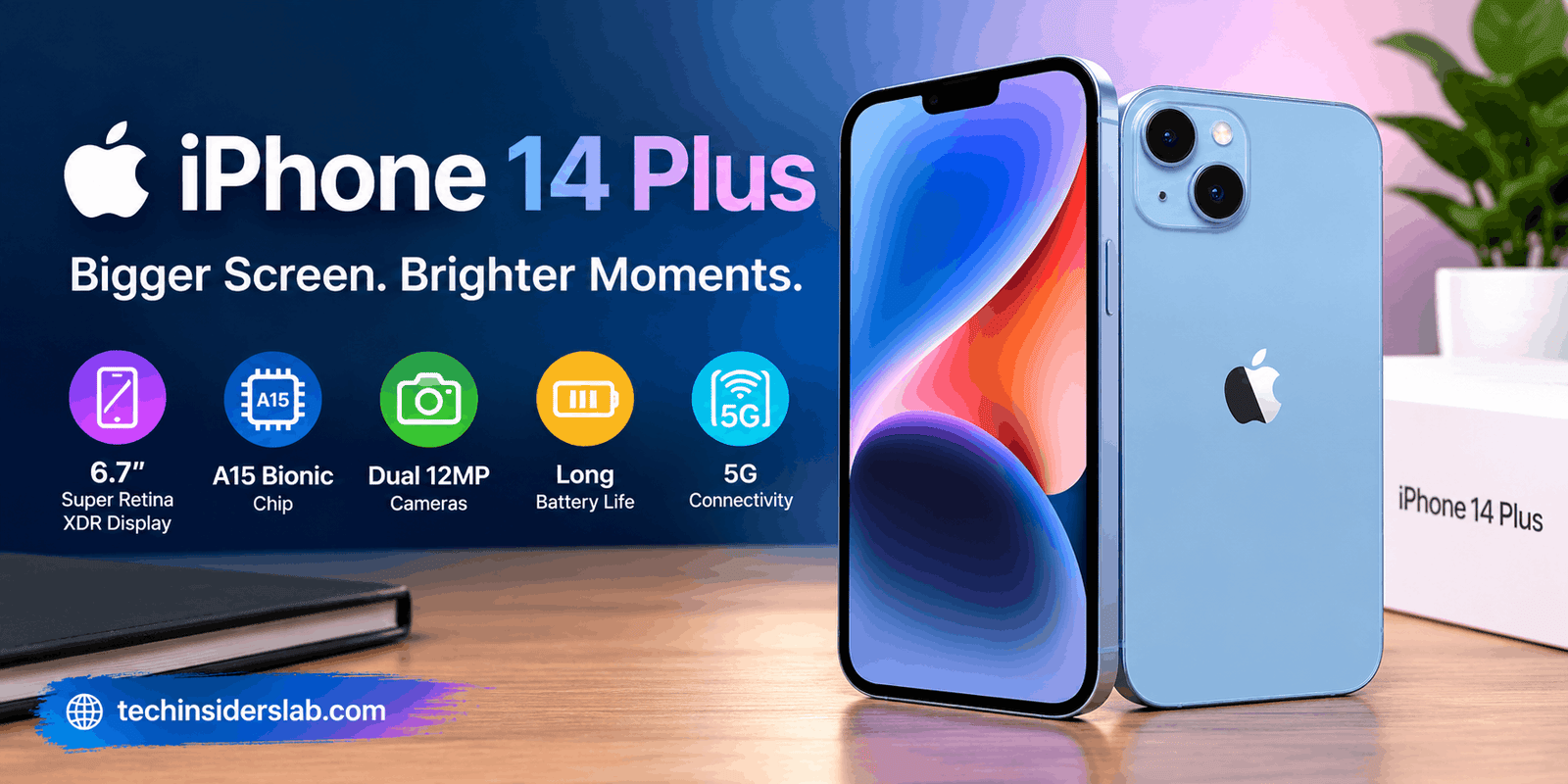
The iPhone 14 Plus is a large-screen smartphone introduced by Apple in 2022 as part of the iPhone 14 family. It was designed for people who wanted the experience of a larger iPhone without moving to the Pro Max model. With its 6.7-inch OLED display, A15 Bionic chip, dual-camera system, long battery life, and familiar Apple design, the iPhone 14 Plus remains an interesting option for users who prioritize screen size and everyday reliability.
Unlike the smaller standard iPhone 14, the iPhone 14 Plus focuses heavily on providing a larger viewing experience while maintaining many of the core features associated with Apple’s mainstream iPhone lineup. It is suitable for watching videos, browsing websites, taking photos, communicating, gaming, and handling everyday productivity tasks.
iPhone 14 Plus Overview
The iPhone 14 Plus combines a large display with a relatively straightforward hardware configuration. Apple introduced the device in 2022, and it was offered in several storage capacities, including 128GB, 256GB, and 512GB. Available finishes included Midnight, Starlight, Blue, Purple, Yellow, and PRODUCT(RED).
The phone uses an aluminum frame, a glass back, and a Ceramic Shield front. This gives it the familiar premium appearance associated with recent iPhone generations while keeping the design relatively simple compared with Apple’s Pro models.
One of the most noticeable characteristics of the iPhone 14 Plus is its size. It measures 160.8 mm in height, 78.1 mm in width, and 7.8 mm in thickness, with a weight of 203 grams.
This combination makes the phone considerably larger than the standard iPhone 14 while still keeping its weight below some larger premium smartphones.
Large 6.7-Inch Super Retina XDR Display
The display is arguably the main reason someone might choose the iPhone 14 Plus. Apple equipped it with a 6.7-inch Super Retina XDR OLED display. It has a resolution of 2778 × 1284 pixels and a pixel density of 458 pixels per inch.
OLED technology allows the screen to produce deep blacks, strong contrast, and vibrant colors. The display also supports HDR and Apple’s True Tone technology. Wide color support using the P3 color space helps produce a broad range of colors for compatible content.
The display has a typical maximum brightness of 800 nits and can reach up to 1,200 nits peak brightness when displaying HDR content.
The larger screen can be particularly useful for people who spend considerable time watching YouTube videos, browsing social media, reading articles, viewing photos, or playing mobile games. It also provides more room for typing and interacting with applications.
For users who prefer large screens, the iPhone 14 Plus offers a different experience from the smaller iPhone models without requiring the Pro Max line.
A15 Bionic Performance
The iPhone 14 Plus is powered by Apple’s A15 Bionic chip. The configuration includes a six-core CPU with two performance cores and four efficiency cores, a five-core GPU, and a 16-core Neural Engine.
This hardware gives the device enough processing capability for a broad range of everyday tasks. Applications can open quickly, multitasking is generally smooth, and demanding games can take advantage of the integrated GPU.
The A15 Bionic is also important for photography and video processing. Apple’s computational photography features use processing power to improve image quality in different lighting conditions.
For regular users, the practical advantage of the chip is that the phone does not need an extremely complicated setup to handle common smartphone activities. Messaging, browsing, streaming, social media, navigation, photography, and productivity applications can all be handled within the capabilities of the device.
Dual-Camera System
Photography is another important part of the iPhone 14 Plus experience. The rear camera system contains two 12MP cameras: a main camera and an ultra-wide camera. The main camera uses a 26mm equivalent focal length with an f/1.5 aperture and sensor-shift optical image stabilization. The ultra-wide camera has a 13mm equivalent focal length, an f/2.4 aperture, and a 120-degree field of view.
The main camera is designed for general photography. It can capture everyday subjects such as people, landscapes, food, pets, buildings, and events. Optical image stabilization can also help reduce the effects of small movements while taking photos.
The ultra-wide camera provides a much broader perspective. It can be useful when photographing large buildings, landscapes, groups of people, or situations where it is difficult to move farther away from the subject.
The camera system also supports Night mode, Portrait mode, Smart HDR 4, Deep Fusion, Photonic Engine, Photographic Styles, and other computational photography features.
These technologies allow the phone to process captured images and improve aspects such as detail, exposure, color, and performance in challenging lighting.
Video Recording Capabilities
The iPhone 14 Plus is also designed for users who regularly record videos. Apple’s camera system supports high-quality video recording and stabilization features, making the phone suitable for everyday video creation.
Users can record family moments, travel footage, social media clips, short videos, and other content without needing a dedicated camera for many situations.
The combination of Apple’s camera processing and A15 Bionic chip contributes to the device’s video capabilities. For casual creators, the phone provides an accessible way to capture and edit content directly from a smartphone.
Battery Life
Battery life is one of the areas where the iPhone 14 Plus is particularly interesting because of its larger physical size. Apple rates it for up to 26 hours of video playback, up to 20 hours of streamed video playback, and up to 100 hours of audio playback under Apple’s testing conditions.
Actual battery performance depends on factors such as network conditions, display brightness, application usage, background activity, and battery health.
The device supports MagSafe wireless charging at up to 15W and Qi wireless charging at up to 7.5W. Apple also states that the phone can reach up to 50 percent charge in around 30 minutes when paired with a 20W adapter or higher.
The larger battery capacity associated with the Plus design makes the phone attractive to users who place a high priority on battery endurance.
Storage Options
The iPhone 14 Plus was introduced with three storage choices: 128GB, 256GB, and 512GB.
Choosing the right capacity depends on how the phone will be used.
The 128GB version can be suitable for users who primarily use cloud storage and do not keep a very large collection of photos and videos locally. The 256GB option provides additional room for applications, photographs, videos, games, and downloaded content. The 512GB version is more appropriate for users who regularly store large amounts of media on the device.
Because iPhones do not provide a traditional microSD card slot for expanding internal storage, selecting an appropriate capacity at purchase is important.
Design and Durability
The iPhone 14 Plus has a glass back, aluminum construction, and a Ceramic Shield front. Its design follows Apple’s recognizable flat-edged approach used across the iPhone 14 generation.
The device also carries an IP68 rating for splash, water, and dust resistance under IEC 60529. Apple specifies testing for a maximum depth of 6 meters for up to 30 minutes.
Water resistance should not be interpreted as permanent waterproofing. The level of protection can change with normal wear and potential damage to the device.
At 203 grams, the iPhone 14 Plus is not an especially lightweight phone, but its weight is reasonable considering the large 6.7-inch display and overall dimensions.
Connectivity and Wireless Features
The iPhone 14 Plus supports 5G cellular connectivity, allowing compatible networks and plans to provide faster mobile data speeds. It also includes Wi-Fi 6, Bluetooth 5.3, NFC, and an Ultra Wideband chip.
Wi-Fi 6 can provide improved wireless performance on compatible networks, while Bluetooth 5.3 supports modern wireless accessories.
The phone also includes Face ID through its TrueDepth camera system. Face ID can be used for device authentication and supported Apple services.
Safety Features
Apple introduced several safety-related features with the iPhone 14 generation. The iPhone 14 Plus supports Emergency SOS via satellite in supported regions, as well as Crash Detection. Availability of some emergency features can depend on location and other conditions.
These features are designed to provide additional communication and safety capabilities when users encounter certain emergency situations.
The inclusion of such features makes the iPhone 14 Plus more than simply a device for entertainment and communication. It also incorporates technology intended to assist users in specific emergency scenarios.
iPhone 14 Plus for Gaming
The A15 Bionic chip and five-core GPU give the iPhone 14 Plus the hardware needed for a wide range of mobile games.
The large 6.7-inch OLED display can make games more immersive because players have more screen space for controls and visual elements. Games that rely heavily on graphics can also benefit from Apple’s GPU performance.
However, gaming performance can vary depending on the specific title, graphics settings, software version, and device temperature.
The large screen can be particularly useful for games involving detailed maps, action controls, racing environments, or strategy interfaces.
iPhone 14 Plus for Content Consumption
One of the strongest use cases for the iPhone 14 Plus is media consumption. The 6.7-inch OLED display provides a larger viewing area than the standard-sized iPhone models.
Users can watch movies, TV shows, YouTube videos, social media clips, and other visual content on a spacious screen.
Reading can also be more comfortable for some users because larger text and wider page layouts can be easier to view. Students, professionals, and people who regularly browse websites from their phones may appreciate the additional display area.
The large display therefore gives the iPhone 14 Plus a useful advantage for entertainment and everyday browsing.
iPhone 14 Plus for Photography
The camera system is designed to cover common photography situations without making the user switch between complicated settings.
The main camera is suitable for general photos, while the ultra-wide camera provides flexibility for larger scenes. Night mode can assist in low-light situations, while Portrait mode is designed to create a depth-based photographic effect.
Features such as Photonic Engine and Deep Fusion use computational processing to improve image results.
For casual photographers, this means the phone can produce versatile results while keeping the photography experience relatively simple.
Software Experience
The iPhone 14 Plus was designed around Apple’s iOS ecosystem. This provides access to Apple’s applications, services, security features, and a large collection of third-party applications.
The software experience is an important part of the phone because Apple’s hardware and operating system are designed to work together.
Users can also connect the iPhone with other Apple devices and services, depending on their setup. This can make the phone useful for people who already use products such as Macs, iPads, or Apple Watches.
Who Is the iPhone 14 Plus For?
The iPhone 14 Plus can appeal to several types of users.
It is particularly relevant for people who want:
- A large 6.7-inch OLED display
- Strong everyday performance
- A capable dual-camera system
- Long battery life
- 5G connectivity
- Large storage options
- Face ID
- MagSafe charging
- Apple’s iOS ecosystem
The phone may also appeal to users who prefer a large display but do not specifically need the additional Pro-oriented hardware found on Apple’s higher-end models.
Things to Consider Before Buying
Although the iPhone 14 Plus offers many useful features, buyers should consider their personal requirements before choosing a device.
The first consideration is size. A 6.7-inch phone provides a spacious viewing experience, but it can be less convenient for people who prefer compact devices.
The second consideration is the camera system. The phone has two rear cameras rather than the more extensive camera arrangements found on some Pro models.
Storage should also be considered carefully because there is no conventional microSD expansion option.
Finally, buyers considering a used or refurbished iPhone 14 Plus should pay attention to battery health, physical condition, storage capacity, authenticity, and repair history.
Conclusion
The iPhone 14 Plus remains a capable large-screen smartphone with a strong combination of performance, display quality, camera features, battery life, and Apple’s iOS ecosystem. Its 6.7-inch Super Retina XDR display makes it especially suitable for watching videos, browsing, gaming, reading, and everyday smartphone tasks. The A15 Bionic chip provides dependable performance, while the dual-camera system offers versatile photography and video capabilities.
Its long battery life, 5G connectivity, MagSafe support, Face ID, and safety features further add to its overall functionality. For users who prefer a larger iPhone without necessarily choosing a Pro Max model, the iPhone 14 Plus offers a practical combination of size and everyday features.