STANLEY Tools – Reliable Hand Tools for Professionals
introduction
When it comes to choosing dependable tools for construction, repair, woodworking, maintenance, or DIY projects, having the right equipment can make every task easier. STANLEY Tools is a well-established name in the hand tools industry, offering a wide selection of products designed for professional tradespeople, contractors, craftsmen, mechanics, DIY enthusiasts, and homeowners.
From measuring and cutting to fastening, woodworking, automotive maintenance, and general repairs, STANLEY provides tools for a broad range of applications. The company’s official product range includes tape measures, utility knives, hammers, hand saws, screwdrivers, pliers, wrenches, ratchets and sockets, chisels, levels, squares, manual fastening tools, and more.
With roots going back to 1843, STANLEY has built a long-standing reputation around quality, reliability, innovation, and practical tool design. Today, its products can be found in workshops, garages, construction sites, and home toolboxes around the world.
What Are STANLEY Tools?
STANLEY Tools primarily falls into the Tools & Hardware category, with Hand Tools being one of its most important product categories. The brand manufactures tools intended to help users build, make, repair, maintain, and complete different types of projects.
STANLEY’s hand tools are not limited to basic household equipment. Its current portfolio includes products for professional construction, woodworking, automotive work, measuring, cutting, fastening, painting and decorating, and general maintenance.
This variety makes STANLEY suitable for people with very different requirements. A homeowner may need a simple screwdriver or tape measure for occasional repairs, while a contractor may require heavy-duty hammers, saws, levels, utility knives, and professional tool sets for everyday work.
A Tool Brand With a Long History
STANLEY’s history dates back to 1843, when Frederick T. Stanley founded the Stanley Works in New Britain, Connecticut. The company gradually expanded its product range and became associated with many important hand-tool developments.
Over the years, STANLEY introduced products across several important tool categories. The company began manufacturing boxwood rules in 1854 and levels in 1857. Hammers followed in 1863, while screwdrivers were added in 1870. STANLEY later introduced its first steel tape rule in 1930 and utility knives in 1936.
This history is particularly relevant because measuring and cutting tools remain central to the STANLEY product portfolio today. The company has continued developing its products as the needs of professionals and everyday users have changed.
STANLEY Hand Tools
Hand tools remain one of the core areas of the STANLEY brand. They are designed for users who need dependable equipment without relying on powered machinery for every task.
The current STANLEY hand-tool collection covers a wide range of products, including measuring and layout tools, knives and blades, hammers, hand saws, screwdrivers, wrenches, pliers, ratchets, sockets, chisels, punches, files, clamps, and manual fastening tools.
The advantage of having such a broad range is that users can gradually build a toolkit around the work they actually perform.
STANLEY Measuring and Layout Tools
Accurate measurement is fundamental to construction, woodworking, installation, renovation, and many household projects. A reliable measurement can help users achieve better alignment, spacing, cutting, and positioning.
STANLEY offers tape measures as well as levels, squares, chalk reels, measuring wheels, and other layout products. Its official measuring and layout category currently includes multiple types of tape measures, levels, squares, long tapes, and measuring accessories.
Tape measures are particularly associated with the STANLEY name. The company’s history records the introduction of its first steel tape rule in 1930, followed decades later by the PowerLock tape rule and FATMAX tape measures.
For professionals, the choice of measuring tool can have a direct effect on productivity. For DIY users, a good tape measure and level can make common home-improvement projects considerably easier.
STANLEY Utility Knives and Blades
Cutting is another major part of the STANLEY product range. Utility knives can be used for tasks such as cutting packaging, drywall materials, flooring, roofing materials, carpet, and other suitable materials.
STANLEY currently offers utility knives, safety knives, snap-off knives, specialist knives, replacement blades, and blade accessories.
For users who frequently perform cutting work, replaceable blades can be convenient because the cutting edge can be renewed without replacing the entire knife. Different knife designs can also provide different levels of control depending on the application.
STANLEY Hammers
A hammer may look like a simple tool, but different jobs require different designs, weights, and head styles. STANLEY offers several hammer types, including framing hammers, nail hammers, ball pein hammers, sledge hammers, soft-face hammers, and specialty models.
Selected STANLEY hammer designs incorporate features intended to improve grip, control, and comfort during use. For professionals who use a hammer repeatedly throughout the working day, balance and handle design can be important considerations.
Choosing the correct hammer should always depend on the intended application. A framing hammer, for example, is designed for different work than a soft-face hammer.
STANLEY Hand Saws
STANLEY hand saws are designed for users who need manual cutting performance and control. The current range includes wood hand saws, hacksaws, specialty hand saws, coping saws, mitre-related products, and replacement blades.
Different saw designs are suitable for different materials and cutting requirements. Tooth pattern, blade length, and saw style can influence the cutting experience and the type of finish users can achieve.
For woodworking, carpentry, renovation, and general construction tasks, selecting the correct handsaw can be just as important as choosing the right hammer or measuring tool.
Screwdrivers, Pliers, Wrenches and Sockets
A practical toolbox usually needs several fastening and gripping tools. STANLEY offers screwdrivers, pliers, wrenches, ratchets, sockets, and related accessories for different applications.
Its ratchet and socket range includes both SAE/imperial and metric sizes, along with individual ratchets, sockets, and combination sets.
These tools can be useful for automotive maintenance, workshop repairs, equipment servicing, assembly work, and general mechanical applications.
For someone building a new toolkit, purchasing a STANLEY tool set can also be a convenient way to obtain multiple commonly used tools in one package. More experienced users may prefer selecting individual tools based on their specific requirements.
STANLEY Tools for Woodworking
Woodworking has a particularly strong connection with STANLEY’s history. The company’s development included woodworking tools such as planes, chisels, saws, and measuring equipment. STANLEY’s historical timeline also highlights its relationship with Bailey woodworking planes and the later reintroduction of SweetHeart planes.
Modern woodworking projects can require accurate measurement, controlled cutting, shaping, and finishing. STANLEY’s range includes tools that can support several of these tasks, including hand saws, chisels, planes, squares, and other layout equipment.
For woodworking enthusiasts, hand tools can provide a level of control that is useful for detailed work, adjustments, trimming, and finishing.
STANLEY FATMAX Tools
STANLEY FATMAX represents a premium range within the STANLEY portfolio. The company describes FATMAX as its selection of higher-quality and higher-performing tools and equipment intended particularly for serious professionals.
The FATMAX range includes products such as tape measures, knives and blades, levels, hammers, saws, screwdrivers, pliers, storage products, and organizers.
For professionals who use their tools frequently, FATMAX products may be worth considering when features such as durability, handling, visibility, storage, and jobsite performance are priorities.
STANLEY Automotive Tools
STANLEY also offers products intended for automotive and mechanical applications. Its automotive tool category includes tool sets, punches and chisels, battery-related equipment, and other automotive accessories.
For garage and maintenance work, having the appropriate combination of sockets, ratchets, wrenches, screwdrivers, and specialty tools can make routine repairs more organized and efficient.
Tool Storage and Organization
A good toolkit is not only about the tools themselves. Proper storage helps users keep equipment organized, protected, and easier to transport.
STANLEY offers storage solutions including toolboxes, organizers, and jobsite-oriented storage products. The FATMAX range also includes storage and organizer products designed around professional use.
For contractors who move between different jobsites, portable storage can be particularly useful. For home users, an organized toolbox can make it much easier to locate the right tool when a repair is needed.
Who Should Use STANLEY Tools?
STANLEY tools are designed for a broad audience rather than one specific type of user. The brand’s hand-tool range is aimed at professionals as well as people who demand professional equipment for building, making, repairing, and other tasks.
STANLEY tools can be suitable for:
- Contractors and construction workers
- Carpenters and woodworkers
- Mechanics and automotive users
- Maintenance professionals
- Renovation workers
- Tradespeople
- DIY enthusiasts
- Homeowners
- Workshop users
The best tool will always depend on the task. Users should consider the material, frequency of use, required precision, working environment, and tool specifications before making a purchase.
How to Choose the Right STANLEY Tool
Start by identifying exactly what you need the tool to do. A tape measure, for example, is ideal for measuring distances, while a level is intended to help establish horizontal or vertical alignment.
Next, consider how often the tool will be used. Occasional DIY users may only need essential tools, whereas professionals may benefit from more specialized or premium products.
Comfort and handling are also worth considering. Grip, weight, balance, visibility, and overall design can influence how practical a tool feels during extended use.
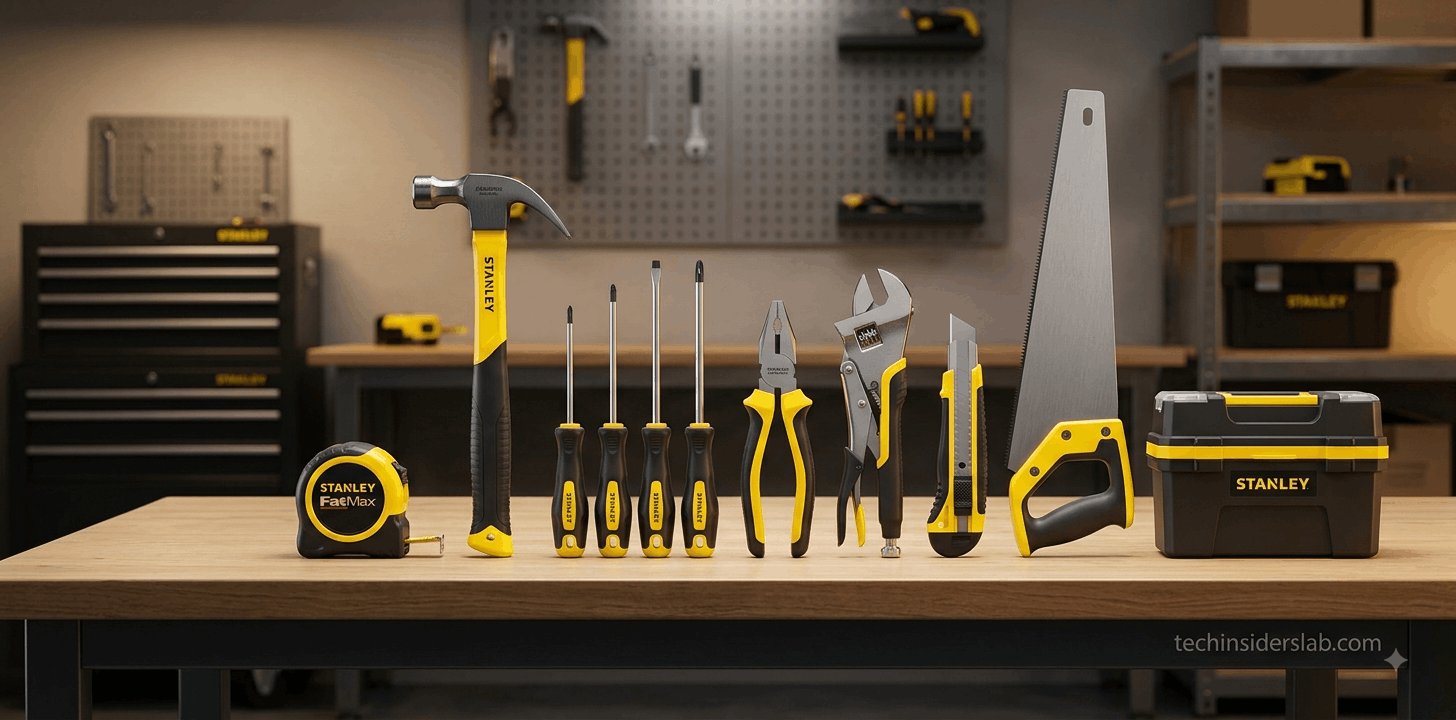
If you are creating a basic home toolkit, useful starting points can include a tape measure, hammer, screwdriver set, pliers, adjustable wrench, utility knife, and handsaw. As projects become more specialized, additional tools such as socket sets, levels, chisels, clamps, and specialty cutting tools can be added.
Conclusion
STANLEY Tools has developed from a historic American tool manufacturer into a broad modern brand serving professionals, tradespeople, DIY enthusiasts, and homeowners. With its roots dating back to 1843, the company has spent generations developing products for measuring, cutting, fastening, woodworking, construction, maintenance, and repair.
Today, STANLEY hand tools remain one of the brand’s most important categories, with an extensive selection covering tape measures, knives, hammers, saws, screwdrivers, pliers, wrenches, sockets, chisels, layout tools, and more.
For users looking for reliable tools, the key is to choose products according to the job rather than simply buying the largest or most expensive set. STANLEY’s broad portfolio makes it possible to start with essential tools and expand a collection as requirements grow. For demanding professional applications, the STANLEY FATMAX range provides another option focused on higher-level performance and professional use.
Whether you are measuring timber, cutting materials, assembling furniture, repairing a vehicle, renovating a room, or working on a construction project, choosing the right STANLEY tool can help you approach the job with greater confidence and organization.