Language Translator: Complete Guide to Modern Translation Tools
introduction
In today’s connected world, language should not be a barrier to communication. People regularly interact with websites, apps, businesses, documents, and individuals from different countries. A Language Translator makes these interactions easier by converting text from one language into another.
Modern translation tools have evolved far beyond simple word replacement. Many can understand complete sentences, recognize context, translate conversations, and even work with images or spoken language. Whether you are a student, traveler, professional, content creator, or everyday internet user, a language translator can save time and make communication much easier.
What Is a Language Translator?
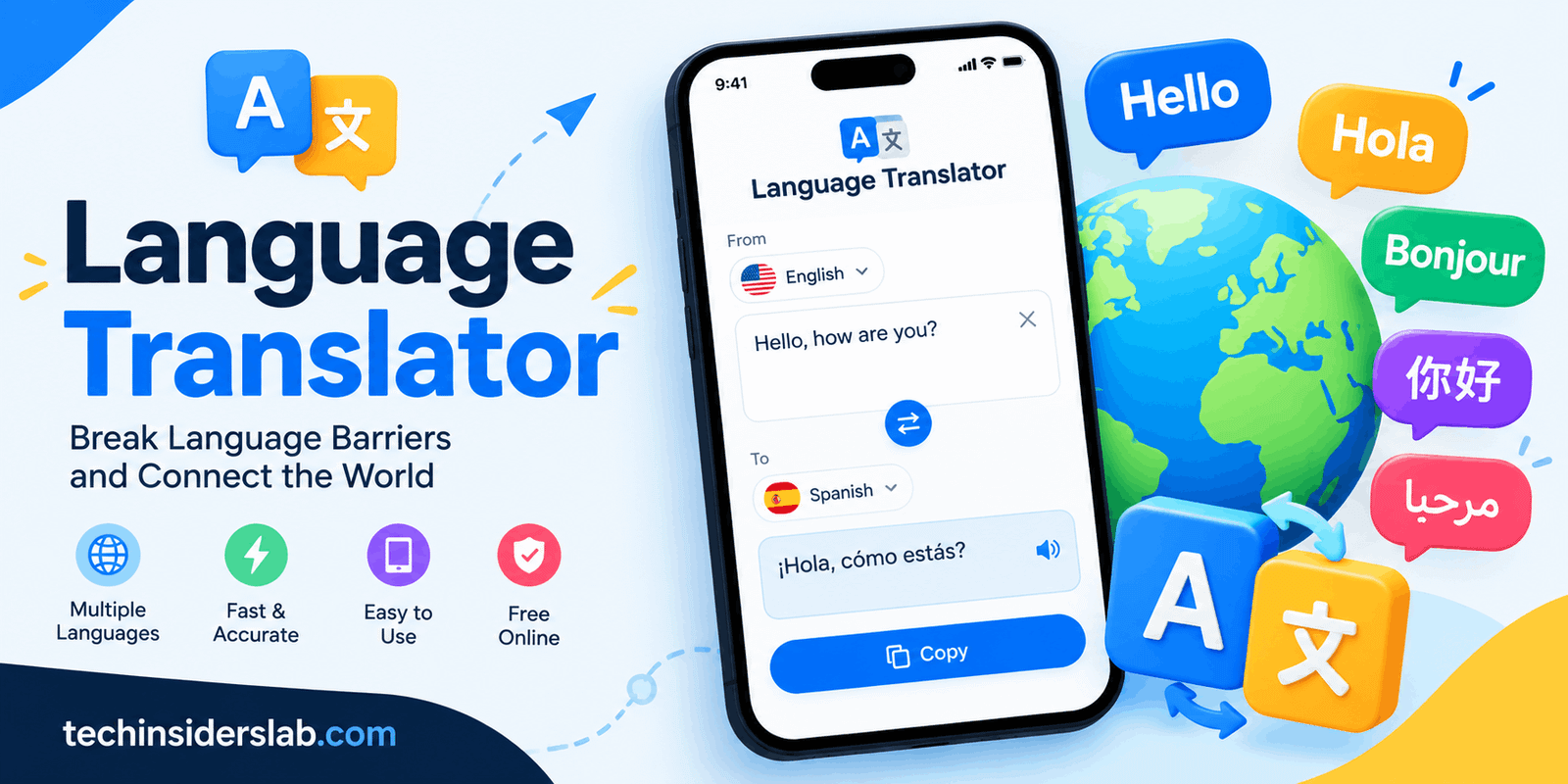
A Language Translator is a digital tool that converts written or spoken content from one language into another. For example, a user can enter an English sentence and translate it into Spanish, French, German, Arabic, Urdu, or many other languages.
Translation tools can be available as websites, mobile applications, desktop programs, browser features, or integrated software. Some are designed for basic everyday translations, while advanced platforms provide features for businesses, developers, documents, websites, and professional communication.
The quality of translation depends on the technology behind the tool. Traditional systems often relied on predefined rules and dictionaries, while modern translators commonly use machine learning and artificial intelligence to understand language patterns and context.
How Does a Language Translator Work?
A modern translator generally follows several steps to produce a translated result.
First, the system receives the user’s input. This could be typed text, speech, an uploaded document, or text detected from an image.
Next, the translation engine analyzes the input. It identifies words, sentence structure, grammar, and relationships between different parts of the sentence.
The system then determines the most appropriate translation in the target language. Advanced AI-powered systems consider context rather than translating every word independently.
Finally, the translated content is presented to the user. Some tools can also provide pronunciation, alternative translations, or audio output.
This process can happen almost instantly, allowing users to communicate across languages without manually searching through dictionaries.
Common Types of Language Translators
Language translators are available in several forms, each designed for different situations.
Text Translators
Text translation is the most common type. Users enter or paste content into a translation box and select the source and target languages.
This option is useful for emails, messages, website content, short documents, instructions, and everyday communication.
Voice Translators
Voice translation tools allow users to speak instead of typing. The system recognizes the spoken language, converts the speech into text, and translates it.
This can be especially useful while traveling or communicating with someone who speaks another language.
Image Translators
Image translation uses optical character recognition and translation technology. Users can take a picture of a sign, menu, document, or printed text, and the tool identifies and translates the visible words.
This feature can be extremely helpful when traveling in countries where unfamiliar languages are commonly used.
Document Translators
Some translation platforms allow users to upload documents. Depending on the tool, supported formats may include text documents, presentations, spreadsheets, or PDFs.
Document translation can help students, businesses, researchers, and organizations understand large amounts of foreign-language content.
Website Translators
Website translation tools can translate web pages into another language. This allows users to access information from international websites without manually copying every paragraph into a translator.
Why Are Language Translators Important?
The internet has made information global. However, language differences can still make that information difficult to access.
A language translator helps reduce this barrier. Students can understand foreign educational resources, travelers can communicate with locals, and businesses can interact with international customers.
For online users, translation tools can also make websites, software interfaces, product descriptions, instructions, and social media content easier to understand.
Translation technology is particularly valuable for people who frequently work across multiple languages.
Benefits of Using a Language Translator
1. Fast Translation
One of the biggest advantages is speed. A translator can process content within seconds, making it much faster than manually searching for individual words.
2. Better Communication
Translation tools make it easier for people who speak different languages to exchange messages and understand each other.
3. Useful for Travel
Travelers can use translation tools to understand signs, menus, directions, transportation information, and basic conversations.
4. Supports Learning
Students learning a new language can use translators to understand unfamiliar vocabulary and compare different sentence structures.
However, translators should support learning rather than completely replace language practice.
5. Easy Access to Global Information
A large amount of online content is published in languages other than English. Translation tools allow users to explore information that might otherwise be difficult to understand.
6. Increased Productivity
Professionals can quickly understand foreign-language emails, reports, messages, and documents. This can reduce the time spent switching between different language resources.
Language Translator for Students
Students can benefit from translation tools in several ways. They can translate unfamiliar words, understand foreign-language articles, and check the general meaning of sentences.
Language translators can also help students compare vocabulary across languages. For example, a student learning Spanish may translate an English sentence into Spanish and then study how the sentence is structured.
However, students should avoid depending completely on automated translations for assignments. Machine-generated translations may sometimes misunderstand context or produce unnatural wording. Learning grammar and vocabulary remains important for developing genuine language skills.
Language Translator for Businesses
Businesses increasingly communicate with international customers, suppliers, partners, and employees.
A language translator can help businesses understand customer messages, translate basic marketing content, communicate through email, and research international markets.
For larger projects, professional human translation may still be necessary. Legal contracts, medical information, technical documentation, and important business materials often require careful review because small translation errors can create significant problems.
AI and the Future of Translation
Artificial intelligence has significantly changed the translation industry.
Older translation systems often struggled with context, idioms, sentence structure, and ambiguous words. AI-based systems can analyze much larger language patterns and generate more natural translations.
Modern AI translation can also consider surrounding sentences instead of treating every sentence as an isolated unit. This helps the system choose translations that better match the meaning of the original content.
Future translation tools may become even more conversational. Instead of simply translating text, they may understand the purpose, tone, and context of a conversation and provide more natural multilingual communication.
Real-time speech translation is another area with significant potential. As speech recognition and AI improve, conversations between people speaking different languages may become increasingly seamless.
Limitations of Language Translators
Although translation technology has improved considerably, it is not perfect.
One major limitation is context. A word can have multiple meanings depending on how it is used. Automated systems may occasionally select an incorrect meaning.
Idioms can also be difficult. Expressions that make sense in one language may sound strange or meaningless when translated literally.
Cultural differences present another challenge. A phrase that is acceptable in one culture may require different wording in another.
Technical, legal, and medical content can also require specialized knowledge. A general translator may produce an understandable result while still missing important technical details.
For these reasons, automated translation is best treated as a helpful tool rather than an unquestionable authority.
How to Choose the Right Language Translator
There are many translation tools available, so users should consider their specific needs before choosing one.
First, check the number of supported languages. If you regularly translate less common languages, make sure the tool supports them.
Next, consider the type of translation you need. Basic text translation may require only a simple tool, while voice, image, document, or website translation may require more advanced features.
Accuracy is another important factor. A useful translator should produce natural sentences and handle context reasonably well.
Users should also consider ease of use, speed, privacy, device compatibility, and available features.
For frequent professional use, additional features such as document support, terminology management, or integration with other applications may be valuable.
Tips for Getting Better Translation Results
Users can improve translation quality by providing clear and complete sentences.
Instead of entering isolated words with multiple possible meanings, provide enough surrounding context whenever possible.
Avoid unnecessary spelling mistakes and unclear abbreviations. Clear input generally produces better output.
For important content, compare the translation with the original text. If the meaning is critical, consider having the result reviewed by someone who understands both languages.
It is also useful to understand that translation and localization are not exactly the same. Translation focuses on converting language, while localization adapts content to the cultural expectations and conventions of a particular audience.
Language Translator vs. Human Translator
Automated translators and human translators serve different purposes.
A machine translator is generally faster, cheaper, and convenient for everyday content. It is ideal when users need to understand the general meaning of something quickly.
A human translator can consider cultural context, tone, audience, industry terminology, and subtle meanings. This makes professional translation particularly valuable for important or sensitive material.
The best choice depends on the situation. For a casual message or travel phrase, an online translator may be more than enough. For a legal agreement, professional publication, or high-value business document, human review can provide additional reliability.
Privacy and Security Considerations
Users should also think about privacy when using online translation services.
Some translation tools process submitted content through cloud-based systems. Therefore, users should avoid entering confidential information unless they understand how the service handles submitted data.
Sensitive business documents, passwords, private communications, financial information, and other confidential material should be handled carefully.
Before using a translation service for important information, users should review its privacy practices and understand how submitted content may be processed or stored.
Conclusion
A Language Translator is an important digital tool for modern communication. It helps users overcome language barriers, understand international information, communicate while traveling, support language learning, and work with people around the world.
Modern translation technology has become much more capable through machine learning and artificial intelligence. Text, voice, images, documents, and websites can now be translated with increasing speed and convenience.
At the same time, automated translation still has limitations. Context, cultural meaning, technical terminology, and complex expressions can sometimes lead to inaccurate or unnatural results.
For everyday communication and quick understanding, a language translator can be extremely useful. For professional or sensitive content, human review remains valuable. Used appropriately, translation technology can make the internet and global communication more accessible to everyone.