introduction
If you are a Pokémon fan, you probably have a few favorite Pokémon that you choose again and again. But what happens when you want something completely unexpected? This is where a Random Pokémon Generator becomes useful.
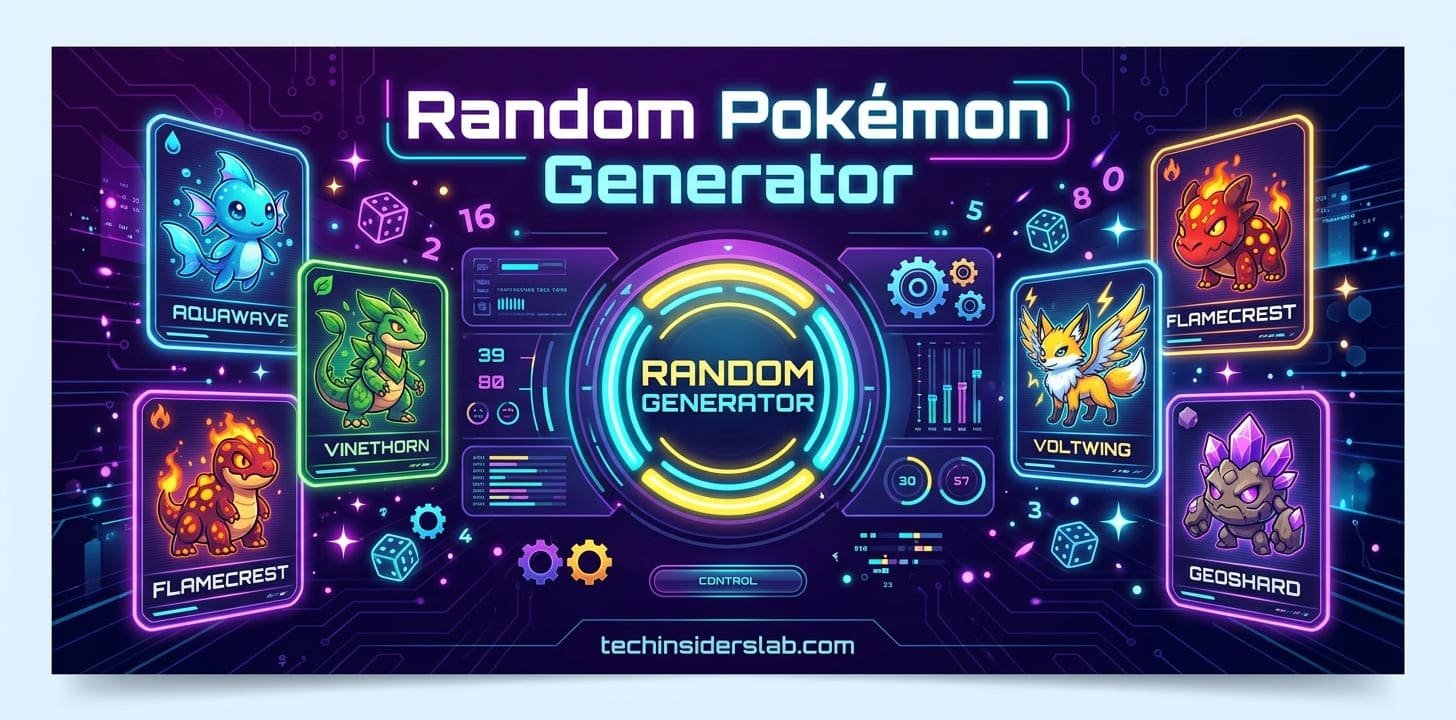
A Random Pokémon Generator is an online tool that randomly selects a Pokémon from a defined Pokémon database. Instead of manually browsing hundreds of Pokémon, users can click a button and instantly receive a surprise selection. Depending on the tool, you may be able to generate one Pokémon, a complete team, or a customized group based on generation, type, evolution stage, rarity, or other characteristics.
Modern generators have become much more than simple randomizers. Some tools cover all nine generations and provide filters, team-building options, Pokémon statistics, nature information, abilities, and other details. Current generator tools commonly work with a pool of up to 1,025 Pokémon, although the exact database and available forms can vary between websites.
What Is a Random Pokémon Generator?
A Random Pokémon Generator is an interactive online tool that chooses Pokémon randomly from a predefined database.
The simplest version works like this:
- Open the generator.
- Select optional settings.
- Click the Generate button.
- Receive a random Pokémon.
- Generate again if you want another result.
For example, a completely random selection could produce Pikachu, Garchomp, Fuecoco, Umbreon, or any other Pokémon included in the generator’s database.
The main attraction is unpredictability. Rather than choosing a Pokémon based on popularity or personal preference, the generator introduces an element of surprise.
More advanced tools can allow users to control the randomization process. Current examples offer filters for generation, type, evolution stage, legendary status, base-stat totals, and the number of Pokémon generated at once.
How Does a Random Pokémon Generator Work?
Behind the simple Generate button is a basic random-selection process.
A generator starts with a database or list of Pokémon. Each entry can contain information such as:
- Pokémon name
- Pokédex number
- Generation
- Type
- Abilities
- Base statistics
- Evolution stage
- Legendary or Mythical classification
- Height and weight
- Other relevant information
The tool then creates a pool of Pokémon that match the user’s selected filters. A random-selection function chooses one or more entries from that pool.
For example, if you choose Fire type, the generator first limits the available pool to Pokémon that meet that condition. It then randomly selects a Pokémon from that smaller group.
Some generators also prevent duplicate results within a single roll, while others may allow them. This is why users should check how a particular generator handles repeated selections.
Why Use a Random Pokémon Generator?
The biggest advantage is simple: it makes Pokémon discovery more exciting.
Many players naturally return to familiar Pokémon. A random generator can introduce you to species that you may have ignored previously.
It can also be useful for:
Pokémon Challenges
Players can use randomly generated Pokémon to create unusual challenges. For example, you could generate a team and attempt to complete a playthrough using only those Pokémon.
Nuzlocke Ideas
Random selections can add another layer of unpredictability to challenge runs. Instead of choosing your preferred Pokémon, you can use a generated selection as the basis for a challenge.
Team Building
A generator can produce six Pokémon and give you the starting point for a new team. Some advanced tools include dedicated team-building features and allow users to lock or save selected Pokémon.
Trivia and Games
Teachers, content creators, streamers, and Pokémon communities can use random selections for quizzes, guessing games, competitions, and discussion topics.
Discovering New Favorites
With more than a thousand Pokémon available across the current National Pokédex, it is easy to overlook less famous species. The official Pokémon Pokédex provides searchable information across the roster, while random generators provide a faster way to make unexpected discoveries.
Random Pokémon Generator vs. Official Pokédex
These two tools serve different purposes.
The official Pokémon Pokédex is designed for searching and exploring Pokémon information. Users can search by name or number and use advanced filters such as type, weakness, ability, height, weight, and number range.
A random generator has a different goal.
Instead of asking, “Which Pokémon am I looking for?” it asks, “Which Pokémon will I get?”
That makes the generator more suitable for:
- Random challenges
- Surprise selections
- Team ideas
- Games
- Content creation
- Casual exploration
The Pokédex is better when you already know what you want to research, while a randomizer is better when you want the tool to make the decision for you.
Important Features to Look For
Not every Random Pokémon Generator offers the same functionality. If you are choosing an online tool, several features can make the experience considerably better.
1. Generation Filters
Generation filters allow users to restrict the random pool.
For example, you might choose:
- Generation 1
- Generation 2
- Generation 3
- Generation 4
- Generation 5
- Generation 6
- Generation 7
- Generation 8
- Generation 9
This is particularly useful when you want a challenge based on a specific era or game generation.
2. Type Filters
Type filtering is another useful feature.
A generator may allow you to select Fire, Water, Grass, Electric, Psychic, Dragon, Ghost, Fairy, or another Pokémon type.
The official Pokédex recognizes 18 Pokémon types and also provides type and weakness search functionality.
A type filter can be useful for creating themed teams or mono-type challenges.
3. Legendary and Mythical Filters
Random results can become dramatically different depending on whether Legendary and Mythical Pokémon are included.
Some generators allow users to exclude these special categories or specifically generate them. Other tools provide additional categories such as Ultra Beasts and Paradox Pokémon.
For a normal playthrough challenge, excluding these categories can create a more balanced selection.
4. Evolution Filters
Evolution-stage filters provide another way to control results.
You may want:
- Unevolved Pokémon
- Middle-stage Pokémon
- Final-stage Pokémon
- Fully evolved Pokémon
This can be especially useful for challenge runs where you want the generated Pokémon to have a particular progression level.
5. Base Stat Filters
Some advanced generators allow users to filter Pokémon according to Base Stat Total (BST).
This gives users more control over the overall power level of the generated pool. For example, someone designing a stronger competitive-style challenge could use a minimum BST rather than accepting every Pokémon equally.
However, BST alone does not determine whether a Pokémon is good in battle. Typing, abilities, movepool, speed, held items, team synergy, and battle format can all matter.
Generating a Full Pokémon Team
One of the most entertaining uses of a random generator is creating a team.
A standard Pokémon team contains six Pokémon, so many generators provide a six-Pokémon option.
A basic process is:
Step 1: Open the generator.
Step 2: Decide whether you want completely random results or filtered results.
Step 3: Choose a team size.
Step 4: Click Generate.
Step 5: Review the Pokémon.
Step 6: Decide whether to keep the team or reroll it.
Some modern tools also let users lock individual Pokémon while regenerating the remaining slots. This is useful when you like part of the generated team but want to replace one or two selections.
Random Pokémon Generator for Nuzlocke Challenges
Nuzlocke players can use random generators to create additional rules or challenge concepts.
For example, you could randomly generate a Pokémon before starting a run and make it your required team member. Another approach is generating several Pokémon and choosing one according to a predetermined rule.
The important point is that the generator does not replace the game’s own mechanics. It simply creates an additional layer of randomness.
Players should always establish their rules before beginning a challenge so that rerolling does not become a way of avoiding difficult results.
Using Random Pokémon for Content Creation
Random generators can also be useful for YouTubers, streamers, bloggers, and social-media creators.
A simple video concept could be:
“I Built a Pokémon Team Using a Random Generator.”
Other possibilities include:
- Random Pokémon battles
- Guess the Pokémon challenges
- Random starter challenges
- Random type challenges
- Generate a Pokémon and rate it
- Build a team from random generations
- Random legendary selection
- Viewer-controlled random teams
Because the result is unpredictable, the generator can create natural suspense.
Some current tools also provide shareable results or card-style outputs, which can make generated Pokémon easier to post on social media.
Randomness Does Not Always Mean Equal Results
An important concept is that “random” depends on how the generator is programmed.
If a tool contains 1,025 Pokémon and selects one uniformly from that pool, each entry has the same probability of being selected during a single unrestricted draw.
However, once filters are applied, the probability changes because the available pool becomes smaller.
For example, if only Fire-type Pokémon are selected, non-Fire Pokémon are removed from the pool.
Some generators may also use weighted systems for special categories, shiny results, or other features. Therefore, users should not assume that every online generator uses exactly the same randomization method.
A well-designed tool should clearly explain its selection rules when those details matter.
Are Random Pokémon Generators Free?
Many online Random Pokémon Generators are available for free.
Current examples advertise free access, while features can vary significantly from one site to another. Some offer basic one-click generation, while others include advanced filters, team builders, detailed Pokémon information, or sharing tools.
Before using any online tool, it is still sensible to check the site’s privacy policy and understand whether it requires registration or collects information.
For a simple random selection, you generally should not need to provide sensitive personal information.
Benefits of Using a Random Pokémon Generator
A good generator provides several advantages:
Fast: You can receive a result in seconds.
Simple: No complicated Pokémon knowledge is required.
Creative: Random results can inspire new teams and challenges.
Flexible: Filters allow users to control the selection pool.
Educational: Exploring random Pokémon can encourage users to learn about types, abilities, stats, and evolution.
Fun: The surprise factor makes even familiar Pokémon more interesting.
Useful for content: Random results can become the foundation of videos, posts, quizzes, or community challenges.
Things to Keep in Mind
Although these tools are simple, users should understand a few limitations.
First, different generators may have different databases. One tool may include regional forms or special categories, while another may focus only on species.
Second, Pokémon data can change or be updated as new games and official information become available. This means an older generator may not reflect the latest Pokédex.
Third, “random” does not automatically mean “competitive.” A random team may contain Pokémon with overlapping weaknesses or poor synergy. That is part of the fun, especially for casual challenges.
Finally, users should distinguish between a fan-made generator and official Pokémon services. A randomizer is generally a third-party tool rather than the official Pokémon Pokédex.
How to Choose a Good Random Pokémon Generator
When selecting a generator, look for these qualities:
- A clearly explained Pokémon database
- Recent updates
- Simple interface
- Mobile-friendly design
- Generation filters
- Type filters
- Legendary/Mythical controls
- Team generation
- No unnecessary registration
- Useful Pokémon information
- Clear privacy practices
- No excessive intrusive advertising
Advanced users may also appreciate BST filtering, evolution filters, nature options, abilities, team analysis, favorites, and sharing features. Current tools demonstrate that the category has evolved from a basic “spin the wheel” concept into much more sophisticated Pokémon utilities.
Conclusion
A Random Pokémon Generator is a simple and entertaining online tool that makes Pokémon discovery more exciting. Whether you want to generate a single Pokémon, build a random team, create a challenge, or find a Pokémon you have never used before, these generators provide a quick and creative solution. With useful filters for generations, types, evolution stages, and special categories, users can customize their experience while still keeping the element of surprise.
For TechInsidersLab, Tools is the most suitable category for this keyword because a Random Pokémon Generator is primarily an interactive online utility.