
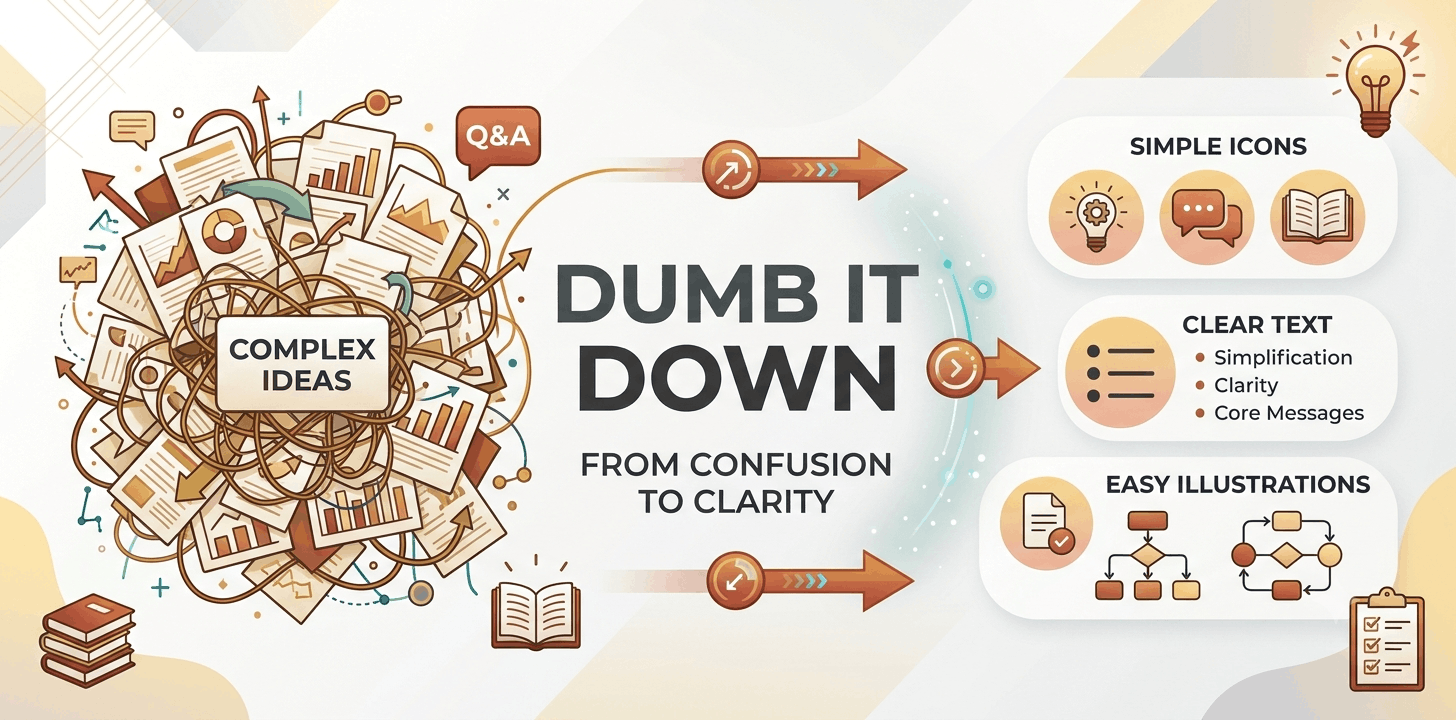
Dumb It Down: Meaning, Origin, Examples, and When to Use It
Introduction
Have you ever asked someone to explain something in simpler words? That’s exactly what “dumb it down” means. It refers to making information easier to understand by using simple language, avoiding jargon, and breaking complex ideas into smaller steps.
Although the phrase is common in everyday English, some people consider it insensitive because it may imply that the listener lacks intelligence. In this guide, you’ll learn its meaning, origin, examples, alternatives, and when to use—or avoid—it.
What Does “Dumb It Down” Mean?
Dumb it down means to simplify information so it’s easier for others to understand.
This usually involves:
- Using simple vocabulary
- Avoiding technical jargon
- Breaking ideas into smaller steps
- Giving practical examples
Simple Definition:
To make information easier to understand by reducing unnecessary complexity.
Origin of the Phrase
The expression became popular in the late 20th century. Originally, the word “dumb” meant unable to speak, but over time it also came to mean unintelligent in informal English. Because of this, many people now prefer neutral alternatives like “simplify” or “explain in plain language.”
Why Do People Say “Dumb It Down”?
People use this phrase whenever they need a simpler explanation.
Common situations include:
- Education: Teachers simplify difficult concepts for students.
- Business: Professionals explain technical topics to clients.
- Marketing: Companies use clear language to reach more customers.
- Public Speaking: Speakers avoid complex terms to keep audiences engaged.
Is “Dumb It Down” Offensive?
It depends on the context.
Some people see it as a harmless expression, while others find it disrespectful because it can suggest the audience isn’t smart.
Safer alternatives include:
- Simplify the explanation
- Explain it simply
- Use plain language
- Break it down
- Clarify the information
When Should You Use It?
The phrase is acceptable in casual conversations, for example:
- “Can you dumb it down a little? I’m new to this.”
- “Let’s dumb it down for beginners.”
In professional writing or presentations, it’s usually better to say “simplify” or “explain clearly.”
Everyday Examples
- “Could you dumb it down for me? I’m still learning.”
- “The teacher explained the lesson in simpler terms.”
- “The company rewrote the guide using plain language.”
- “The doctor avoided medical jargon while explaining the diagnosis.”
Dumb It Down vs. Simplify
| Dumb It Down | Simplify |
|---|---|
| Informal | Professional |
| May sound negative | Neutral |
| Focuses on reducing complexity | Focuses on clarity |
| Can imply oversimplification | Widely accepted |
Common Alternatives
Instead of saying “dumb it down,” try:
- Simplify
- Clarify
- Break it down
- Explain clearly
- Use plain language
- Make it beginner-friendly
- Explain step by step
Tips for Clear Communication
To explain complex ideas effectively:
- Know your audience.
- Avoid unnecessary jargon.
- Use real-life examples.
- Present information step by step.
- Encourage questions.
Using “Dumb It Down” in Different Contexts
The meaning of “dumb it down” stays the same in most situations—making information easier to understand. However, whether the phrase is appropriate depends on your audience.
In Education
Teachers simplify difficult subjects to help students build a strong foundation before moving to advanced concepts. Good teaching doesn’t remove important information; it presents it in a clear and logical way.
For example, a science teacher might explain gravity with everyday examples before introducing formulas.
In Business Communication
Businesses often communicate with customers, employees, and partners who have different levels of knowledge. Using too much technical language can create confusion.
To improve clarity, professionals often:
- Use short sentences
- Explain technical terms
- Organize content with headings
- Focus on the reader’s needs
In Marketing
Marketing works best when messages are simple and direct. Customers want to know:
- What does the product do?
- How does it help?
- Why should I choose it?
Instead of using complicated industry jargon, successful marketers explain benefits in plain language that anyone can understand.
In Technical Writing
Technical writers simplify complex instructions without sacrificing accuracy. User manuals, help guides, and software documentation become more useful when they:
- Use clear language
- Define technical terms
- Include step-by-step instructions
- Avoid unnecessary complexity
Why Simple Communication Works
Simple communication helps people understand information faster and remember it longer. It also reduces confusion and encourages action.
Benefits include:
- Better understanding
- Improved memory
- Fewer misunderstandings
- Higher engagement
- Greater trust
That’s why plain language is widely used in education, healthcare, customer service, and digital marketing.
Common Misconceptions
Myth 1: It Means Removing Important Information
Not true. Good simplification keeps the key ideas while making them easier to understand.
Myth 2: Simple Language Sounds Unprofessional
In reality, many skilled writers and speakers intentionally use simple language because it communicates ideas more effectively.
Myth 3: Experts Should Always Use Technical Terms
Experts should adjust their language to match their audience. A customer guide, classroom lesson, and research paper all require different levels of detail.
Better Alternatives to “Dumb It Down”
Since some people consider the phrase insensitive, these alternatives are often a better choice:
- Simplify
- Clarify
- Break it down
- Explain in plain language
- Explain step by step
- Use simpler words
- Make it beginner-friendly
- Start with the basics
These phrases express the same idea while sounding more respectful and professional.
Tips for Explaining Complex Ideas
To communicate clearly:
- Start with the main idea before discussing details.
- Use familiar examples that people can relate to.
- Avoid unnecessary jargon.
- Organize information with headings and short paragraphs.
- Ask for questions or feedback to check understanding.
Common Mistakes to Avoid
When simplifying information, avoid these errors:
- Oversimplifying: Removing too much detail can make information inaccurate.
- Assuming prior knowledge: Don’t expect everyone to understand technical terms.
- Using excessive jargon: Explain specialized words whenever possible.
- Ignoring your audience: Tailor your explanation to the listener’s knowledge level.
- Sounding condescending: Simplifying information should never make people feel less intelligent.
Conclusion
The phrase “dumb it down” simply means making information easier to understand by reducing unnecessary complexity. While it’s commonly used in everyday conversations, it can sometimes sound insensitive because of the word “dumb.” In professional, academic, or customer-facing communication, it’s usually better to use alternatives like “simplify,” “clarify,” or “use plain language.”
Clear communication isn’t about removing important details—it’s about presenting ideas in a way that’s easy for your audience to understand. Whether you’re teaching, writing, marketing, or explaining technical concepts, using simple language helps improve understanding, build trust, and keep people engaged. By focusing on clarity instead of complexity, you can communicate more effectively and ensure your message reaches everyone
Frequently Asked Questions (FAQs)
It means making information easier to understand by using simpler language or reducing unnecessary complexity.
It can be, depending on the audience. Many people prefer neutral alternatives like “simplify” or “explain clearly.”
Yes. It’s common in everyday conversations, education, business, and the media
Words like simplify, clarify, break it down, and use plain language are more suitable for professional settings.
No. Good explanations remain accurate while becoming easier to understand.
Plain language improves understanding, reduces confusion, and helps people make informed decisions.
Yes. Effective teaching often starts with simple explanations before introducing advanced concepts.
Not exactly. “Break it down” focuses on explaining something step by step, while “dumb it down” may suggest reducing complexity more broadly.