introduction
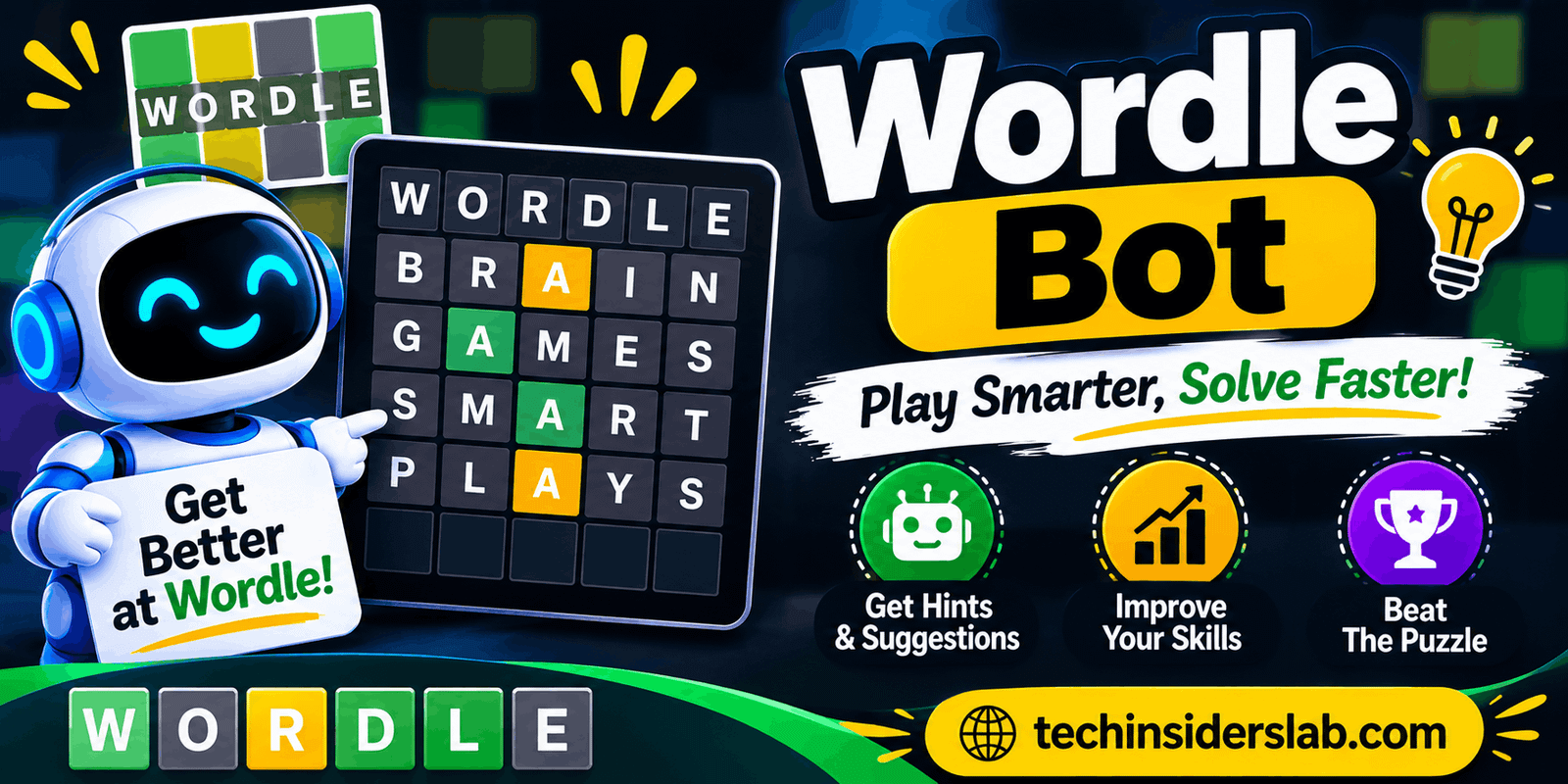
Wordle Bot is a useful digital assistant for players who want to improve their Wordle skills, understand word patterns, and make smarter guesses. Instead of relying entirely on random attempts, players can use a Wordle bot to analyze possible answers, evaluate their guesses, and learn strategies that make solving word puzzles easier.
Whether you are a beginner trying to understand Wordle or an experienced player aiming to improve your daily results, Wordle Bot can provide valuable assistance. It combines word knowledge, logical thinking, and pattern analysis to help players make better decisions.
In this guide, we will explore what Wordle Bot is, how it works, its main features, benefits, limitations, and how players can use it effectively.
What Is Wordle Bot?
Wordle Bot is a digital assistant designed to help users analyze and solve Wordle puzzles. It uses word patterns, letter positions, and possible word combinations to suggest better guesses. Depending on the tool, it may recommend suitable starting words, identify potential answers, and explain why one guess is more effective than another.
The term Wordle Bot can refer to different automated Wordle-solving tools. One particularly well-known example is the WordleBot feature from The New York Times. It reviews a player’s completed game and evaluates the guesses based on factors such as information gained, remaining possibilities, and solving efficiency.
Unlike a regular Wordle game, which requires players to make decisions independently, a Wordle bot provides additional guidance. It helps users understand the reasoning behind each guess rather than simply choosing words without a clear strategy.
Wordle bots are especially useful for people who enjoy word games but want to develop stronger vocabulary and problem-solving skills.
How Does Wordle Bot Work?
Wordle Bot generally works by analyzing the information available after each guess. In Wordle, players have six attempts to discover a hidden five-letter word. After entering a guess, the game provides colored feedback that shows which letters are correct and where they belong.
A bot uses this feedback to narrow down the possible answers.
For example:
- Green: The letter is correct and in the right position.
- Yellow: The letter appears in the answer but is in a different position.
- Gray: The letter does not appear in the answer, subject to Wordle’s repeated-letter rules.
Once this information is available, the bot evaluates the remaining possibilities and recommends another guess.
Its basic process involves several steps:
- Analyzing the Guess: It examines the letters entered by the player.
- Reading Feedback: It interprets the green, yellow, and gray results.
- Removing Impossible Words: It eliminates words that do not match the available clues.
- Evaluating Remaining Options: It compares possible words and their usefulness.
- Recommending a Guess: It suggests a word that can help identify the answer.
Some advanced bots also use probability, letter frequency, and information theory to determine which guess is likely to provide the most useful information.
This approach turns Wordle into a logical challenge rather than a guessing competition.
Key Features of Wordle Bot
Wordle bots offer different features depending on the platform. However, most useful tools focus on improving guessing accuracy and helping players understand word patterns.
1. Smart Word Suggestions
One of the most valuable features is intelligent word suggestions. Instead of selecting a random five-letter word, users can receive recommendations based on the clues already discovered.
A good suggestion considers both possible answers and the information a guess could reveal. Sometimes, the best guess is not necessarily the word most likely to be the answer. It may be a word that tests several useful letters at once.
2. Letter Pattern Analysis
Wordle bots analyze letter positions to identify possible word structures. If a player discovers that the first letter is green and the final letter is yellow, the tool can use those clues to narrow down the search.
This feature is helpful when several possible answers share similar letters.
3. Possible Answer Identification
As players receive feedback, the number of possible answers becomes smaller. A bot can compare the remaining clues against a word list and identify words that match the known pattern.
This saves time and makes difficult puzzles easier to approach.
4. Starting Word Recommendations
The first guess can have a major impact on the rest of a Wordle game. A Wordle bot may recommend starting words that contain common letters and useful vowel combinations.
Words such as SLATE, CRANE, and TRACE are popular examples of strategic starting choices.
The goal is to discover useful letters early rather than immediately guessing an answer without enough information.
5. Guess Evaluation
Some Wordle bots, particularly NYT WordleBot, evaluate guesses after a game is completed. They can help players understand whether a particular choice was efficient or whether another word could have reduced the remaining possibilities.
This makes the tool useful for learning, not just solving.
6. Performance Analysis
Depending on the platform, players may receive information about their guessing performance, including the number of attempts used and the quality of their decisions.
These insights can help users recognize repeated mistakes and develop better strategies over time.
How to Use Wordle Bot Effectively
Using a Wordle bot is relatively simple, but getting the best results requires understanding how its recommendations work.
Here is a practical approach:
Step 1: Start With a Strong Word
Choose a five-letter word containing common letters. A balanced opening guess can reveal useful information about vowels and consonants.
Step 2: Enter Your Guess
Play the Wordle puzzle and enter your selected word. Observe the color feedback carefully before making another attempt.
Step 3: Analyze the Results
If you are using an independent Wordle solver, enter the guessed word and its corresponding color pattern. The tool can use these clues to identify possible solutions.
Step 4: Review Suggested Words
Look at the recommended guesses and consider which one provides the most useful information. Avoid choosing a word simply because it looks familiar.
Step 5: Make Your Next Guess
Use the available clues to select another word. Continue eliminating unlikely possibilities until you discover the correct answer.
Step 6: Review Your Performance
After completing the puzzle, use NYT WordleBot, where available, to review your decisions and understand whether your guesses were efficient.
One important distinction is that the official NYT WordleBot primarily analyzes completed games rather than functioning as a live answer generator. Independent Wordle-solving bots may offer real-time suggestions.
Understanding WordleBot’s Skill and Luck Scores
One interesting aspect of the official WordleBot is its ability to evaluate both skill and luck. These measurements help players understand why a particular game was easy or difficult.
Skill Score
The skill score measures how effectively a player uses available information. It considers whether a guess reduces the number of possible answers efficiently.
For example, imagine that your first guess identifies two correct letters but leaves many possible solutions. Another guess might reveal fewer correct letters but eliminate a much larger number of possibilities.
The second guess could be strategically better because it provides more useful information.
Luck Score
Luck measures how favorable the results of your guesses were compared with what could reasonably have been expected.
Sometimes, a player discovers the correct letters early because the chosen word happens to match the hidden answer. This can make the puzzle easier even if the original guess was not particularly strategic.
A lucky result does not necessarily mean that someone has excellent Wordle skills. Similarly, an unlucky result does not automatically indicate poor decision-making.
Steps or Number of Guesses
The number of steps represents how many attempts were needed to solve the puzzle.
Players generally want to complete Wordle in fewer attempts, but the number of guesses does not tell the entire story. A player might solve a puzzle in three guesses through favorable luck, while another might demonstrate more consistent decision-making despite needing four guesses.
Looking at all three measurements provides a more complete understanding of performance.
Best Strategies for Improving Your Wordle Results
A Wordle bot becomes more useful when players combine its analysis with practical guessing strategies.
Here are some approaches worth developing.
Choose Words With Common Letters
Some letters appear more frequently in English words than others. Starting with words containing common letters can help reveal useful patterns.
Letters such as E, A, R, O, T, and S are often valuable when exploring possible answers.
However, letter frequency should not be the only consideration. The position of each letter also matters.
Avoid Repeating Incorrect Letters
If the game confirms that a letter does not appear in the answer, avoid using it again unless repeated-letter feedback creates a specific reason to reconsider its presence.
This allows players to focus on unexplored letters and make more informative guesses.
Pay Attention to Letter Positions
Finding the correct letter is only part of the challenge. Players must also determine its correct position.
For example, if the letter A appears yellow in the second position, it must be placed somewhere else in the answer.
A Wordle bot can help track these restrictions and prevent unnecessary guesses.
Understand Repeated Letters
Repeated letters can make some puzzles particularly confusing. A word might contain two identical letters, even when the first attempt only reveals one of them.
Players should carefully examine the color feedback rather than assuming that every gray tile means the letter is completely absent.
Use Hard Mode Carefully
Hard Mode requires players to use previously revealed green and yellow letters in subsequent guesses.
This can encourage disciplined thinking, but it can also limit opportunities to test other letters.
A strategic player should understand the difference between discovering new information and following already established clues.
Learn From Previous Games
Reviewing completed puzzles is one of the best ways to improve. Pay attention to situations where you selected a word that provided little information or ignored an obvious letter pattern.
Over time, recognizing these mistakes can make your decisions more efficient.
Benefits of Using Wordle Bot
Wordle bots offer several advantages for casual players and dedicated puzzle enthusiasts.
1. Better Decision-Making: They help players choose guesses based on available information instead of relying entirely on intuition.
2. Vocabulary Development: Exploring possible five-letter words introduces players to unfamiliar vocabulary and different spelling patterns.
3. Time Savings: Automated analysis can quickly eliminate impossible answers and narrow down potential solutions.
4. Improved Logical Thinking: Players learn to compare possibilities, recognize patterns, and make decisions using limited information.
5. Performance Tracking: Some tools provide detailed feedback that helps users understand their strengths and weaknesses.
6. Learning Opportunities: Instead of simply revealing an answer, analytical bots can explain why one guess was more effective than another.
7. More Enjoyable Gameplay: Players who occasionally struggle with difficult puzzles can use these tools to understand the game without losing interest.
Wordle Bot vs. Playing Wordle Without Assistance
Both approaches offer different experiences. Playing independently encourages personal problem-solving, while using a bot provides additional analytical support.
| Feature | With Wordle Bot | Without a Bot |
| Word suggestions | Available in solver tools | Personal choice |
| Guess analysis | Automated feedback | Manual evaluation |
| Possible answers | Can be narrowed automatically | Requires independent thinking |
| Learning support | Detailed explanations on supported tools | Experience-based learning |
| Convenience | More analytical assistance | Simple gameplay |
| Challenge | Depends on how much help is used | Full independent challenge |
Neither approach is necessarily better for everyone. Players who enjoy solving puzzles independently may prefer the original experience, while those interested in improving their strategies can benefit from automated analysis.
Is Wordle Bot Free to Use?
The cost depends on which Wordle bot you choose.
The original Wordle game from The New York Times is available to play without purchasing a Games subscription. However, access to official WordleBot analysis has subscription requirements that can vary by account and subscription offering.
Third-party Wordle solvers and independent bots may offer free features, while some provide additional tools or services through paid plans.
Before using a service, check its current pricing, features, and access requirements. Do not assume that every tool using the WordleBot name is officially connected to The New York Times.
Limitations of Wordle Bot
Although Wordle bots are useful, they are not perfect solutions for every player.
Dependence on Automated Suggestions: Relying too heavily on recommended words can reduce the opportunity to develop independent problem-solving skills.
Different Word Lists: Not every solver uses exactly the same collection of acceptable guesses and possible answers. This can affect its recommendations.
Limited Learning Without Practice: Reading suggestions is not enough to develop strong puzzle-solving abilities. Players still need to understand why a particular guess works.
Subscription Restrictions: Some official analysis features may require a paid subscription.
No Guaranteed Perfect Experience: A recommendation can be mathematically useful without being the most intuitive choice for a human player.
Repeated-Letter Confusion: Puzzles involving repeated letters can be challenging, especially when players misunderstand how the game’s color feedback works.
Understanding these limitations helps users treat Wordle Bot as a learning assistant rather than an infallible answer machine.
Who Should Use Wordle Bot?
Wordle Bot can be useful for different types of users:
- Beginners: People learning Wordle rules and understanding letter combinations.
- Daily Wordle Players: Users who want to improve their daily puzzle-solving performance.
- Word Game Enthusiasts: People who enjoy challenging themselves with vocabulary games.
- Students: Learners interested in spelling, vocabulary, and logical reasoning.
- Competitive Players: Users who want to compare their strategies and improve their solving efficiency.
It is particularly helpful for players who want to understand the reasoning behind successful guesses instead of depending on random word selection.
Conclusion
Wordle Bot is a helpful tool for anyone interested in improving their Wordle experience. By analyzing guesses, identifying letter patterns, evaluating possible solutions, and providing performance feedback, it makes word puzzles more educational and strategic. Its skill and luck analysis can help players understand their mistakes and develop better guessing habits. Although it should not replace independent thinking, Wordle Bot can be an excellent learning companion for beginners and experienced players alike. Whether your goal is to solve puzzles in fewer attempts or simply enjoy learning new strategies, this tool offers a practical way to make your daily Wordle sessions more engaging.