DALL·E: A Complete Guide to AI Image Generation
introduction
Artificial intelligence has changed the way people create, design, and communicate visual ideas. Instead of spending hours learning complex design software, users can now describe an idea in natural language and let an AI system turn that description into an image. One of the names that played a major role in making this technology popular is DALL·E.
DALL·E is an AI image-generation technology developed by OpenAI. It was designed to understand text descriptions and generate original images based on those instructions. Over time, the DALL·E family evolved considerably, with DALL·E 3 becoming particularly well known for its ability to understand detailed prompts and produce more accurate visual results.
Today, the broader AI image-generation landscape has moved forward, and OpenAI has introduced newer image-generation systems. However, understanding DALL·E remains useful because it represents an important stage in the development of modern generative AI.
What Is DALL·E?
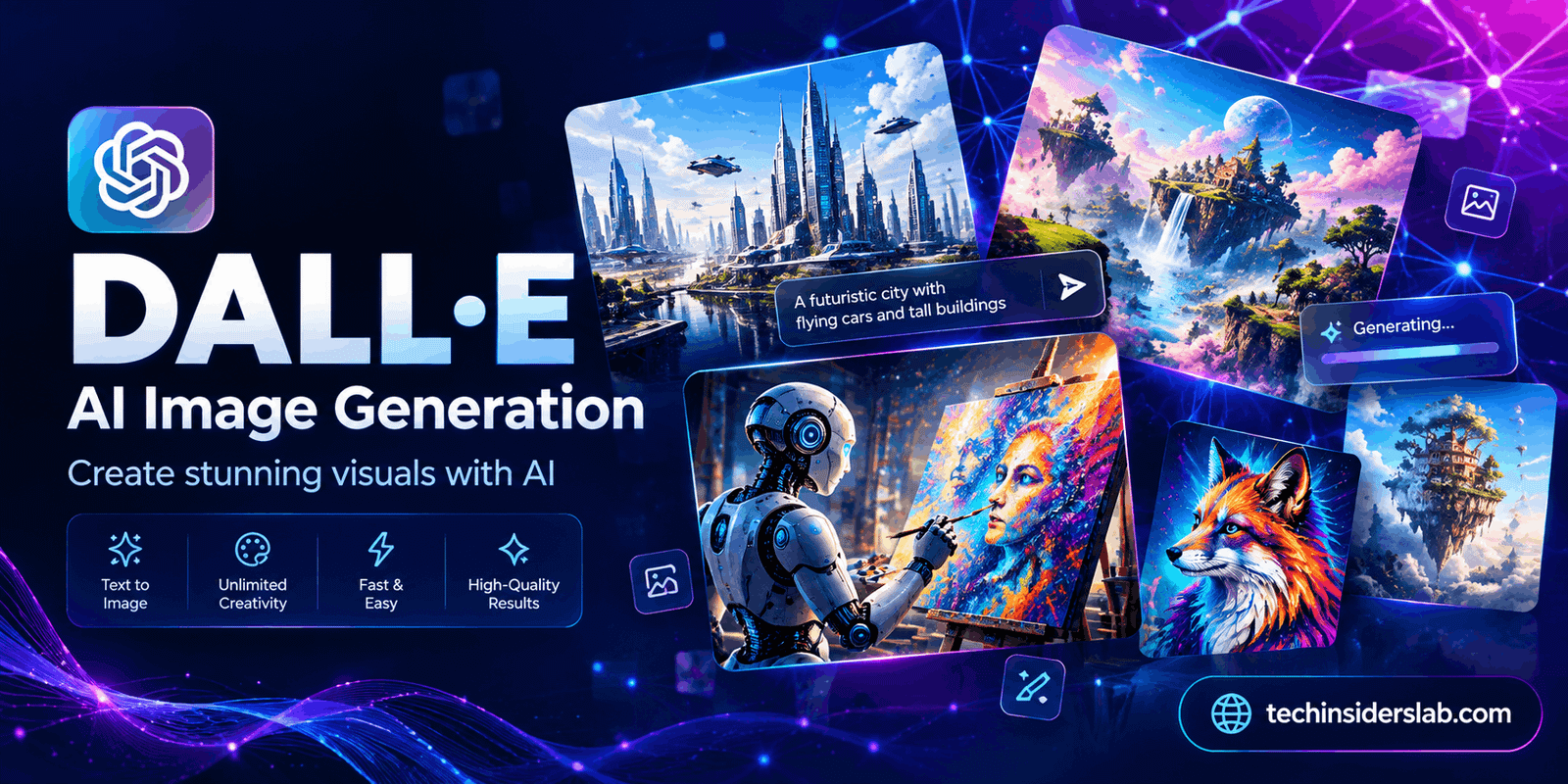
DALL·E is a generative AI system that creates images from written descriptions. A user can describe an object, environment, character, illustration, or visual concept, and the model attempts to produce an image matching that description.
For example, someone could describe a futuristic city at night with glowing buildings, flying vehicles, and rain-covered streets. Rather than manually drawing each element, an AI image generator can interpret the description and produce a visual representation.
The name DALL·E combines references to the artist Salvador Dalí and the animated character WALL·E. The project became notable because it demonstrated how language and visual generation could be connected.
OpenAI’s early DALL·E research showed that the system could generate images from text descriptions, combine unrelated concepts, create variations, render text, and transform portions of existing images.
How Does DALL·E Work?
At a basic level, DALL·E works by interpreting the relationship between language and visual concepts.
A user provides a prompt such as:
“A small wooden cabin beside a frozen lake surrounded by snowy mountains at sunrise.”
The AI analyzes the important concepts in the sentence, including the cabin, frozen lake, mountains, snow, and sunrise. It then generates an image intended to represent those concepts together.
Modern image-generation systems are significantly more sophisticated than simply searching for existing pictures. They generate new visual content based on patterns learned during training.
DALL·E 3 introduced major improvements in understanding detailed prompts. OpenAI explained that it was designed to pay closer attention to user-provided descriptions, allowing users to communicate ideas in ordinary language rather than relying entirely on complicated prompt-engineering techniques.
DALL·E 2 vs. DALL·E 3
The development from DALL·E to DALL·E 2 and eventually DALL·E 3 represented important improvements in AI image generation.
Earlier versions demonstrated that text could be used to create surprisingly diverse images. DALL·E 2 improved image quality and realism, while DALL·E 3 focused heavily on understanding the details contained in prompts.
DALL·E 3 was particularly recognized for better handling of complex descriptions, improved visual details, and stronger prompt adherence. OpenAI also highlighted improvements involving text, hands, faces, and different image orientations.
This evolution helped establish an important idea: AI image generation was becoming less about knowing special commands and more about communicating an idea clearly.
Main Features of DALL·E
1. Text-to-Image Generation
The most important capability of DALL·E is turning written descriptions into images.
This makes the technology useful for people who have creative ideas but may not have professional illustration skills.
A writer can describe a fictional setting, a marketer can describe an advertising concept, and a student can visualize an educational topic.
2. Detailed Prompt Understanding
DALL·E 3 was designed to understand more detailed and nuanced prompts than earlier systems.
Instead of saying only “a dog,” users could describe the breed, environment, lighting, composition, mood, and artistic characteristics.
This makes the process feel more like communicating with a creative assistant.
3. Different Visual Styles
AI image generators can create images in many different visual approaches, including illustrations, realistic scenes, conceptual artwork, cartoons, posters, and imaginative environments.
This flexibility is one reason generative image tools became popular among designers, marketers, content creators, and hobbyists.
4. Text in Images
Generating readable text inside images has historically been difficult for AI image systems. DALL·E 3 made improvements in this area and was specifically noted by OpenAI for its ability to render text more effectively.
However, AI-generated text should still be checked carefully because image models can make spelling or layout mistakes.
5. Creative Ideation
DALL·E is not only useful for producing a final image. It can also help users explore ideas.
For example, a designer who is unsure about a poster concept can generate several visual directions before choosing one. This makes AI useful during the brainstorming stage as well as the production stage.
How to Write Better DALL·E Prompts
The quality of an AI-generated image often depends on how clearly the user communicates the desired result.
A useful prompt can describe several elements:
- Main subject
- Environment
- Lighting
- Camera angle
- Mood
- Composition
- Colors
- Visual style
- Important objects
- Image orientation
For example, instead of writing:
“A futuristic car.”
a more descriptive prompt could be:
“A sleek futuristic electric sports car driving through a modern city at night, glowing skyscrapers in the background, wet streets reflecting neon lights, cinematic lighting, wide composition.”
The second description gives the model considerably more visual information.
One of the major ideas behind DALL·E 3 was reducing the need for users to master complicated prompt-engineering techniques. OpenAI integrated DALL·E 3 with ChatGPT so that ChatGPT could help turn simple ideas into more detailed prompts.
Who Can Use DALL·E?
AI image generation can be useful for many different types of users.
Bloggers and Website Owners
Website owners can use AI-generated visuals for blog headers, featured images, illustrations, social media graphics, and explanatory content.
For a technology website, for example, an AI image generator can help create custom graphics for articles about artificial intelligence, software, cybersecurity, apps, and emerging technologies.
Graphic Designers
DALL·E can be used during the concept stage of a design project. Designers can experiment with compositions and visual directions before creating polished final artwork.
Marketers
Marketing teams can use generative AI to brainstorm advertisements, campaign concepts, social posts, and visual themes.
Students and Teachers
Educational users can create visual representations of historical scenes, scientific concepts, fictional environments, or classroom examples.
Social Media Creators
Creators can use AI-generated images for thumbnails, posts, Pinterest graphics, backgrounds, and creative experiments.
Benefits of DALL·E
One of DALL·E’s biggest advantages is accessibility.
Traditional digital illustration can require significant technical knowledge. AI image generation allows users to start with a simple written description.
Another benefit is speed. Generating an initial visual concept can be much faster than creating everything manually.
DALL·E also encourages experimentation. Users can try unusual combinations that would take significant effort to illustrate traditionally.
The technology can therefore function as a creative assistant rather than simply replacing traditional design tools.
Limitations of DALL·E
Despite its capabilities, AI image generation is not perfect.
One common limitation is inconsistency. An image may look excellent overall while containing small mistakes in objects, proportions, anatomy, or environmental details.
Text can also remain challenging. OpenAI’s DALL·E 3 research documentation notes that although the model can generate text, rendering can still be unreliable in some situations.
Another limitation involves precise control. A professional designer may require exact positioning, measurements, branding, typography, and layout. An AI model may not always provide that level of deterministic control.
For professional work, AI-generated imagery may therefore be most useful as a starting point, concept generator, or supporting design element.
DALL·E and Copyright Considerations
AI-generated content creates important questions about ownership, copyright, and responsible use.
OpenAI’s DALL·E 3 page stated that users could use images they created with DALL·E without needing OpenAI’s permission to reprint, sell, or merchandise those images.
However, users should still consider other legal and practical issues. For example, generating content that imitates protected branding, creates misleading material, or uses recognizable individuals can introduce additional concerns.
Copyright rules can also vary by country and can evolve as governments and courts address generative AI.
For commercial projects, users should always review the current terms and applicable laws rather than assuming that every AI-generated image has identical legal treatment.
Safety and Responsible AI
Image-generation technology can be powerful, but it can also be misused.
OpenAI introduced safety measures around DALL·E 3 to reduce the generation of harmful content. These measures included systems designed to detect and restrict certain problematic requests and generated imagery.
OpenAI also described work related to public figures, misinformation, harmful biases, and identifying AI-generated imagery.
Responsible use is especially important when AI-generated images could be mistaken for authentic photographs or real-world events.
Users should avoid presenting fictional AI imagery as genuine evidence, especially in contexts involving news, politics, public safety, or serious claims.
DALL·E for Content Creation
For content creators, AI image generation can significantly expand the number of visual concepts that can be produced.
A blogger might use AI to create:
- Blog featured images
- Article illustrations
- Pinterest graphics
- Social media visuals
- Concept artwork
- Infographics
- Background images
- Product concepts
The biggest advantage is not necessarily replacing every traditional design workflow. Instead, AI can reduce the time required to move from an idea to a visual concept.
For websites that publish frequently, this can make visual content production more flexible.
Is DALL·E Still Available?
This is an important distinction today.
DALL·E 3 was a major OpenAI image-generation model, but OpenAI’s current developer documentation lists DALL·E 3 as deprecated and removed from the API, recommending newer GPT Image models for current image generation and editing.
Similarly, OpenAI’s current ChatGPT Images documentation says that the official DALL·E GPT has been retired from ChatGPT and directs users toward the newer ChatGPT Images experience.
Therefore, people searching for DALL·E today may encounter newer OpenAI image-generation products instead. DALL·E remains an important name in the history of generative AI, but it should not necessarily be treated as OpenAI’s newest image model.
Why DALL·E Was Important
The biggest contribution of DALL·E was helping demonstrate that natural language could become a practical interface for visual creation.
Before generative AI became mainstream, creating a custom image usually required drawing skills, design software, photography, stock-image libraries, or a combination of these.
DALL·E helped popularize another approach:
Describe the image → generate the concept → refine the result.
That workflow influenced how people think about creative software.
Instead of learning every technical tool before starting a project, users can begin with an idea and gradually refine it.
The Future of AI Image Generation
The future of image generation is likely to focus on greater control, improved realism, better text rendering, stronger editing capabilities, and easier integration with creative workflows.
OpenAI’s current image-generation API documentation already reflects this shift toward newer GPT Image models, which support image generation and editing capabilities beyond the older DALL·E models.
The larger trend is clear: AI image generation is becoming part of broader creative software rather than remaining a standalone experiment.
Designers, developers, marketers, educators, and everyday users can increasingly combine text, images, editing, and AI assistance within the same workflow.
Conclusion
DALL·E has played an important role in making AI-powered image creation accessible to everyone. By turning simple text descriptions into creative visuals, it has changed how bloggers, designers, marketers, students, and content creators approach visual content. Although newer OpenAI image-generation models have moved beyond DALL·E, its impact on generative AI remains significant. For anyone interested in AI creativity, DALL·E is an important milestone that shows how natural language and visual technology can work together to transform ideas into images.