introduction
In today’s digital world, businesses generate enormous amounts of data through websites, mobile applications, customer transactions, online platforms, and business software. However, collecting information is only the first step. Organizations also need to organize, clean, and transfer that information into a central location where it can be analyzed and used for better decision-making. This is where ETL (Extract, Transform, Load) becomes important.
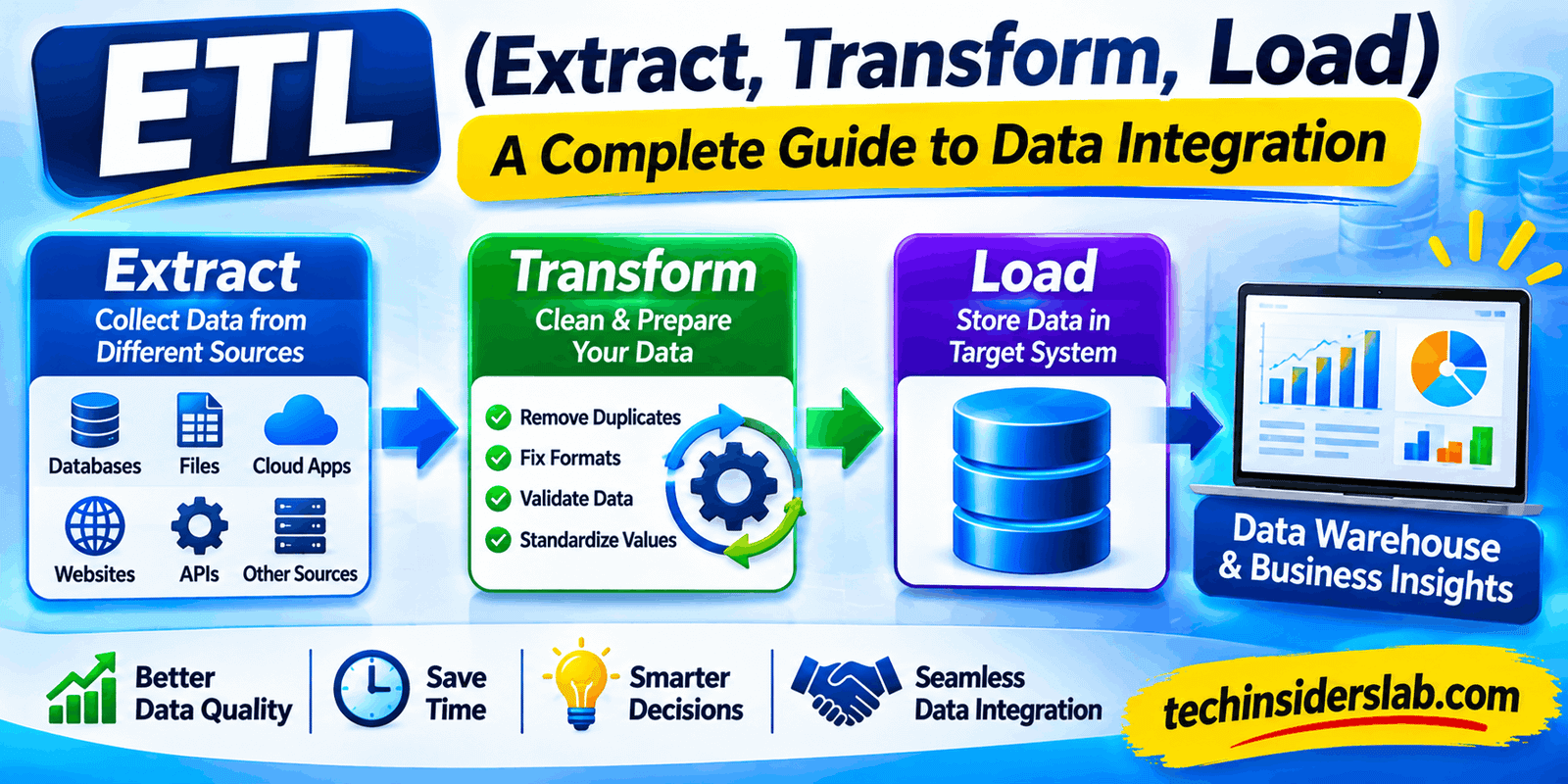
ETL is a data integration process that collects information from different sources, transforms it into a consistent format, and loads it into a destination such as a data warehouse. It helps businesses turn scattered and unorganized information into useful data that supports reporting, analytics, and business intelligence.
Whether a company manages customer records, sales information, financial transactions, or website performance, ETL can help create a more organized data environment.
In this guide, we will explore what ETL means, how it works, its major components, benefits, challenges, real-world applications, and how it compares with modern data integration approaches.
Understanding the Three Main Components of ETL
ETL consists of three connected stages. Each stage performs a specific job to ensure that information moves from its original source into a destination in a useful and reliable format.
1. Extract: Collecting Data From Different Sources
Extraction is the first stage of the ETL process. During this step, data is collected from different systems and transferred into a temporary processing environment.
Businesses often store information across multiple platforms. For example, customer details may exist in a CRM system, sales information may be stored in a database, and website activity may be recorded in analytics software.
An ETL system connects to these sources and retrieves the required information.
Common data sources include:
- Relational databases such as MySQL and PostgreSQL.
- Customer relationship management (CRM) platforms.
- Enterprise resource planning (ERP) systems.
- CSV and Excel files.
- Websites and application programming interfaces (APIs).
- Cloud applications and business software.
- IoT devices and system logs.
There are different ways to extract information. Full extraction collects an entire dataset, while incremental extraction collects only new or changed records. Incremental extraction can reduce processing time when dealing with large databases.
The main objective is to gather the required information without unnecessarily affecting the performance of the original systems.
2. Transform: Cleaning and Preparing Data
Transformation is the second and often most important stage of ETL. Raw information is rarely ready for immediate analysis because different systems may use different formats, naming conventions, and data structures.
This stage converts collected information into a consistent format that meets the requirements of the destination system.
Common transformation activities include:
- Data Cleaning: Removing incorrect, incomplete, or duplicate records.
- Data Formatting: Converting dates, numbers, and text into standard formats.
- Data Validation: Checking whether information meets predefined rules.
- Data Filtering: Removing unnecessary records that do not support the intended purpose.
- Data Integration: Combining information from multiple sources.
- Data Aggregation: Calculating totals, averages, and other useful measurements.
- Data Standardization: Making different naming conventions and values consistent.
For example, imagine a company receives customer records from two different systems. One system stores dates as MM/DD/YYYY, while another uses DD-MM-YYYY. During transformation, both formats can be converted into one standard format.
Similarly, duplicate customer records can be identified and combined to improve data accuracy.
This stage helps ensure that the final dataset is more consistent, organized, and suitable for reporting.
3. Load: Moving Processed Data to Its Destination
Loading is the final stage of ETL. Once information has been extracted and transformed, it is transferred into a target system where users and applications can access it.
Common destinations include:
- Data warehouses.
- Relational databases.
- Cloud storage platforms.
- Data lakes.
- Business intelligence systems.
There are two common loading approaches.
Full Loading: The entire processed dataset is loaded into the destination. This approach may be suitable for smaller datasets or initial data transfers.
Incremental Loading: Only new or updated records are transferred. This approach is often more efficient when businesses regularly process large amounts of information.
After loading, the information can be used for business reports, dashboards, financial analysis, customer insights, and other analytical activities.
For a successful ETL process, organizations should verify that the loaded records match the expected results and that important data has not been lost during transfer.
How Does the ETL Process Work?
ETL works through a connected data pipeline that moves information from different sources into a centralized destination.
Consider an online shopping company that wants to understand its sales performance. It collects information from its website, payment system, customer database, and inventory platform.
The ETL process brings this information together so that managers can analyze business performance from one location.
Here is a simple step-by-step example:
- Data Collection: The ETL system collects order details, customer information, payment records, and product information.
- Data Extraction: Required records are copied from the original systems.
- Data Transformation: Duplicate transactions are removed, inconsistent formats are corrected, and customer information is organized.
- Data Loading: The cleaned information is transferred into a centralized data warehouse.
- Data Analysis: Reporting and business intelligence tools use the prepared information to create dashboards and reports.
For example, management can use the combined information to identify best-selling products, calculate monthly revenue, understand customer purchasing patterns, and compare sales across different locations.
This demonstrates how ETL converts information from separate systems into a more useful business resource.
Different Types of ETL Processing
ETL can be implemented in different ways depending on the amount of information, business requirements, and how frequently data needs to be updated.
Batch ETL
Batch ETL processes information in groups at scheduled intervals. Instead of transferring every record immediately, the system collects data and processes it at a specific time.
For example, a company might update its sales warehouse every night after business hours.
Batch processing is useful for organizations that do not require immediate updates. It can also make resource management easier because processing happens during planned periods.
Real-Time ETL
Real-time ETL processes information continuously or with very little delay as new data becomes available.
It is useful when businesses need timely information to make decisions or respond to events.
For example, financial monitoring systems may need to process transaction information quickly to identify unusual activity.
Real-time pipelines can be more complex because they require reliable event handling, low-latency processing, and careful management of failures.
Incremental ETL
Incremental ETL processes only new or changed information instead of extracting an entire dataset every time.
This approach can save processing resources and reduce unnecessary data transfers.
For example, an online store with millions of historical orders may only need to process orders created or updated since its previous successful run.
Full ETL
Full ETL extracts and processes the complete dataset before loading it into the destination.
It can be useful when setting up a new data warehouse, rebuilding a dataset, or performing a complete refresh.
However, repeatedly processing large datasets can consume more time and computing resources than incremental processing.
Benefits of Using ETL
ETL provides several important benefits for organizations that depend on data for daily operations and long-term planning.
1. Better Data Quality
Different systems often contain incomplete, inconsistent, or duplicated information. ETL helps clean and standardize records before they reach the target database.
This improves the reliability of reports and reduces errors caused by poor-quality data.
2. Centralized Data Management
Many organizations store information in separate applications and databases. ETL combines relevant information into a centralized environment.
This makes it easier for teams to access and analyze information without switching between multiple systems.
3. Improved Business Decisions
Reliable information helps managers understand business performance and identify opportunities.
For example, sales teams can compare revenue across different periods, while marketing departments can study customer behavior and campaign performance.
4. Time Savings Through Automation
ETL pipelines can automate repetitive data collection, cleaning, and loading activities.
Instead of manually combining spreadsheets and databases, employees can use scheduled workflows to process information automatically.
5. Better Reporting and Analytics
ETL prepares data for business intelligence applications and analytical platforms.
Well-organized information makes it easier to generate reports, build dashboards, and identify meaningful trends.
6. Support for Data Integration
Businesses frequently use multiple applications that were not originally designed to share information.
ETL helps connect these systems and creates a consistent data environment.
7. More Consistent Business Operations
When departments use standardized information, they can work with the same definitions, formats, and reporting structures.
This reduces confusion and helps teams communicate more effectively.
Common Uses of ETL in Different Industries
ETL is used across many industries because organizations need to combine information from different sources.
E-Commerce and Retail
Online stores use ETL to combine customer records, product information, inventory details, and sales transactions.
This information helps businesses understand purchasing behavior, track product performance, and manage stock levels.
Healthcare
Healthcare organizations can use data integration processes to organize information from different systems, including administrative records, appointment platforms, and laboratory systems.
Data handling must follow applicable privacy and security requirements, particularly when personal medical information is involved.
Banking and Finance
Financial institutions process large amounts of transaction and account information. ETL can help combine financial records, prepare reports, and support risk analysis.
Education
Schools, colleges, and universities can use ETL to combine student records, attendance information, examination results, and enrollment data.
This helps administrators understand academic performance and manage educational resources.
Marketing
Marketing teams can combine information from advertising platforms, websites, email campaigns, and customer databases.
This allows them to measure campaign performance and better understand customer engagement.
Manufacturing
Manufacturing companies can integrate production records, inventory information, equipment data, and supply chain details.
These insights can help improve production planning and operational efficiency.
ETL vs. ELT: What Is the Difference?
ETL and ELT are two important approaches to data integration. Both move information from source systems into a target environment, but they follow different processing orders.
In ETL, data is transformed before it reaches the final destination. In ELT, data is loaded first and transformed afterward within the destination system.
| Feature | ETL | ELT |
| Full Form | Extract, Transform, Load | Extract, Load, Transform |
| Processing Order | Transform before loading | Load before transforming |
| Transformation Location | Separate processing environment | Target data platform |
| Common Use | Structured and curated datasets | Large-scale modern analytics |
| Data Preparation | Before loading | After loading |
| Flexibility | Defined transformations | Raw data can be transformed later |
ETL can be a suitable choice when data must be cleaned, standardized, or protected before entering a destination system.
ELT is often useful when organizations work with scalable cloud data warehouses and want to retain raw information for different analytical requirements.
Neither approach is universally better. The right option depends on data volume, infrastructure, security needs, processing requirements, and available resources. Some organizations also use a combination of both methods.
Google Cloud+3
Popular ETL Tools and Technologies
Several software platforms help organizations build, manage, and automate ETL pipelines. These tools offer different capabilities depending on business size and technical requirements.
1. Apache Airflow
An open-source workflow orchestration platform used to schedule, monitor, and manage data pipelines.
2. Talend
Provides data integration and data quality capabilities for connecting different information sources.
3. Informatica
Offers enterprise data integration, transformation, governance, and management solutions.
4. Azure Data Factory
A cloud-based data integration service used to create and manage data workflows.
5. AWS Glue
A managed data integration service that helps discover, prepare, and combine data for analytics.
These platforms can reduce manual work and make it easier to manage complex data workflows. The best choice depends on the organization’s infrastructure, budget, and technical expertise.
Common Challenges of ETL
Although ETL offers many advantages, implementing and maintaining an effective pipeline can involve several challenges.
Data Quality Problems: Source systems may contain missing, inaccurate, or duplicated information. Poor-quality input can affect the reliability of the final dataset.
Complex Data Integration: Connecting different databases, applications, and file formats can require additional configuration and transformation rules.
Processing Time: Large datasets may take considerable time to extract, transform, and load, especially when processing resources are limited.
Security and Privacy: Sensitive information must be protected during extraction, transformation, storage, and transfer.
Pipeline Failures: Network interruptions, changed source structures, and unexpected errors can interrupt data workflows.
Maintenance Requirements: ETL pipelines need regular monitoring, testing, and updates as business systems and data requirements change.
Organizations can reduce these challenges by using reliable tools, implementing validation checks, maintaining proper documentation, and monitoring pipeline performance.
Best Practices for an Effective ETL Process
Building a successful ETL pipeline requires more than connecting different databases. Organizations should follow practical data management practices to improve reliability and performance.
- Understand Your Data Sources: Identify where information comes from and understand its structure before designing a pipeline.
- Maintain Data Quality: Use validation rules to identify incomplete, duplicated, and inaccurate records.
- Automate Repetitive Tasks: Schedule regular data extraction and loading activities to reduce manual effort.
- Protect Sensitive Information: Apply encryption, access controls, and appropriate data protection policies.
- Monitor Pipeline Performance: Track processing time, failures, and unexpected changes.
- Keep Backup Records: Maintain appropriate recovery procedures to protect important information.
- Document Transformation Rules: Record how information is cleaned, converted, and combined so that workflows remain understandable.
- Choose Scalable Infrastructure: Select tools and processing resources that can support future data growth.
Following these practices can help businesses build dependable data pipelines that support long-term analytical requirements.
Conclusion
ETL (Extract, Transform, Load) is an important data integration process that helps businesses collect information from different sources, organize it, and transfer it into a centralized destination. Its three stages work together to improve data quality, simplify reporting, and make information more useful for business analysis.
From e-commerce and healthcare to banking, education, and manufacturing, ETL supports organizations that depend on accurate and well-organized information. Although challenges such as data quality, processing time, security, and maintenance can affect implementation, the right tools and practices can make the process more efficient.
Overall, ETL remains a valuable part of modern data management. Whether an organization is building its first data warehouse or managing complex information across multiple platforms, understanding ETL provides a strong foundation for better data integration and smarter business decisions.