NPC Meaning:What Does NPC Mean in Gaming,Text,Social Media
introduction
If you have spent time playing video games, reading comments, or scrolling through social media, you have probably seen the term NPC. It is a short abbreviation that can have slightly different meanings depending on where you see it.
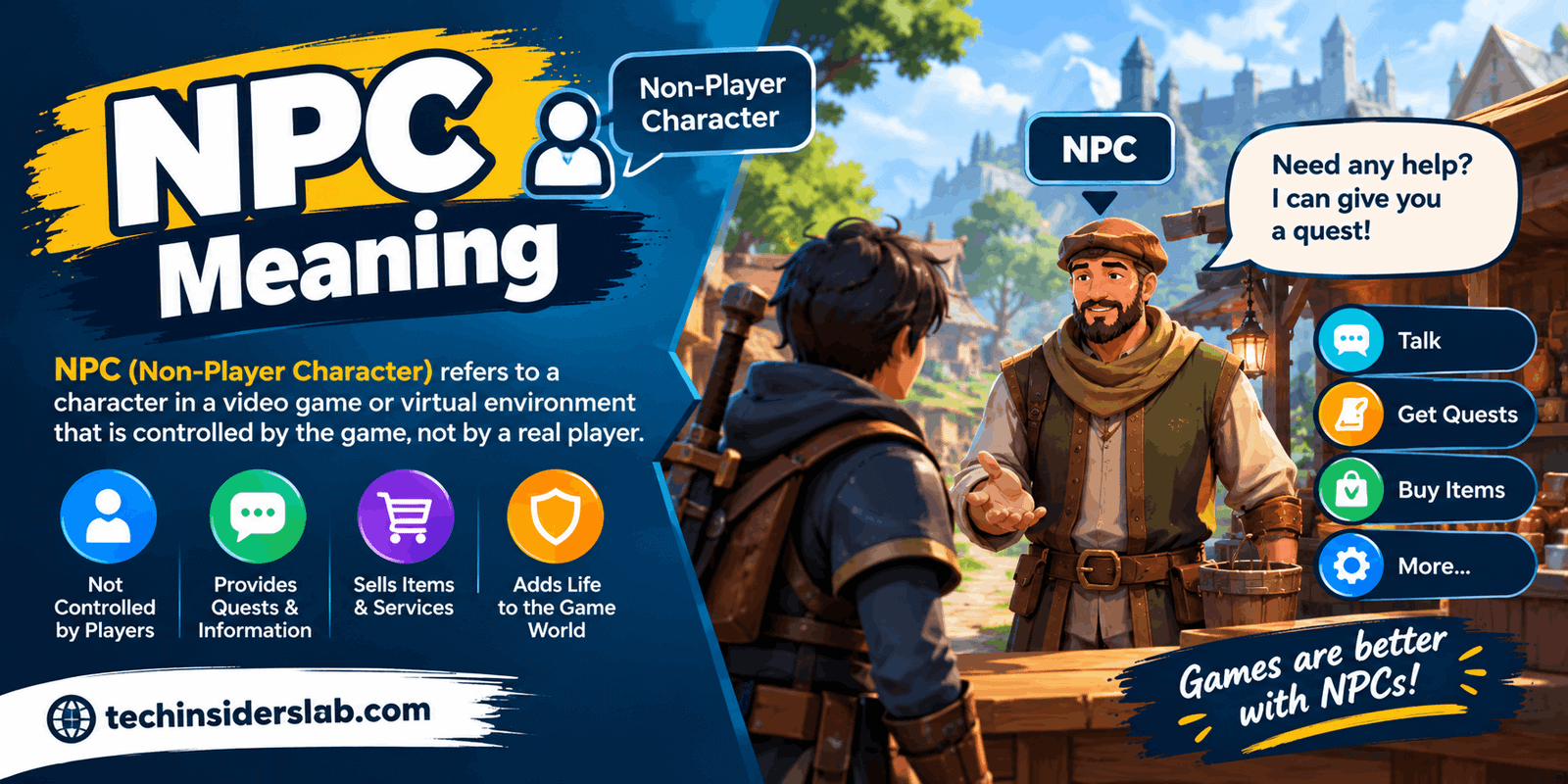
In gaming, NPC usually stands for Non-Player Character. It refers to a character that is not directly controlled by a human player. Shopkeepers, villagers, guards, quest givers, guides, and many other characters found inside games can be NPCs.
However, the meaning of NPC has expanded beyond gaming. On social media, in text messages, memes, and online conversations, people sometimes call another person an “NPC” when they believe that person is acting in a predictable, repetitive, robotic, or scripted way.
The term has therefore become much more than a gaming abbreviation. It is now part of internet culture and can be used seriously, humorously, or even as an insult.
What Does NPC Stand For?
NPC commonly stands for Non-Player Character. You may also see the phrase Non-Playable Character, particularly in casual online discussions.
In simple terms, an NPC is a character that the player does not directly control. Instead, the game, computer system, programmed behavior, or another game authority controls the character.
For example, imagine that you enter a virtual town and meet a shopkeeper. You cannot control the shopkeeper, but you can talk to them, purchase items, receive information, or complete a quest through them. That shopkeeper is an NPC.
The same basic idea applies to characters that give missions, protect locations, provide instructions, interact with the player, or simply make the game world feel populated.
What Is an NPC in Gaming?
In video games, NPCs are an important part of the game world. Without them, many games would feel empty and lifeless.
An NPC can have a very simple role or become an important part of the story. Some NPCs may only repeat a few lines of dialogue, while others can have complicated personalities, relationships, schedules, reactions, and storylines.
Common examples include:
- Shopkeepers
- Villagers
- Guards
- Quest givers
- Trainers
- Guides
- Friendly characters
- Enemy characters
- Story characters
- Computer-controlled teammates
- Background characters
An NPC does not necessarily mean an unimportant character. Some NPCs can be central to a game’s story and may influence major events.
Modern games can give NPCs increasingly sophisticated behavior. Their actions may change depending on the player’s decisions, location, reputation, progress, or other events happening in the game world.
Why Are NPCs Important?
NPCs help developers create a believable and interactive environment.
Consider an open-world game with a large city. If there were only buildings and roads but no people, the city would feel unrealistic. NPCs can walk through streets, operate businesses, communicate with the player, react to events, and create the impression that the world continues to exist around the player.
NPCs also help with gameplay. A character might give you a mission, sell you equipment, teach you an ability, provide a clue, or introduce an important part of the story.
In role-playing games, NPCs can be especially important because they help build the game’s narrative.
They can act as friends, enemies, mentors, merchants, strangers, leaders, or even characters whose motivations are not immediately clear.
NPC vs Player Character
One easy way to understand NPC meaning is to compare an NPC with a player character.
A player character is controlled directly by the person playing the game. The player decides where the character goes, what actions they perform, and often what choices they make.
An NPC, on the other hand, is controlled by the game or another non-player system.
For example, if you are playing a role-playing game and control your own hero, your hero is the player character. The merchant standing inside the nearby shop is an NPC.
The distinction is mainly about who controls the character.
What Does NPC Mean in Texting?
The meaning changes when NPC appears in texting or online conversations.
When someone calls another person an “NPC,” they are usually making a comparison to a video-game character. They may be suggesting that the person behaves as though they are following a script.
For example, someone might say:
“Why does he keep saying the same thing? He is acting like an NPC.”
In this context, the speaker is not talking about an actual video-game character. They are describing a person’s behavior as repetitive or predictable.
Depending on the situation, this can be a joke between friends or a negative comment.
NPC Meaning in Slang
As internet slang, NPC can describe someone who appears to lack originality or independent behavior.
People may use the term when they think someone:
- Repeats the same phrases
- Follows trends without questioning them
- Copies popular opinions
- Behaves predictably
- Appears to be on “autopilot”
- Repeats what other people are doing
- Gives responses that seem scripted
The comparison comes from the way many traditional game NPCs operate. A basic NPC might stand in one location, repeat the same dialogue, and perform a limited set of actions.
Calling a real person an NPC borrows that concept and applies it to human behavior.
Because of this, the slang usage can be insulting. It can imply that someone is not thinking independently or is simply following a script.
Is Calling Someone an NPC an Insult?
It can be.
The meaning depends heavily on the context and tone.
Friends might jokingly call each other NPCs after someone repeats the same phrase or performs the same routine every day. In another situation, someone may use the term to dismiss another person’s opinions.
For example, saying “I’m an NPC today” can simply be self-deprecating humor about feeling tired or going through the same routine.
However, calling another person an NPC during an argument can be more offensive because it may suggest that the person has no original thoughts or individuality.
Therefore, it is important to consider the audience and situation before using the term.
NPC Meaning on Social Media
Social media helped expand NPC from a gaming abbreviation into a broader internet expression.
You may see the term in comments, memes, short videos, gaming communities, and online discussions.
A person may be described as an NPC because they repeatedly follow a trend or use the same popular phrase as everyone else.
The term is particularly effective as internet slang because most gamers already understand the basic concept. Even people who are not serious gamers may recognize the idea of a background character following programmed behavior.
As a result, “NPC” became a convenient shorthand for describing repetitive or predictable behavior.
What Is NPC Streaming?
NPC also became associated with a specific type of livestreaming trend.
In NPC-style livestreams, creators intentionally behave like video-game characters. They may respond to viewer interactions with repetitive movements, facial expressions, sounds, or short phrases.
Some livestream formats involve creators responding to virtual gifts or other viewer actions with predetermined reactions.
The concept became widely recognizable on short-form video platforms and livestreaming services. Instead of criticizing someone for behaving like an NPC, creators began intentionally performing the behavior as entertainment.
This is an interesting example of how internet slang can evolve. A word that originally described a game character became an insult and later became part of an online entertainment format.
Are NPCs Controlled by AI?
Not necessarily.
An NPC can be controlled using simple programming, scripted events, behavior systems, decision-making logic, or artificial intelligence techniques.
A very simple NPC might follow a fixed sequence:
- Walk to a location.
- Wait.
- Say a particular line.
- Walk somewhere else.
- Repeat the process.
More advanced NPCs can respond dynamically to what happens around them.
Some modern games use sophisticated AI and behavior systems to make NPCs react to players and changing situations. However, the term NPC itself only describes the character’s role—it does not automatically mean that the character uses AI.
This distinction is important.
NPC describes what the character is. AI describes technology that may be used to control or influence its behavior.
NPC and AI: What Is the Difference?
NPC and AI are often mentioned together, but they are not the same thing.
An NPC is a character that is not directly controlled by the player.
AI is a collection of technologies or methods that can allow software to make decisions, recognize patterns, generate responses, or adapt behavior.
A game developer could create an NPC with simple scripted behavior without using advanced AI.
On the other hand, an NPC could use sophisticated AI systems to make its behavior appear more dynamic.
Therefore, saying “NPC” does not automatically mean “AI character.”
NPCs in Different Types of Games
NPCs appear across many gaming genres.
Role-Playing Games
RPGs often depend heavily on NPCs. They can provide quests, sell equipment, reveal information, and contribute to the story.
Open-World Games
Open-world games use NPCs to make cities, villages, and other environments feel active. Characters may walk around, work, interact, and respond to events.
Adventure Games
NPCs can provide clues, dialogue, missions, or story information.
Simulation Games
NPCs may represent residents, workers, customers, or other characters who interact with the player’s simulated environment.
Multiplayer Games
Some multiplayer games also include computer-controlled characters alongside human players. These characters can help populate the world or provide additional gameplay challenges.
Why Do NPCs Sometimes Repeat Dialogue?
Repetitive dialogue is one of the most recognizable characteristics associated with NPCs.
Game developers may intentionally limit dialogue because creating unique conversations for every possible situation requires significant development resources.
A shopkeeper might say the same greeting whenever the player enters the store. A guard may repeat the same warning whenever the player approaches a restricted area.
This repetition is also part of the reason the word NPC became useful as internet slang.
When people notice someone repeatedly saying or doing the same thing, they compare that behavior to a scripted game character.
Can an NPC Be Important to the Story?
Absolutely.
The word NPC does not mean “background character.”
Some of the most memorable characters in games are NPCs. They can have their own personalities, motivations, relationships, and story arcs.
An NPC might be responsible for starting the main quest, revealing an important secret, helping the player during a difficult mission, or creating a major conflict.
In many story-driven games, NPCs are essential because they help connect the player’s actions with the larger narrative.
Common Examples of NPC Behavior
Here are some simple examples of what NPC behavior might look like in a game:
Merchant: Sells weapons, clothing, food, or other items.
Quest Giver: Gives the player a mission or objective.
Guard: Protects an area and reacts to suspicious behavior.
Guide: Explains game mechanics or helps the player understand where to go.
Villager: Adds atmosphere and makes the game world feel populated.
Enemy: Challenges the player and may use programmed combat behavior.
Companion: Travels with the player and assists during gameplay.
Each of these characters can be considered an NPC when the player does not directly control them.
NPC Meaning in Everyday Internet Culture
Today, NPC has become a recognizable part of online vocabulary.
Its gaming meaning remains the most literal definition, but its slang meaning has become common enough that people may use the word without talking about games at all.
For example, a social media comment might say:
“Everyone is copying the same trend. NPC behavior.”
Here, NPC is being used metaphorically.
The person writing the comment is comparing repetitive social behavior to programmed game characters.
This usage can be humorous, sarcastic, critical, or insulting depending on the context.
How to Understand NPC From Context
If you see the word NPC, look at the surrounding conversation.
If people are discussing games, characters, quests, or gameplay, NPC almost certainly means Non-Player Character.
If it appears in a social media argument, meme, or casual conversation about someone’s behavior, it may be slang.
If it appears in a livestream discussion, it could refer to NPC-style entertainment.
The same three letters can therefore have different meanings without actually being contradictory.
Conclusion
NPC is a common term that originally comes from gaming and stands for Non-Player Character. These are characters controlled by the game rather than the player. Today, NPC has also become popular internet slang for someone who behaves in a predictable, repetitive, or scripted way. Its meaning depends on the context, whether you see it in a game, text message, meme, or social media post.