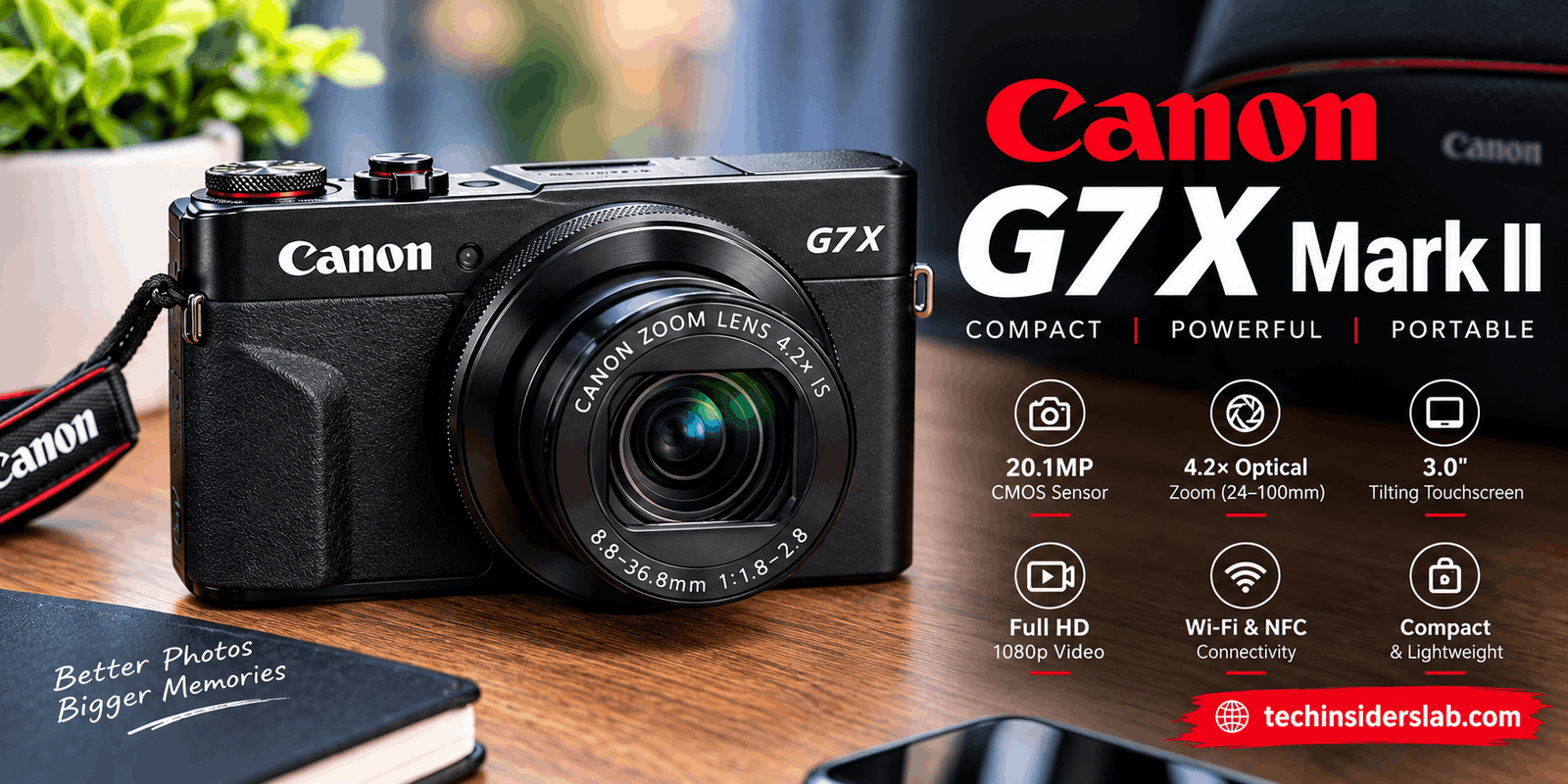
Canon G7X Mark II:Guide to Canon’s Popular Compact Camera
introduction
The Canon G7X Mark II is a compact digital camera designed for photographers, travelers, and content creators who want better image quality and more control than a typical smartphone or basic point-and-shoot camera can provide. Although it was introduced several years ago, the camera continues to attract attention because of its compact body, large 1-inch sensor, bright zoom lens, and easy-to-use controls.
The camera combines a 20.1-megapixel CMOS sensor with a 24–100mm equivalent zoom lens and Canon’s DIGIC 7 image processor. This combination makes it suitable for everyday photography, travel, portraits, food photography, street photography, and casual video recording.
What Is the Canon G7X Mark II?
The Canon PowerShot G7X Mark II is a premium compact camera from Canon’s PowerShot G series. Unlike inexpensive compact cameras that usually rely on very small sensors, the G7X Mark II features a 1-inch CMOS sensor.
The larger sensor is one of the camera’s biggest advantages because it can capture more light and provide better image quality in many situations. The camera also provides manual exposure controls and RAW image recording, making it useful for beginners as well as photography enthusiasts.
One of its most attractive characteristics is its size. The G7X Mark II is small enough to carry during travel or everyday activities without the weight and complexity associated with many DSLR or mirrorless camera systems.
20.1-Megapixel 1-Inch Sensor
The G7X Mark II features a 20.1-megapixel 1-inch CMOS sensor. This sensor provides enough resolution for everyday photography, social media images, prints, and general creative work.
The 1-inch sensor is significantly larger than the sensors traditionally found in inexpensive compact cameras. As a result, the camera can produce images with better detail, improved low-light performance, and more attractive background separation.
The camera also supports RAW photography. RAW files provide photographers with considerably more flexibility during editing. Exposure, shadows, highlights, white balance, and other aspects can be adjusted after taking the photograph.
For photographers who want to learn editing and improve their images during post-processing, RAW support is an important feature.
Bright 24–100mm Equivalent Zoom Lens
Another major attraction of the G7X Mark II is its built-in zoom lens.
The camera offers a 24–100mm equivalent focal range, giving users a useful combination of wide-angle and short-telephoto perspectives.
The 24mm equivalent wide end is helpful for:
- Travel photography
- Landscapes
- Architecture
- Group photographs
- Indoor photography
- Everyday scenes
The 100mm equivalent telephoto end can be useful for:
- Portraits
- Food photography
- Details
- Close-up subjects
- Photographing subjects from a distance
The lens also features a bright f/1.8–2.8 aperture. The wide aperture allows more light to reach the sensor and can help create a softer background, especially when photographing people or objects at closer distances.
This combination of a large sensor and bright zoom lens is one of the main reasons the G7X Mark II remains an interesting compact camera.
Optical Image Stabilization
Handheld photography can become challenging when lighting conditions are poor or when using longer focal lengths. The G7X Mark II includes optical image stabilization to help reduce the effects of camera movement.
Image stabilization is particularly useful for travel photography, indoor scenes, evening photography, and other situations where using a tripod is inconvenient.
However, image stabilization cannot completely stop movement from the subject. If a person, animal, or object is moving quickly, a faster shutter speed may still be necessary.
DIGIC 7 Image Processor
Canon equipped the G7X Mark II with a DIGIC 7 image processor. The processor plays an important role in image processing, noise reduction, autofocus performance, and overall camera operation.
It also helps the camera handle continuous shooting at relatively high speeds.
This can be useful when photographing moving subjects, children, pets, sports moments, or other scenes where timing is important.
The combination of the sensor and processor also contributes to the camera’s ability to produce detailed and well-processed JPEG images directly from the camera.
Tilting Touchscreen Display
The G7X Mark II features a 3-inch tilting touchscreen LCD. The screen can be tilted to make photography from unusual angles easier.
This feature is particularly useful for:
- Self-portraits
- Travel photography
- Low-angle shots
- High-angle shots
- Video recording
- Content creation
The touchscreen also makes the camera relatively easy to use for people who are accustomed to smartphone photography.
Instead of relying entirely on physical controls, users can interact with the camera through the display and use touch-based focusing in supported shooting situations.
Compact and Portable Design
Portability is one of the strongest characteristics of the G7X Mark II.
The camera has a relatively small body and weighs around 319 grams with the battery and memory card. This makes it considerably easier to carry than many DSLR and mirrorless camera setups.
Its compact design is especially useful for travelers. Instead of carrying a camera body and multiple lenses, users can take one small camera with a built-in zoom lens that covers a useful range.
The physical grip also provides a more secure feeling than completely flat compact cameras.
The camera includes a control ring around the lens that can be assigned to different functions. This gives photographers a more traditional camera experience while maintaining the convenience of a compact body.
Manual Shooting Controls
Although the G7X Mark II is designed to be easy to use, it also provides controls for photographers who want to take greater control over their images.
Shooting options include automatic modes as well as:
- Program mode
- Aperture Priority
- Shutter Priority
- Manual mode
- Various scene modes
- Movie modes
These options make the camera suitable for users at different experience levels.
Beginners can start with automatic settings and gradually learn about aperture, shutter speed, ISO, and exposure compensation. More experienced photographers can use manual controls to achieve a specific creative result.
This flexibility makes the camera more than just a simple point-and-shoot device.
Low-Light Photography
The bright lens is especially useful when photographing in challenging lighting conditions.
The f/1.8 aperture at the wide end allows a relatively large amount of light to reach the sensor. Combined with the 1-inch sensor and optical stabilization, this can help produce better handheld photographs in many indoor and evening situations.
However, the G7X Mark II is still a compact camera with a 1-inch sensor. Larger APS-C and full-frame cameras generally provide greater flexibility when shooting at very high ISO settings.
For everyday low-light photography, however, the G7X Mark II can be surprisingly capable when used correctly.
Photographers can improve results by keeping the ISO as low as practical, using the widest suitable aperture, and taking advantage of image stabilization.
Video Recording
The G7X Mark II can record Full HD video and offers several video-related controls.
Its compact body makes it convenient for casual video recording, travel clips, family videos, and online content.
The wide 24mm-equivalent end of the lens is useful for handheld recording because it provides a reasonably broad field of view.
The tilting screen is another benefit for video users because it makes framing easier when the camera is positioned at different angles.
However, one important limitation is that the G7X Mark II does not offer 4K video recording. Users who specifically need modern 4K video capabilities may need to consider a newer camera.
Wi-Fi and Connectivity
Wireless connectivity is another useful feature.
The camera supports wireless image transfer, allowing users to move photographs to compatible smartphones and other devices. This can be particularly useful for travelers and social media users who want to share photographs without transferring the memory card manually.
For people who frequently take photographs for social media, the wireless functionality can make the process from camera to smartphone more convenient.
The camera uses commonly available SD, SDHC, and SDXC memory cards, giving users flexibility when choosing storage capacity.
Battery Performance
Battery performance is an important consideration for compact cameras.
The G7X Mark II can provide a few hundred photographs on a charge depending on shooting conditions and camera settings. Actual battery life can vary based on LCD usage, continuous shooting, video recording, wireless connectivity, and other functions.
For everyday photography, the battery can be sufficient for shorter shooting sessions. However, travelers and people recording a lot of video may want to carry an additional battery.
Having a spare battery can be especially useful during long trips where charging opportunities may be limited.
Who Should Use the Canon G7X Mark II?
The camera can work well for several types of users.
Travel Photographers
Travelers can benefit from the camera’s compact size and versatile zoom range. It can handle landscapes, buildings, food, portraits, and everyday travel scenes without requiring multiple lenses.
Everyday Photographers
If you want a dedicated camera that offers more control than a smartphone, the G7X Mark II can be an attractive option.
Content Creators
The compact body, bright lens, tilting screen, and Full HD video make it useful for casual content creation.
Beginners
Automatic shooting modes make it easy to start, while manual controls provide an opportunity to learn photography.
Photography Enthusiasts
RAW recording, manual exposure, aperture priority, shutter priority, and the customizable control ring give enthusiasts more creative control.
Advantages of the Canon G7X Mark II
The G7X Mark II offers several notable strengths:
- 20.1MP 1-inch CMOS sensor
- Bright f/1.8–2.8 lens
- 24–100mm equivalent zoom range
- Compact and lightweight body
- Optical image stabilization
- RAW image support
- Tilting touchscreen
- Fast continuous shooting
- Manual shooting controls
- Built-in flash
- Wireless connectivity
- Good portability
Its biggest advantage is arguably the balance between image quality and size. Users can get many of the controls associated with a more advanced camera without carrying a large camera system.
Limitations to Consider
Despite its strengths, the G7X Mark II has several limitations.
The biggest issue for modern video creators is the lack of 4K recording. The camera is limited to Full HD video.
It also does not include an electronic viewfinder. Photographers must therefore use the LCD screen to compose their photographs.
Battery life may also be limited during heavy use, particularly when recording video or using wireless features frequently.
Another consideration is its age. The camera was designed according to the technology standards of its release period. Newer cameras can offer more advanced autofocus, higher-resolution video, newer connectivity options, and other improvements.
Canon G7X Mark II vs Smartphone Cameras
Modern smartphones are extremely capable and can produce excellent photographs. However, the G7X Mark II provides several features that appeal to dedicated photography users.
Its 1-inch sensor, optical zoom, physical controls, RAW capture, and bright lens give users more direct control over the photographic process.
A smartphone is usually more convenient for instant sharing, computational photography, and everyday snapshots. The Canon, on the other hand, provides a more traditional photography experience.
The right option depends on the user’s priorities. Someone who values convenience may prefer a smartphone, while someone who wants dedicated camera controls and optical zoom may appreciate the G7X Mark II.
Is the Canon G7X Mark II Still Worth Considering?
The answer depends on what features you need.
If your priority is a small camera with good still-image capabilities, a bright zoom lens, RAW support, and manual controls, the G7X Mark II remains an interesting option.
If 4K video, modern autofocus systems, or the latest connectivity features are essential, newer cameras may be more suitable.
The G7X Mark II is best understood as a compact photography-focused camera rather than a modern all-in-one video platform.
Conclusion
The Canon G7X Mark II continues to stand out because it combines several useful features in a remarkably compact package. Its 20.1-megapixel 1-inch sensor, bright 24–100mm equivalent lens, optical stabilization, RAW support, manual controls, and tilting touchscreen make it versatile for everyday photography and travel.
It does have limitations, especially the lack of 4K video and an electronic viewfinder. Nevertheless, its portability and photographic flexibility remain appealing.
For travelers, casual photographers, beginners, and enthusiasts who want a small dedicated camera, the G7X Mark II offers a practical combination of convenience and control.