iPhone 15 Plus:Guide to Features, Performance, Camera, Battery
introduction
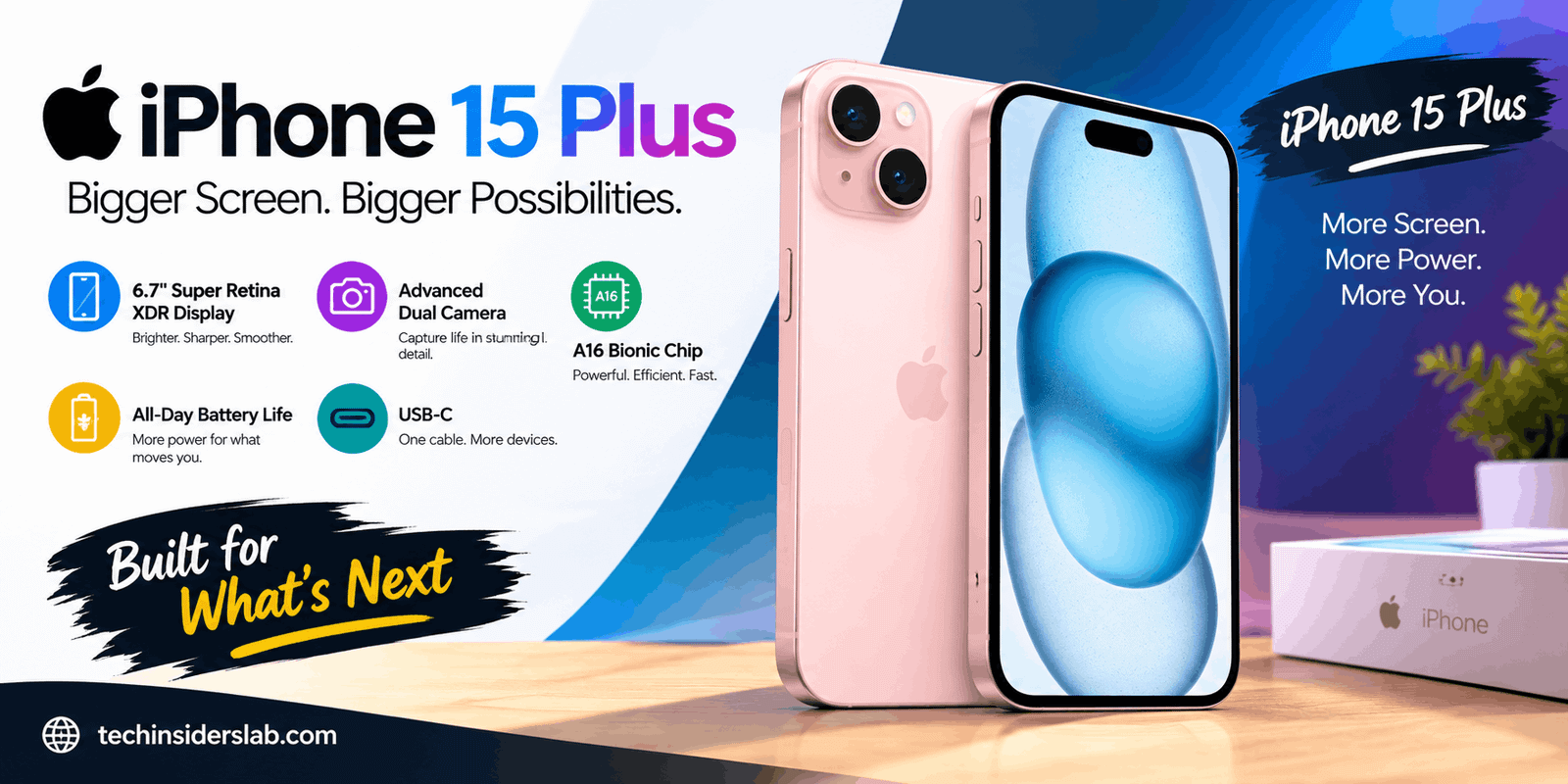
The iPhone 15 Plus is a large-screen smartphone introduced by Apple in 2023 as part of the iPhone 15 lineup. It combines a spacious 6.7-inch OLED display, the A16 Bionic chip, a 48MP main camera, Dynamic Island, USB-C connectivity, and a large battery-focused design. Unlike the Pro models, the iPhone 15 Plus focuses on providing a premium everyday experience without adding some of the specialized Pro features.
For users who want a bigger iPhone but do not necessarily need a Pro Max model, the iPhone 15 Plus offers a practical balance between screen size, performance, cameras, battery life, and portability. Apple offers the phone in 128GB, 256GB, and 512GB storage configurations.
Design and Build Quality
The iPhone 15 Plus follows Apple’s familiar flat-sided design but introduces more comfortable, slightly contoured edges compared with earlier generations. Its aluminum frame and color-infused glass back give it a premium appearance while keeping the device lighter than many large-screen smartphones.
The phone measures approximately 160.9 mm in height, 77.8 mm in width, and 7.8 mm in thickness, with a weight of about 201 grams. It is available in Black, Blue, Green, Yellow, and Pink finishes.
Apple also includes Ceramic Shield protection on the front. The device has an IP68 rating for splash, water, and dust resistance, although water resistance should not be treated as permanent protection because it can decrease with normal wear and accidental damage.
The large size is one of the main reasons people choose the Plus model. It provides more screen area than the standard iPhone 15 while retaining a relatively straightforward design.
6.7-Inch Super Retina XDR Display
One of the biggest attractions of the iPhone 15 Plus is its display. The smartphone features a 6.7-inch Super Retina XDR OLED display with a resolution of 2796 × 1290 pixels at 460 pixels per inch.
The OLED panel supports HDR, True Tone, wide P3 color, and Haptic Touch. Apple lists typical brightness of up to 1,000 nits, 1,600 nits peak HDR brightness, and up to 2,000 nits peak outdoor brightness.
The display also features Dynamic Island, replacing the traditional notch used on older standard iPhone models. Dynamic Island can display alerts, timers, calls, music controls, and other supported activities in an interactive area around the front camera and Face ID hardware.
One point buyers should understand is that the iPhone 15 Plus uses a 60Hz refresh rate. This is perfectly suitable for everyday use, social media, video, photography, and most applications, but users coming from high-refresh-rate Android phones may notice that 90Hz or 120Hz displays can feel smoother during scrolling.
A16 Bionic Performance
The iPhone 15 Plus is powered by Apple’s A16 Bionic chip. This processor was previously used in the iPhone 14 Pro series and remains a powerful platform for everyday tasks, photography, video editing, gaming, and demanding applications.
The A16 Bionic contains a six-core CPU with two performance cores and four efficiency cores, along with a five-core GPU and a 16-core Neural Engine.
In practical use, the processor gives the iPhone 15 Plus plenty of performance headroom. Apps generally open quickly, multitasking is responsive, and demanding games can run smoothly when optimized for iOS.
The A16 also helps with computational photography. Features such as image processing, HDR, portrait effects, and other camera functions depend heavily on Apple’s combination of hardware and software.
For someone purchasing an iPhone 15 Plus today, performance remains one of the phone’s important strengths because the hardware was designed for demanding mobile workloads rather than only basic smartphone activities.
Camera System
Apple significantly improved the standard iPhone camera experience with the iPhone 15 generation. The iPhone 15 Plus features a dual-camera system consisting of a 48MP main camera and a 12MP ultra-wide camera.
The 48MP main camera uses a 26mm equivalent lens with an f/1.6 aperture and sensor-shift optical image stabilization. It can capture high-resolution 24MP and 48MP images under supported conditions.
The 12MP ultra-wide camera provides a 120-degree field of view, making it useful for landscapes, architecture, group photographs, and situations where fitting more of the scene into the frame is important.
An interesting feature is the 2x telephoto option. Instead of using a separate physical telephoto camera, the iPhone 15 Plus uses the high-resolution main sensor to provide a 2x optical-quality zoom experience.
The camera system also supports Night mode, Photonic Engine, Deep Fusion, Smart HDR 5, Portrait mode, Photographic Styles, panorama photography, and other computational photography features.
For video recording, the phone supports advanced video features including 4K recording, cinematic-style recording, stabilization, and slow-motion capabilities. This makes the iPhone 15 Plus useful not only for casual photography but also for social media creators and everyday video production.
Battery Life
Battery life is another major reason to consider the Plus version. The larger body provides room for a larger battery than the standard iPhone 15, and independent testing has highlighted the iPhone 15 Plus for its strong endurance. TechRadar and Tom’s Guide both reported particularly strong battery performance in their testing.
This can be especially useful for people who spend a lot of time watching videos, browsing websites, using social media, taking photographs, navigating with maps, or playing games.
The phone supports wired charging through USB-C and wireless charging through MagSafe and Qi. Apple lists support for fast charging with a 20W or higher adapter, although the charging adapter is sold separately.
The combination of a large display and strong battery endurance makes the iPhone 15 Plus particularly suitable for users who prefer long periods of use without constantly checking the battery percentage.
USB-C Connectivity
One of the most important changes in the iPhone 15 generation is the move from Apple’s Lightning connector to USB-C.
For iPhone 15 Plus users, USB-C makes charging more convenient because the same general connector family is widely used by modern phones, tablets, laptops, headphones, cameras, and other accessories.
However, buyers should understand that the standard iPhone 15 Plus does not have the same high-speed USB data capabilities as the Pro models. Reviews have noted that its USB-C connection uses USB 2-class data speeds, while the Pro models support considerably faster wired transfers.
For normal charging, connecting accessories, and transferring smaller amounts of data, this difference may not matter. It becomes more important for people who regularly transfer very large video files.
Storage Options
The iPhone 15 Plus comes with three official storage capacities: 128GB, 256GB, and 512GB.
Because iPhones do not provide a conventional microSD card slot for expanding internal storage, choosing the appropriate capacity at purchase is important.
The 128GB version can work for users who primarily use streaming services and cloud storage. People who take many high-resolution photos, record lots of videos, download games, or keep large offline media libraries may prefer 256GB or 512GB.
Storage needs are highly personal, so buyers should consider their previous phone’s storage usage rather than selecting a capacity based only on the available numbers.
iOS Experience
The iPhone 15 Plus runs Apple’s iOS ecosystem, giving users access to the App Store and Apple’s collection of integrated services and features.
The software experience includes Face ID, Apple Pay where supported, iCloud integration, AirDrop, FaceTime, Messages, and close integration with other Apple devices.
For users who already own a MacBook, iPad, Apple Watch, or AirPods, the iPhone can become part of a connected ecosystem. Features such as AirDrop and iCloud can make moving information between compatible Apple devices more convenient.
Software support is also an important consideration when buying an iPhone. Apple has historically supported iPhones for multiple years, although the exact availability of future features can vary by model and software release.
Everyday Use
The iPhone 15 Plus is designed for a broad range of everyday activities.
For social media, the large OLED display provides plenty of space for browsing Instagram, TikTok, Facebook, YouTube, and other platforms. The strong main camera can also be useful for people who regularly create photos and videos for social media.
For students, the large screen can make reading documents, browsing educational websites, attending video calls, and taking notes more comfortable.
For professionals, the A16 Bionic chip provides enough performance for communication, email, web applications, document handling, video meetings, and many productivity tasks.
Entertainment is another strong use case. The 6.7-inch OLED display is well suited to movies, television shows, YouTube videos, and mobile games.
Gaming Performance
Gaming performance is another area where the iPhone 15 Plus benefits from its A16 Bionic processor and strong GPU.
Many popular mobile games are optimized for iOS, and the A16 provides enough processing power for demanding titles. The large display can also provide a more immersive gaming experience compared with smaller phones.
However, serious competitive gamers may want to consider the display refresh rate. The 60Hz panel is not as fast as 120Hz screens found on some competing flagship devices.
Therefore, the iPhone 15 Plus can be powerful for gaming while still being positioned more as a large everyday flagship smartphone than a dedicated gaming phone.
iPhone 15 Plus for Photography and Content Creation
The iPhone 15 Plus can be particularly attractive to casual creators.
The 48MP main camera provides additional flexibility for cropping and detailed images, while the ultra-wide camera expands creative options. Apple’s computational photography also helps produce consistent results across different lighting situations.
For social media creators, the combination of good cameras, strong video recording, powerful processing, and iOS editing applications makes the phone capable of handling many content-creation tasks without requiring a dedicated camera.
For professional filmmakers, photographers, or users who need advanced manual controls and Pro-specific video features, Apple’s Pro models may provide more specialized hardware.
Things to Consider Before Buying
Although the iPhone 15 Plus remains a capable smartphone, buyers should consider several points before purchasing one.
First, the display is 60Hz. Users who strongly prefer 120Hz displays should take this into account.
Second, the phone is relatively large. A 6.7-inch smartphone can be excellent for videos and productivity but may feel less comfortable for one-handed use.
Third, storage cannot be expanded through a memory card, so choosing the right capacity is important.
Fourth, the standard iPhone 15 Plus does not include the specialized Pro camera system, ProMotion display, or other Pro-specific features.
For a used iPhone 15 Plus, buyers should also inspect battery health, screen condition, cameras, Face ID, speakers, charging port, buttons, and the device’s overall physical condition.
Is iPhone 15 Plus Still Relevant?
The iPhone 15 Plus can still be relevant for buyers who want a large-screen iPhone with strong performance, USB-C, Dynamic Island, a capable camera system, and good battery endurance.
The broader used-iPhone market in 2026 continues to include the iPhone 15 family as a mid-generation option, particularly for buyers comparing older models with newer devices.
Its long-term appeal depends on the price, condition, storage capacity, battery health, and the buyer’s priorities. Someone focused on a large display and battery life may value the Plus design, while someone focused on advanced display technology or professional camera features may look toward newer or Pro-series models.
Final Buying Checklist
Before buying an iPhone 15 Plus, check:
- Storage capacity
- Battery health
- Display condition
- Face ID functionality
- Camera and video quality
- USB-C charging port
- Speaker and microphone performance
- SIM/eSIM compatibility for your region
- Physical frame and back-glass condition
- Warranty or return policy when buying used
These checks are especially important when purchasing a pre-owned device.
Conclusion
The iPhone 15 Plus combines a large 6.7-inch Super Retina XDR display, A16 Bionic performance, a 48MP main camera, Dynamic Island, USB-C connectivity, and strong battery endurance in a premium aluminum-and-glass design. Its large screen makes it suitable for entertainment, productivity, photography, gaming, and social media, while the A16 Bionic provides substantial performance for everyday and demanding tasks.
Its 60Hz display and standard USB 2 data speeds are worth considering for buyers who prioritize high-refresh-rate screens or very fast wired transfers. Overall, the iPhone 15 Plus remains a capable large-screen iPhone, and the right choice depends on the buyer’s desired screen size, storage, budget, camera needs, and preference for newer features.