Perplexity AI: Guide to the AI Search and Research Platform
introduction
The way people search for information online is changing rapidly. Instead of opening multiple websites, reading long articles, and comparing different sources manually, users can now ask an AI system to research a topic and provide a direct answer. Perplexity AI is one of the platforms built around this approach.
Perplexity combines artificial intelligence with web search to provide conversational answers supported by citations. Rather than simply returning a traditional list of search results, it attempts to understand a question, search relevant information, summarize the findings, and show sources that users can check.
The platform has developed beyond basic question answering. Its current ecosystem includes advanced search modes, research capabilities, file analysis, multiple AI models, image generation, projects, and other productivity features.
What Is Perplexity AI?
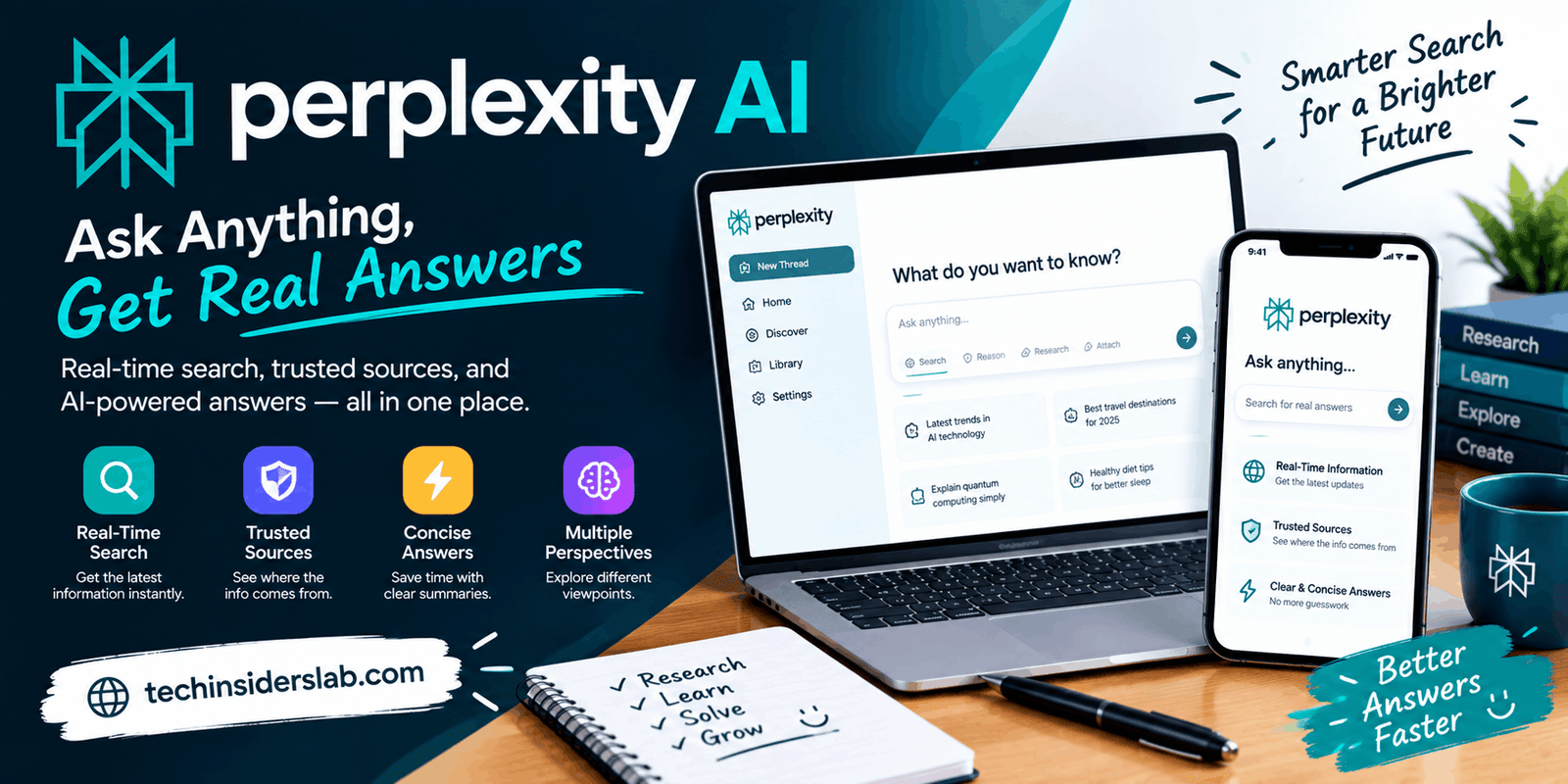
Perplexity is an AI-powered answer and research platform designed to help users find and understand information from the web. The company describes it as an AI answer engine that researches the open web and provides concise answers with citations.
This makes Perplexity different from a conventional search engine. A traditional search engine generally provides a collection of webpages for users to investigate themselves. Perplexity attempts to perform part of that research process automatically by collecting information and presenting a synthesized response.
One of its important characteristics is source visibility. Answers contain citations that allow users to inspect where information came from. This can be particularly useful when researching subjects where checking the original source matters.
Perplexity is available through web and mobile applications, while its broader ecosystem also includes products such as Comet and API services.
How Does Perplexity Work?
When a user enters a question, Perplexity analyzes the request and determines what information may be needed to answer it. Depending on the search mode and question, it can perform searches across different types of online sources.
The system then processes the retrieved information and creates a conversational response. Instead of requiring the user to read every search result, the AI summarizes relevant information into a structured answer.
For more complicated questions, advanced search features can perform multiple searches and synthesize information from numerous sources. Perplexity’s Pro Search documentation explains that the system can search across areas such as the web, academic material, finance information, and user files depending on the selected focus.
However, AI-generated answers should still be checked carefully. Citations make verification easier, but users should not automatically assume that every generated statement is correct. Looking at the cited source is especially important for technical, financial, legal, academic, or rapidly changing information.
Perplexity Search and Pro Search
One of the central features of Perplexity is its search experience. Users can ask questions using natural language instead of trying to create a perfect collection of keywords.
For simple questions, standard search can provide quick answers. More complex questions can benefit from Pro Search, which is designed to perform deeper research.
According to Perplexity’s current documentation, Pro Search can conduct multiple searches, use different types of sources, synthesize information, and provide citations. It can also work with advanced AI models and includes capabilities such as code interpretation for certain research and technical tasks.
This can make the platform useful for tasks such as:
- Understanding complicated technology topics
- Researching academic subjects
- Comparing products or services
- Investigating companies and markets
- Finding information for content creation
- Exploring programming questions
- Summarizing information from multiple sources
- Checking facts and following references
The main advantage is convenience: instead of manually opening dozens of search results, users can start with one question and then continue with follow-up questions.
Perplexity Deep Research
Deep Research is another important part of the platform. It is designed for questions that require considerably more investigation than a quick search.
A Deep Research task can break a complicated subject into smaller research areas, investigate multiple sources, and generate a more comprehensive report.
Perplexity has continued updating its Deep Research capabilities. Its 2026 product updates describe improvements involving advanced models, its proprietary search engine, and research infrastructure.
For example, a user researching an industry could ask Perplexity to investigate market developments, major competitors, recent changes, and supporting sources. A student could use a similar workflow to explore a historical or scientific topic.
Deep Research is particularly useful when the question cannot be answered properly with one or two webpages.
Multiple AI Models
Another notable aspect of Perplexity is its use of multiple AI models.
Instead of requiring users to rely on only one model, Perplexity provides access to different models depending on the plan and feature being used. Its current offerings include models from several major AI developers, along with Perplexity’s own models.
This approach can be useful because different models may perform differently depending on the task. A user working on reasoning, coding, writing, research, or analysis may want different capabilities.
Perplexity can also handle model selection in certain modes, reducing the need for users to understand the technical differences between every available AI model.
Citations and Source Verification
Citations are one of Perplexity’s most recognizable features.
When Perplexity generates an answer, citations can point users toward the sources used to support the information. This creates a more transparent research experience than an AI response that provides no indication of where its information came from.
For users, the important benefit is that they can move from an AI-generated summary to the original material.
For example, if an answer contains a statistic, users can inspect the associated source and determine whether the statistic is being represented correctly. This is especially valuable for professional research and content creation.
Still, citations are not a replacement for critical thinking. A cited source can be outdated, incomplete, or interpreted incorrectly. Users should consider the quality, date, and relevance of the underlying source before relying on an important claim.
Perplexity for Students and Researchers
Perplexity can be useful for students because it can help turn broad questions into organized research.
Instead of searching for a topic using a few keywords, students can ask specific questions and then use follow-up prompts to explore the subject.
For example, a student might begin with a general question about a scientific concept and then ask for historical background, major discoveries, practical applications, or explanations at a simpler level.
Researchers can also benefit from the ability to search across multiple sources and review citations. Perplexity’s advanced research features are intended for more complex research workflows, including academic and professional use cases.
However, students should use AI as a research assistant rather than treating generated content as automatically correct. Original papers, books, institutional resources, and other authoritative material remain important.
Perplexity for Content Creators
Content creators can use Perplexity to research topics before writing articles, guides, newsletters, and social media content.
A useful workflow is to start with a broad topic, identify important subtopics, investigate recent developments, and then review the cited sources. This can help a writer discover information that might otherwise require many separate searches.
The platform can also help creators brainstorm content ideas and understand different perspectives on a subject.
For SEO-focused content, however, AI-generated research should be treated as a starting point. Writers should add original analysis, verify important facts, understand search intent, and avoid simply reproducing AI-generated text.
File Analysis and Research
Perplexity also supports file uploads in its paid offerings, allowing users to provide additional context for certain tasks. Current Pro features include increased file and photo uploads along with research and analysis capabilities.
This can be useful when a user wants to ask questions about a document rather than searching the public web alone.
For example, a user might provide a report and ask the AI to summarize its key points, identify important sections, or compare information inside the document with external research.
This creates a more flexible workflow because the AI can work with both external information and user-provided material.
Perplexity Plans
Perplexity offers a free option as well as paid plans with expanded capabilities.
The free version provides access to core search functionality and citations, making it possible for users to try the platform without paying for a subscription. Paid plans increase usage limits and provide access to additional capabilities such as advanced research, more file uploads, higher-level AI models, and other productivity features.
Perplexity Pro is positioned for users who need more extensive research and AI capabilities. According to the company’s current information, Pro includes features such as extended Pro Search, file analysis, advanced models, image generation, and deeper research access.
There are also higher-level plans designed for users with heavier workloads and professional requirements.
Because pricing and feature availability can change, users should check the current plan information before subscribing.
Advantages of Perplexity
One of the biggest advantages of Perplexity is its combination of search and conversational AI.
Some notable benefits include:
Direct Answers
Users can receive a summarized response rather than manually opening many search results.
Source Citations
Citations make it easier to investigate the information behind an answer.
Natural-Language Search
Questions can be written conversationally, making research more accessible.
Follow-Up Questions
Users can continue the same conversation and refine their research.
Advanced Research
Pro Search and Deep Research can handle more complicated information-gathering tasks.
Multiple AI Models
Different models can be available for different types of tasks.
File Support
Certain plans allow users to upload files and use them as part of research workflows.
Limitations to Consider
Despite its useful features, Perplexity is not a perfect replacement for human research.
AI-generated answers can contain mistakes, misunderstand a question, or summarize a source incorrectly. Search results can also change over time, meaning that an answer produced today may differ from one generated later.
Another limitation is that a citation does not automatically guarantee that a claim is accurate. Users should inspect the original source when accuracy is important.
There can also be differences between free and paid features, including usage limits and access to advanced models.
For high-stakes subjects, users should always verify important information through authoritative primary sources.
Perplexity vs. Traditional Search
The biggest difference between Perplexity and traditional search is the presentation of information.
Traditional search engines are primarily designed to help users discover webpages. Perplexity focuses on producing an AI-generated answer based on information it retrieves.
Neither approach completely eliminates the need for users to evaluate information.
Traditional search gives users more direct control over which pages they open and read. Perplexity can save time by summarizing information first and allowing users to investigate sources afterward.
The better workflow depends on the user’s goal. A quick explanation may benefit from an AI answer, while detailed research may require reading original documents and authoritative sources.
Who Can Use Perplexity?
Perplexity can be useful for a wide range of users.
Students can use it to explore educational topics. Researchers can use it to organize preliminary research. Writers can investigate subjects before creating content. Developers can use it for technical questions and code-related research. Professionals can use it for market and industry research.
Its conversational format also makes it approachable for people who do not want to learn complicated search operators.
The Future of AI Search
Perplexity represents a broader shift from traditional keyword-based search toward AI-assisted information discovery.
Modern AI search platforms are increasingly attempting to do more than find webpages. They can research, summarize, analyze, create content, work with files, and support multi-step tasks.
Perplexity’s recent product updates show this expansion into research, computer-based workflows, connected tools, and other AI capabilities.
This suggests that AI search is becoming part of a larger productivity ecosystem rather than remaining a simple alternative to traditional search.
Conclusion
Perplexity AI is an AI-powered search and research platform that combines web information with conversational artificial intelligence. Its emphasis on cited answers, advanced search, research features, multiple AI models, and file analysis makes it useful for people who want to investigate topics more efficiently.
Its biggest practical advantage is the ability to move from a question to a structured answer while still giving users access to supporting sources. Advanced features such as Pro Search and Deep Research extend this experience to more complex research tasks.
At the same time, users should remember that AI-generated information still needs verification. Citations provide a valuable way to check claims, but important information should be confirmed through reliable original sources.
For everyday questions, research, learning, content planning, and information discovery, Perplexity provides a modern approach to searching the web and interacting with information.