introduction
Healthcare organizations need more than a basic digital patient record. Behavioral health providers, in particular, manage complex treatment plans, group sessions, medications, scheduling, insurance requirements, documentation, and patient communication at the same time. When these activities are handled through disconnected systems, staff can spend significant time moving information from one platform to another.
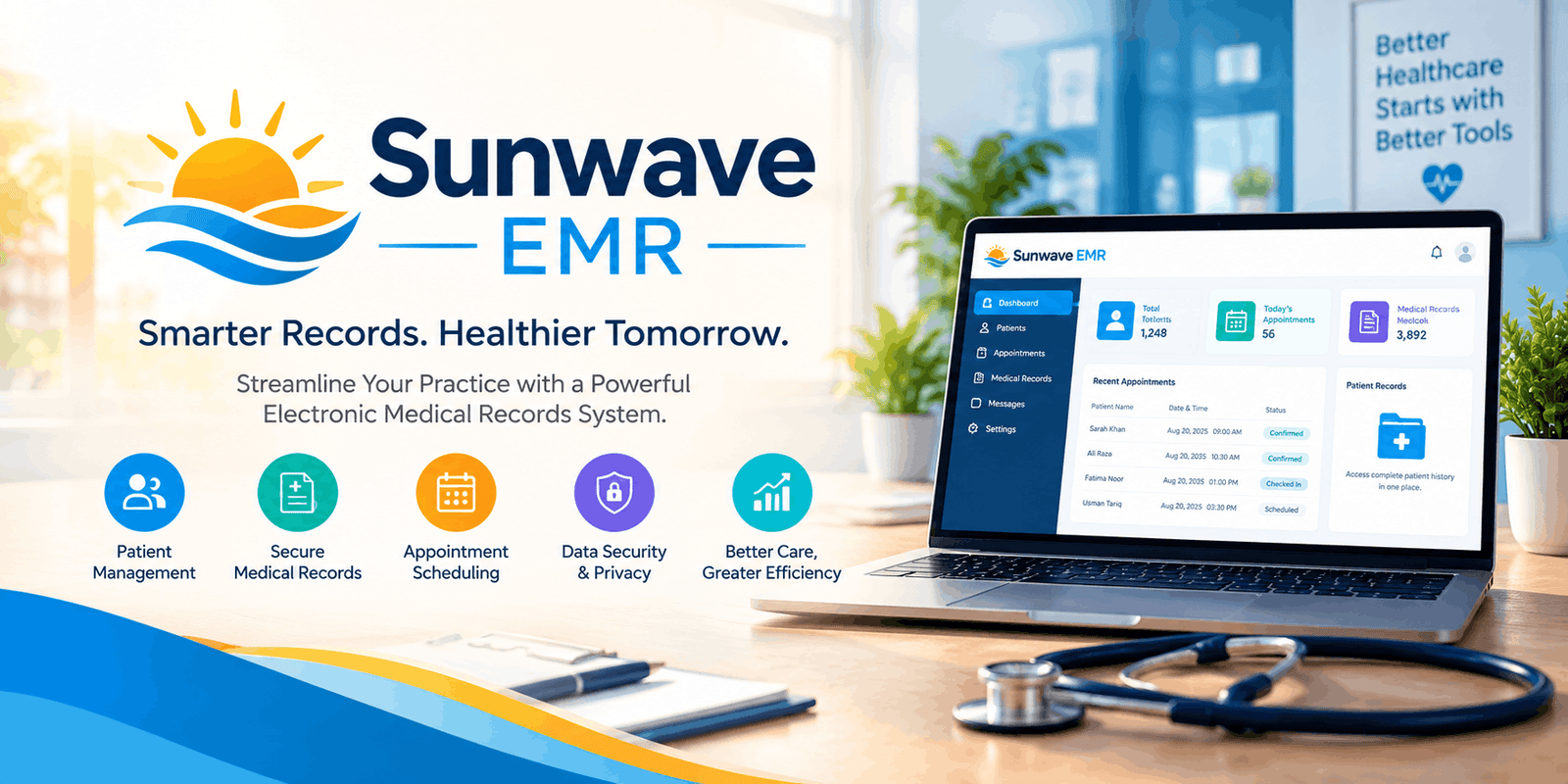
Sunwave EMR is designed to address this problem by bringing behavioral health clinical, administrative, and financial workflows together in a connected software environment. Sunwave Health positions its platform around behavioral health organizations, including mental health and substance use treatment providers. Its broader platform combines an electronic medical record (EMR), customer relationship management (CRM), revenue cycle management (RCM), telehealth, and AI-assisted documentation.
What Is Sunwave EMR?
Sunwave EMR is a behavioral health electronic medical record platform designed to help treatment organizations manage patient information and clinical workflows digitally.
Unlike a general-purpose medical record system, Sunwave focuses heavily on behavioral health workflows. These can include assessments, treatment plans, progress notes, medication management, group documentation, scheduling, telehealth, client communication, and other activities associated with behavioral health treatment.
Sunwave describes its EMR as a platform that connects clinical, administrative, and financial processes. The goal is to reduce duplicated data entry and give staff a more connected view of the patient journey from admission through treatment and discharge.
This approach can be particularly useful for organizations where multiple departments need access to related information. Clinical staff may need patient documentation, administrative teams may need scheduling and admissions information, and billing teams may need documentation that supports claims.
Why Behavioral Health Organizations Need Specialized EMR Software
Behavioral healthcare has workflows that can be considerably different from those found in a traditional medical practice.
A patient may move between different levels of care, participate in individual and group sessions, require medication management, receive telehealth services, and have ongoing authorization or insurance requirements. The medical record therefore needs to tell a continuous story rather than simply store isolated appointments.
Sunwave’s own explanation of behavioral health EMRs emphasizes the importance of connected assessments, treatment plans, progress documentation, group care, levels of care, privacy workflows, and revenue-related processes.
For a treatment organization, this means the quality of an EMR should not be judged only by how attractive its dashboard looks. The more important question is whether the software fits the organization’s actual clinical and administrative workflow.
Key Features of Sunwave EMR
1. Clinical Documentation
Documentation is one of the central functions of any EMR, and Sunwave provides tools for behavioral health documentation.
The platform supports progress notes, assessments, configurable templates, treatment plans, and other clinical documentation workflows. Sunwave says its documentation tools are designed to help organizations maintain complete records and support audit and payer-review requirements.
Configurable documentation can also help organizations adapt forms and workflows to their specific programs rather than forcing every provider to use exactly the same process.
2. Treatment Planning
Treatment planning is another important component of behavioral healthcare.
Sunwave supports configurable treatment plans intended to connect clinical goals, interventions, and ongoing progress documentation. This can help create a more consistent relationship between what was identified during assessment and what clinicians document during treatment.
This connected approach is sometimes described as maintaining a “golden thread” through the clinical record, where assessments, treatment plans, interventions, and progress notes support one another.
3. Scheduling and Calendar Management
Managing appointments manually can become difficult when an organization handles individual therapy, group sessions, psychiatry appointments, telehealth, and multiple staff schedules.
Sunwave’s scheduling functionality includes individual and group appointments, group calendar views, internal availability, appointment reminders, online booking, and options for blocking calendars for non-client activities.
Keeping scheduling within the broader EMR can reduce the need for staff to repeatedly switch between a scheduling application and the patient’s clinical record.
4. Medication Management
Medication workflows can be particularly important in behavioral health and substance use treatment.
Sunwave provides medication-management functionality that includes prescriptions, medication orders, medication history, contraindications, medication-assisted treatment (MAT), and workflows involving controlled and psychotropic substances.
For organizations working with complex medication protocols, having these activities connected to the patient record can provide a clearer picture of treatment history and documentation.
However, organizations should always verify the exact prescribing capabilities, integrations, regulatory requirements, and jurisdiction-specific functionality before implementation.
5. Built-In Telehealth
Telehealth has become an important part of modern behavioral healthcare.
Sunwave offers telehealth functionality within its platform rather than requiring providers to depend entirely on a separate video system. Its telehealth product supports individual and group sessions and can connect documentation and forms with the patient’s record.
Sunwave also describes automated text and email appointment reminders designed to help organizations manage attendance and reduce missed appointments.
The advantage of an integrated approach is straightforward: clinicians can conduct a virtual session and continue documentation without manually transferring information between unrelated systems.
Sunwave AI and SIA
One of the most notable aspects of the modern Sunwave platform is its AI functionality.
Sunwave calls its AI documentation assistant SIA, or Sunwave Intelligent Assistant. According to the company, SIA can assist with individual and group progress notes, patient summaries, assessments, and telehealth transcripts.
The basic idea is to reduce the amount of time clinicians spend creating repetitive documentation.
Sunwave reports customer-specific results from JourneyPure, including time savings per assessment and improvements in documentation-related metrics. These are vendor-reported results rather than independently verified industry-wide measurements, so organizations should evaluate the results in the context of their own workflows.
AI documentation can be useful, but it should not eliminate clinical oversight. Generated notes still need appropriate review and approval by qualified professionals before they become part of the official record.
Client Management and Communication
Behavioral health treatment does not happen only during scheduled appointments. Patients may need communication and support between sessions.
Sunwave includes client-management functionality with a client-facing portal and secure messaging capabilities. The platform describes the client profile as a centralized source of information that helps staff understand a patient’s history and context before sessions.
A connected communication system can help organizations keep important patient interactions associated with the appropriate record rather than scattering information across email inboxes or unrelated messaging platforms.
CRM and Admissions Management
Another major component of Sunwave is its CRM functionality.
Admissions teams often need to track inquiries, referrals, insurance information, available beds, assessments, and the progress of prospective patients. Sunwave’s CRM is designed to provide visibility into inquiries, referral sources, and available capacity.
This is important because an EMR typically becomes most useful after a person becomes a patient, while admissions teams also need tools to manage the journey before admission.
By connecting CRM and EMR workflows, Sunwave aims to reduce the gap between prospective patients and active treatment records.
Revenue Cycle Management
Healthcare software becomes even more valuable when clinical and financial information can work together.
Sunwave’s broader platform includes revenue cycle management alongside its EMR and CRM. The company describes this as an integrated approach to billing and financial workflows rather than requiring organizations to maintain completely separate systems.
This can potentially reduce repetitive data entry and make it easier for billing teams to access information related to the services being billed.
However, organizations should evaluate specific payer workflows, claim requirements, authorization processes, integrations, and reporting capabilities before selecting the platform.
Compliance and Security Considerations
Healthcare software handles highly sensitive information, so security and compliance should be among the first considerations when evaluating any EMR.
Sunwave provides compliance-focused functionality within its behavioral health platform, including documentation controls, medication workflows, consent-related processes, and audit-oriented records.
Behavioral health organizations may also have requirements beyond general healthcare privacy practices. For example, substance use treatment providers can have additional considerations involving 42 CFR Part 2, depending on the records and circumstances involved. Sunwave specifically discusses Part 2 considerations within its substance-use-disorder workflows.
Organizations should independently verify their compliance obligations and confirm how a vendor’s technical controls, contracts, configurations, and integrations apply to their specific environment.
Benefits of Using Sunwave EMR
There are several reasons a behavioral health organization might consider Sunwave.
Centralized information: Clinical, administrative, admissions, and financial workflows can be connected rather than scattered across unrelated systems.
Reduced duplicate entry: Sunwave’s platform is designed around the idea of entering information once and allowing connected workflows to use that information where appropriate.
Behavioral health specialization: The software is specifically positioned for behavioral health rather than being a general medical platform with a small behavioral health add-on.
AI-assisted documentation: SIA can help clinicians generate different types of documentation and summaries, subject to appropriate human review.
Integrated telehealth: Virtual appointments can be connected with the same patient record and documentation environment.
Connected admissions and billing: CRM and RCM functionality can extend the platform beyond the clinical record itself.
Potential Limitations to Consider
No EMR is automatically the right solution for every organization.
One important consideration is complexity. An all-in-one platform can offer significant advantages, but organizations may need time for configuration, training, migration, workflow design, and implementation.
Pricing is another consideration. Sunwave does not prominently publish a standard public price list on its official product pages, so organizations generally need to contact the company for information relevant to their specific requirements.
Independent software-review information also suggests that users generally view Sunwave positively, while some reviews identify customization as an area worth evaluating. Capterra currently lists Sunwave at 4.4 out of 5 based on 36 reviews, while other software directories note both usability strengths and potential cost or customization considerations. These reviews should be treated as user feedback rather than universal conclusions.
For that reason, organizations should request a workflow-based demonstration instead of relying only on a feature checklist.
Who Can Benefit From Sunwave EMR?
Sunwave is most closely aligned with behavioral health organizations, including mental health and substance use treatment providers.
It may be particularly relevant for organizations managing multiple levels of care, group therapy, medication management, telehealth, admissions, insurance processes, and revenue-cycle operations.
Sunwave also identifies enterprise behavioral health organizations among the groups it supports and emphasizes the challenge of coordinating multiple teams, locations, and operational systems.
A small independent provider with very simple workflows may have different needs from a multi-location treatment organization. Therefore, the best fit depends on organization size, patient volume, services, payer mix, existing technology, and implementation requirements.
How to Evaluate Sunwave Before Choosing It
Before purchasing any behavioral health EMR, create a list of your organization’s most important workflows and ask the vendor to demonstrate each one.
For example, ask to see:
- Patient intake and admission
- Assessment and treatment planning
- Individual and group documentation
- Medication workflows
- Authorization and utilization review
- Scheduling
- Telehealth
- Patient communication
- Billing and claims
- Reporting and analytics
- Data migration
- Integrations
- User permissions
- Audit and compliance workflows
It is also useful to ask what requires additional configuration, third-party integrations, separate contracts, or additional fees.
This approach provides a more realistic evaluation than simply comparing the number of features advertised by different vendors.
Conclusion
Sunwave EMR is more than a traditional electronic medical record system; it is a behavioral health technology platform designed to connect clinical care with administrative and financial workflows. Its features for documentation, treatment planning, medication management, scheduling, telehealth, CRM, RCM, and AI-assisted documentation can help organizations create a more connected workflow.
For behavioral health and substance use treatment providers, Sunwave can be a useful option when managing complex patient journeys and multiple operational teams. However, organizations should carefully evaluate pricing, customization, integrations, security, compliance, implementation, and staff training before making a final decision.
Overall, Sunwave EMR is a strong healthcare technology solution for organizations looking for an integrated behavioral health platform rather than a basic EMR alone.