
introduction
Learning new English vocabulary is an important part of improving reading, writing, speaking, and communication skills. One simple way to expand your vocabulary is by learning words according to their first letter. If you are looking for words that start with R, there are hundreds of useful options, ranging from short and simple words to advanced vocabulary used in professional and academic writing.
The letter R is the eighteenth letter of the English alphabet. It appears in everyday words such as rain, red, run, and room, as well as more advanced words like resilience, remarkable, responsibility, and revolution. Understanding these words can help learners express ideas more clearly and develop stronger language skills.
In this guide, you will discover common R words, their meanings, example sentences, vocabulary for children, positive words, and advanced terms. Whether you are a student, teacher, writer, or someone learning English, this collection can help you find the right word for different situations.
Common Words That Start With R
Common R words are used frequently in everyday conversations, books, messages, and educational activities. Learning them first can make English vocabulary easier to understand and remember.
Here are some useful examples:
| Word | Meaning |
| Rabbit | A small animal with long ears |
| Rain | Water falling from clouds |
| Rainbow | A colored arc visible in the sky |
| Read | To look at and understand written words |
| Ready | Prepared for something |
| Real | Existing or genuine |
| Red | A color |
| Remember | To keep something in your memory |
| Repair | To fix something damaged |
| Repeat | To do or say something again |
| Reply | To answer someone |
| Rest | To relax or stop working |
| Rice | A grain used as food |
| River | A natural flowing body of water |
| Road | A route used for traveling |
| Robot | A machine that can perform tasks |
| Room | A space inside a building |
| Rose | A type of flower |
| Run | To move quickly on foot |
| Rule | An instruction or guideline |
These words are useful for beginners because they are easy to recognize and appear in many everyday situations.
3-Letter Words That Start With R
Short words are an excellent starting point for young learners and beginners. Three-letter words are generally easier to spell, pronounce, and use in simple sentences.
Here are some examples:
| Word | Meaning |
| Rag | A small piece of old cloth |
| Ram | An adult male sheep |
| Rap | A style of rhythmic music |
| Rat | A small rodent |
| Raw | Not cooked or processed |
| Ray | A narrow beam of light |
| Red | A basic color |
| Rib | A curved bone in the chest |
| Rid | To remove or get free of something |
| Rig | Equipment or machinery arranged for a purpose |
| Rim | The outer edge of something |
| Rip | To tear something |
| Rob | To steal from someone |
| Rod | A straight, thin piece of material |
| Rot | To decay or decompose |
| Row | A line of things or people |
| Rub | To move something against a surface |
| Rug | A small floor covering |
| Run | To move quickly |
| Rye | A type of grain |
Short vocabulary lists can be especially helpful for spelling games, classroom exercises, and early reading practice.
4-Letter Words That Start With R
Four-letter words help learners move beyond basic vocabulary while keeping spelling relatively simple. Many of these words are commonly used in conversations and written English.
| Word | Meaning |
| Race | A competition to see who is fastest |
| Rack | A structure used for holding objects |
| Raid | A sudden attack or search |
| Rain | Water falling from the sky |
| Rank | A position in a group or organization |
| Rare | Not common or unusual |
| Rate | A measurement or level |
| Read | To understand written information |
| Real | Genuine or actual |
| Rear | The back part of something |
| Rich | Having a lot of money or resources |
| Ride | To travel on a bicycle, horse, or vehicle |
| Ring | A circular piece of jewelry or sound |
| Rise | To move upward |
| Risk | The possibility of danger or loss |
| Road | A path for vehicles and people |
| Rock | A hard natural material |
| Role | A function or part played by someone |
| Room | An enclosed space |
| Rule | An instruction that guides behavior |
5-Letter Words That Start With R
Five-letter words are useful for expanding vocabulary and practicing spelling. They also appear frequently in word puzzles, school assignments, and everyday writing.
Some popular examples include:
| Word | Meaning |
| Radio | A device or system for broadcasting sound |
| Raise | To lift or increase something |
| Range | A variety or distance between limits |
| Reach | To arrive at or extend toward something |
| Ready | Prepared for an activity |
| Reply | An answer to a question |
| Right | Correct or opposite of left |
| River | A natural stream of flowing water |
| Roast | To cook using dry heat |
| Round | Having a circular shape |
| Royal | Connected with a king or queen |
| Ruler | A measuring instrument or person who governs |
| Rural | Related to the countryside |
| Rapid | Happening very quickly |
| Refer | To mention or direct attention to something |
Positive Words That Start With R
Positive vocabulary can make communication more encouraging, expressive, and meaningful. These words are useful for writing descriptions, personal statements, greetings, motivational messages, and professional communication.
| Word | Meaning |
| Radiant | Bright, cheerful, or full of light |
| Reliable | Someone or something that can be trusted |
| Remarkable | Unusual or worthy of attention |
| Respectful | Showing consideration for others |
| Responsible | Dependable and willing to accept duties |
| Resilient | Able to recover from difficulties |
| Resourceful | Good at finding practical solutions |
| Rewarding | Giving satisfaction or benefit |
| Reassuring | Making someone feel less worried |
| Respectable | Deserving respect |
| Refreshing | Pleasantly new or different |
| Refined | Improved, polished, or elegant |
| Rational | Based on reason and logical thinking |
| Robust | Strong and healthy |
| Rejoicing | Expressing happiness |
For example, you could say, “She is a reliable and resourceful team member.” This sentence uses two positive R words to describe someone’s qualities.
Advanced Words That Start With R
Advanced vocabulary is helpful for students, professionals, writers, and people preparing for English examinations. These words can make writing more precise and help communicate complex ideas.
Here are some valuable advanced R words:
| Word | Meaning |
| Raconteur | A person skilled at telling interesting stories |
| Ramification | A possible consequence or result |
| Rationality | The quality of thinking logically |
| Reconciliation | The process of restoring friendly relations |
| Recuperation | The process of recovering health or strength |
| Redundant | No longer needed or useful |
| Refutation | Evidence or an argument that disproves a claim |
| Rejuvenate | To make something feel or look young again |
| Reluctant | Unwilling or hesitant to do something |
| Reminisce | To remember and talk about past experiences |
| Repercussion | An indirect or usually negative consequence |
| Resurgence | A return or increase in activity |
| Retrospective | Looking back at past events |
| Revelation | The discovery or disclosure of something surprising |
| Reverence | Deep respect or admiration |
Example sentences:
- The decision had several unexpected ramifications.
- She was reluctant to accept the offer.
- The organization experienced a resurgence in popularity.
- His presentation provided a rational explanation of the issue.
- The documentary encouraged viewers to reminisce about the past.
Using advanced words in the correct context is more important than simply memorizing difficult vocabulary.
Words That Start With R for Kids
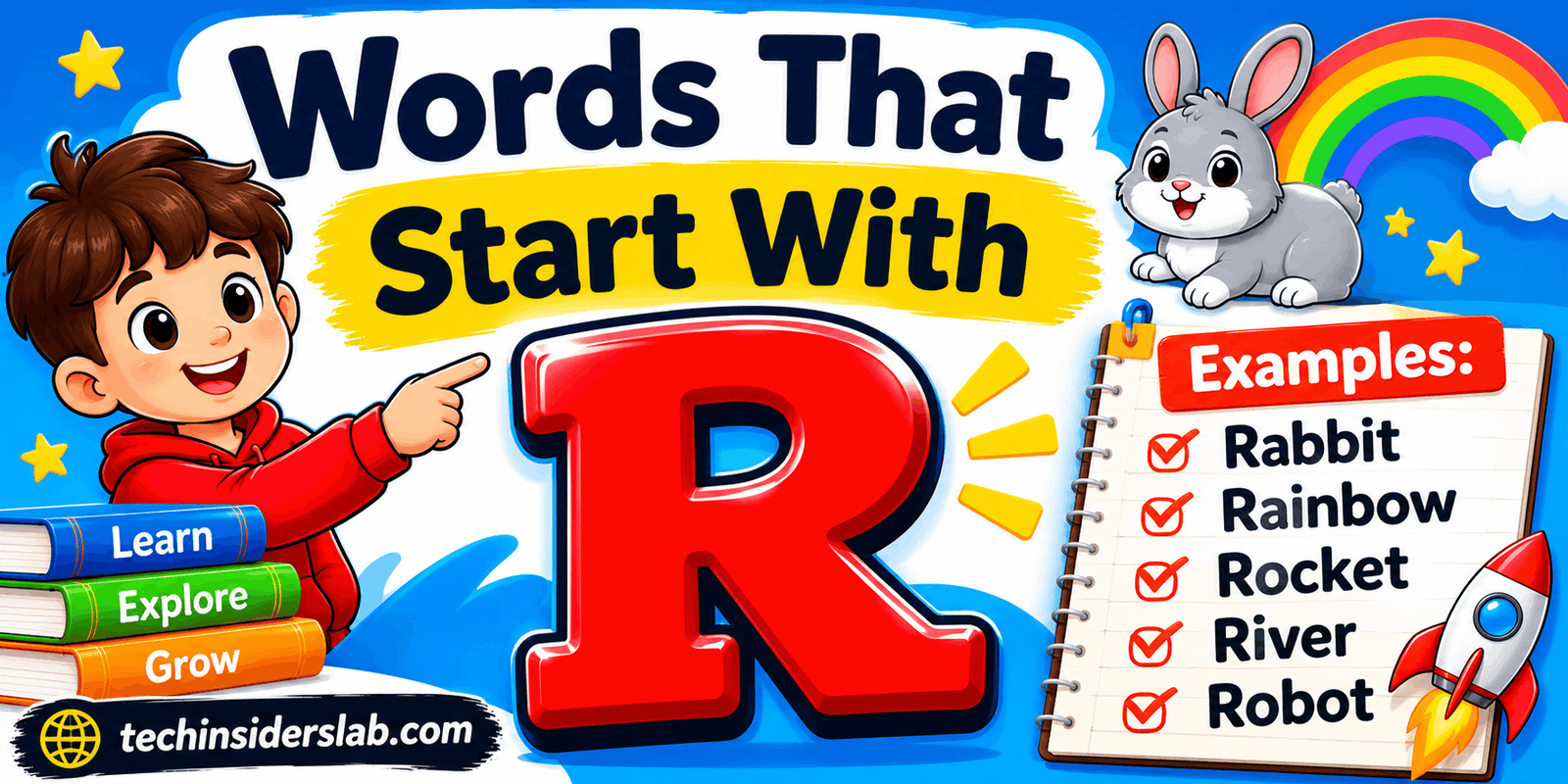
Children can learn vocabulary more effectively when words are connected to familiar objects, animals, colors, and activities. Simple R words can support early reading, spelling, and pronunciation practice.
| Word | Simple Meaning |
| Rabbit | A small animal |
| Rainbow | Colorful shape in the sky after rain |
| Rain | Water from clouds |
| Rose | A beautiful flower |
| Red | A color |
| Robot | A machine that performs tasks |
| Rocket | A vehicle that travels into space |
| Ring | A circular piece of jewelry |
| Rock | A small or large stone |
| Ruler | A tool for measuring |
| Rice | A food grain |
| Road | A place where vehicles travel |
| Ribbon | A narrow strip of decorative fabric |
| Reindeer | An animal related to deer |
| Rooster | A male chicken |
Parents and teachers can make learning more enjoyable by showing pictures, asking children to repeat words, and encouraging them to create short sentences.
For example:
- The rabbit is white.
- The rose is red.
- The rocket flies into space.
- The rainbow has many colors.
Words That Start With R With Example Sentences
Learning a word’s meaning is useful, but seeing it in a sentence helps learners understand how it works in real communication.
Here are ten examples:
- Respect: We should respect other people’s opinions.
- Research: Students use research to learn about new subjects.
- Remember: Please remember to bring your notebook.
- Reliable: My friend is a reliable person.
- Repair: The mechanic will repair the car.
- Reduce: We should reduce unnecessary waste.
- Relax: I like to relax after a busy day.
- Return: Please return the book tomorrow.
- Responsible: Every student should be responsible for their work.
- Remarkable: She made remarkable progress in English.
These sentences demonstrate how R words can be used naturally in everyday English.
Different Types of R Words
Words beginning with R belong to different grammatical categories. Understanding these categories can help learners use vocabulary correctly.
R Nouns
Nouns name people, places, objects, animals, or ideas.
Examples include:
- Rabbit
- River
- Room
- Reason
- Resource
- Relationship
- Responsibility
- Reflection
R Verbs
Verbs describe actions, activities, or states.
Examples include:
- Read
- Run
- Raise
- Repair
- Remember
- Recommend
- Recognize
- Respond
R Adjectives
Adjectives describe people, objects, or situations.
Examples include:
- Red
- Rare
- Rapid
- Reliable
- Respectful
- Remarkable
- Responsible
- Reasonable
R Adverbs
Adverbs provide additional information about verbs, adjectives, or other adverbs.
Examples include:
- Rapidly
- Rarely
- Really
- Recently
- Regularly
- Respectfully
- Reasonably
- Reluctantly
Learning these categories makes it easier to build grammatically correct sentences.
How to Improve Your Vocabulary With R Words
Memorizing a list is a useful beginning, but regular practice helps vocabulary become part of everyday communication. Here are some practical methods for learning R words.
1. Learn a Few Words Every Day
Start with five to ten words. Read their meanings, pronounce them, and write each word in a notebook. Learning a manageable number of words regularly can be more effective than trying to memorize a very long list at once.
2. Create Your Own Sentences
Choose a new word and use it in a sentence related to your daily life. For example, use reliable to describe a person you trust or routine to describe your daily activities.
3. Read English Books and Articles
Reading exposes you to vocabulary in context. When you find an unfamiliar R word, write it down and check its meaning in a reliable dictionary.
4. Practice Spelling
Write each word several times and check its spelling. You can also ask someone to read words aloud while you write them.
5. Play Word Games
Word searches, crossword puzzles, alphabet games, and word-building activities make vocabulary practice more interesting. These activities can also help improve spelling and word recognition.
6. Review Previously Learned Words
Revisit your vocabulary list after a few days. Try explaining the meanings without looking at your notes. Regular revision helps you remember words for longer.
Why Learning Words That Start With R Is Useful
Learning words by their starting letters provides a simple structure for vocabulary development. Instead of studying random words, learners can focus on one group at a time and gradually build a larger vocabulary.
This approach offers several benefits:
- Better spelling: Repeated practice helps learners recognize correct letter patterns.
- Improved reading: Familiarity with words makes reading easier.
- Stronger communication: A wider vocabulary helps people express thoughts more clearly.
- Better writing: Knowing different words allows writers to avoid unnecessary repetition.
- Increased confidence: Understanding more vocabulary can make conversations and classroom activities less challenging.
- Educational support: Alphabetical word lists can help teachers organize spelling and vocabulary exercises.
A focused list of R words can also be useful for word games, creative writing, classroom assignments, and English-language practice.
Conclusion
Words that start with R include a wide range of everyday vocabulary, positive expressions, action words, descriptive terms, and advanced English words. From simple examples like rain, red, and run to more complex vocabulary such as resilience, reconciliation, and remarkable, each word offers an opportunity to improve language skills.
The best way to learn these words is to understand their meanings, practice pronunciation, use them in sentences, and review them regularly. Whether you are helping a child learn the alphabet or expanding your own English vocabulary, this R-word collection provides a useful starting point. Continue exploring new words and practicing them in real situations to become a more confident English reader, writer, and speaker.