introduction
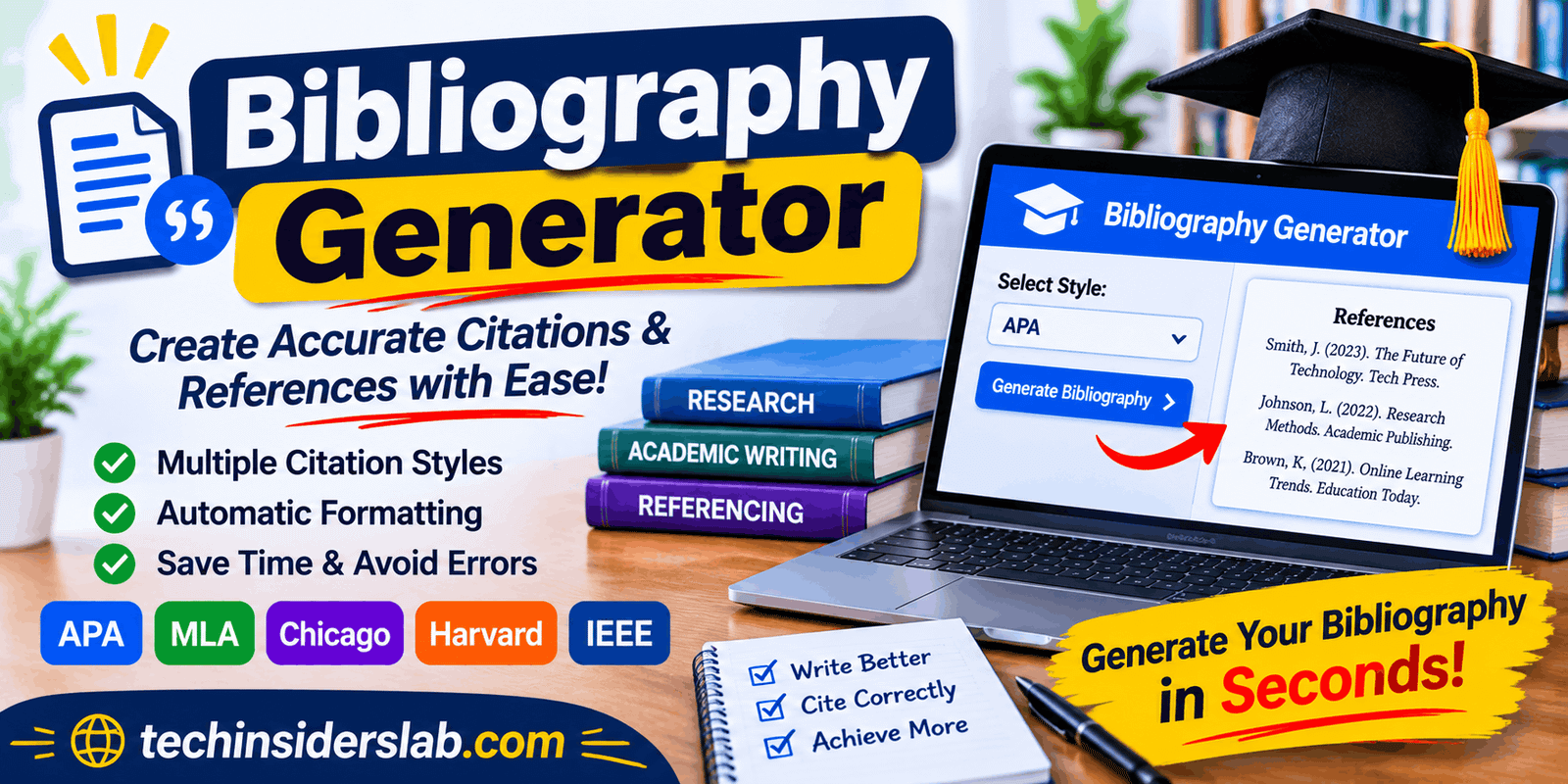
A bibliography generator is a useful online tool that helps students, teachers, researchers, writers, and professionals create properly formatted references for their academic and professional work. Instead of manually arranging author names, publication dates, article titles, website URLs, and other details, users can enter basic source information and generate citations automatically.
Creating a bibliography may seem like a small part of writing an assignment or research paper, but it plays an important role in maintaining academic integrity. Proper references help readers identify original sources, verify information, and understand where research ideas come from.
Whether someone is preparing a school assignment, university dissertation, research article, business report, or blog post, a bibliography generator can make the referencing process easier and more organized.
In this guide, we will explore what a bibliography generator is, how it works, its main features, popular citation styles, benefits, limitations, and how to choose the right tool for different writing needs.
What Is a Bibliography Generator?
A bibliography generator is an online tool or software application that automatically creates formatted references for books, academic journals, websites, newspapers, research papers, and other information sources.
Normally, writers must follow specific referencing rules when mentioning information from external sources. These rules determine how author names, publication dates, titles, publishers, page numbers, and other details should appear in a reference.
Different academic institutions and publications use different citation formats. For example, APA and MLA follow different formatting requirements. Remembering every rule can be challenging, especially when a project includes dozens of sources.
A bibliography generator simplifies this process by organizing source information into the correct citation format.
Most tools allow users to select a citation style, enter source details, and generate a formatted reference within seconds. Some advanced generators can also create in-text citations and complete reference lists.
The main purpose is not simply to save time. It is also to help writers maintain consistency and reduce common formatting mistakes.
How Does a Bibliography Generator Work?
A bibliography generator works by collecting information about a source and arranging it according to a selected citation style.
Although different platforms have different interfaces, the general process is relatively similar.
1. Select a Source Type
The first step is identifying the type of material being referenced. Common options include:
- Books and ebooks
- Journal articles
- Websites and web pages
- Newspapers and magazines
- Research papers
- Online reports
- Videos and multimedia
- Government publications
Selecting the correct source type helps the generator identify which information is required.
2. Enter Source Information
After choosing the source type, users provide relevant details. These may include the author’s name, publication title, publisher, publication year, website address, DOI, and access date.
Some generators also allow users to paste a URL or search for a source using its title or ISBN.
3. Choose a Citation Style
The next step is selecting the required referencing format. Popular options include APA, MLA, Chicago, Harvard, and IEEE.
Each style has its own rules for arranging information and displaying punctuation.
4. Generate the Citation
Once the information has been entered, the tool processes it using the selected formatting rules and produces a citation.
Users can review the result, make corrections, and copy it into their document.
5. Organize the Bibliography
Some tools provide additional features for saving multiple references in one project. They may arrange entries alphabetically, organize sources into folders, and generate a complete bibliography.
This is especially helpful for lengthy research projects.
Popular Citation Styles Supported by Bibliography Generators
One of the most important features of a bibliography generator is its ability to support different citation styles. Writers should always follow the format required by their teacher, university, publisher, or organization.
APA Style
The American Psychological Association (APA) style is commonly used in psychology, education, social sciences, and related academic fields.
APA generally emphasizes the author’s name and publication year. This makes it easier for readers to understand how recently a source was published.
For example, an APA book reference generally includes the author’s surname, initials, publication year, book title, and publisher.
MLA Style
Modern Language Association (MLA) style is widely used in literature, language studies, humanities, and cultural research.
MLA focuses on the author and source title. Its bibliography section is commonly called the Works Cited page.
Students working on literature reviews, essays, and language assignments often use this format.
Chicago Style
Chicago style is frequently used in history, publishing, and some humanities disciplines.
It offers two main documentation systems:
- Notes and Bibliography
- Author-Date
The Notes and Bibliography system uses footnotes or endnotes alongside a bibliography, while Author-Date uses parenthetical citations and a reference list.
Harvard Style
Harvard referencing is an author-date citation system used by many universities and academic institutions.
It usually includes the author’s surname and publication year within the text, with complete source information in a reference list.
Exact formatting requirements can vary between institutions, so users should check their institution’s Harvard referencing guide.
IEEE Style
IEEE referencing is commonly used in engineering, computer science, electronics, and technical research.
It generally uses numbered citations in square brackets. Sources appear in a numbered reference list according to the order in which they are cited.
A bibliography generator makes switching between these formats easier without requiring users to memorize every formatting rule.
Main Features of a Bibliography Generator
Not every bibliography generator offers the same capabilities. Basic tools focus on creating individual citations, while advanced platforms provide complete reference management features.
Here are some useful features to look for.
Automatic Citation Generation
Automatic citation generation is the primary function of these tools. Users can enter source details or provide a source identifier, and the generator arranges the information according to the selected style.
This reduces repetitive formatting work and helps maintain consistency across a document.
URL and DOI Citation Support
Many modern generators allow users to paste a webpage URL or Digital Object Identifier (DOI) to retrieve publication details.
A DOI is a persistent identifier commonly used for scholarly publications. It can help identify a research article even if its original webpage address changes.
However, automatically retrieved information should always be checked because some websites do not provide complete or accurate metadata.
Multiple Citation Styles
A good bibliography generator should support several commonly used academic formats.
This feature is particularly helpful for researchers who work with different institutions, journals, or academic requirements.
In-Text Citations
Some tools generate both complete references and short citations that appear within the body of a document.
For example, an author-date system may display an author’s surname and publication year in the text, while the full reference appears at the end.
Bibliography Organization
Managing multiple sources can become difficult during larger research projects. Advanced generators may provide folders, saved projects, alphabetical sorting, and reference lists.
These features help users keep their research materials organized.
Export and Copy Options
Many tools allow users to copy citations or export their reference lists into formats suitable for documents and research workflows.
Depending on the platform, export options may include Word-compatible files, text, or reference-management formats.
Browser Integration
Some bibliography tools offer browser extensions that help users collect source details while researching online.
Instead of manually copying information from every webpage, users can capture relevant publication details and save them for later.
Benefits of Using a Bibliography Generator
A bibliography generator offers several advantages for people who regularly write assignments, reports, and research documents.
1. Saves Time
Manually formatting every reference can take considerable time, particularly when a project includes many books, articles, and online sources.
A generator automates much of this work, allowing writers to spend more time researching, planning, and improving their content.
2. Reduces Formatting Mistakes
Citation styles contain specific rules for punctuation, capitalization, author names, dates, and publication information.
A bibliography generator helps apply these rules consistently. Although it cannot guarantee perfect accuracy, it reduces many common formatting errors.
3. Supports Academic Integrity
Giving proper credit to original authors is an important part of responsible academic writing.
References help readers distinguish between a writer’s original ideas and information obtained from other sources.
Using a bibliography generator makes it easier to document research materials and acknowledge their original creators.
4. Makes Research More Organized
Students working on dissertations or research papers may collect information from dozens or even hundreds of sources.
Reference management features make it easier to save, sort, and retrieve these sources whenever needed.
5. Helps Beginners Learn Citation Formats
Students who are unfamiliar with APA, MLA, or Chicago referencing may find formatting rules confusing.
A generator provides practical examples of how different sources should be documented. By reviewing generated references, beginners can gradually understand the structure of academic citations.
6. Useful for Different Types of Projects
Bibliography generators are not limited to university assignments. They can also help with professional reports, presentations, articles, books, and other documents that require source attribution.
Who Should Use a Bibliography Generator?
Bibliography generators are useful for different types of users. Their value depends on how frequently someone works with external information.
Students: School, college, and university students can use these tools to prepare assignments, essays, presentations, and research projects. They can also learn how different citation styles work.
Researchers: Academic researchers often work with large collections of journal articles, books, and conference papers. Citation generators and reference managers help them organize these materials and prepare reference lists.
Teachers and Educators: Teachers can use bibliography tools when preparing educational resources, reading lists, worksheets, and academic presentations.
Writers and Bloggers: Content creators who include statistics, research findings, expert opinions, or external information in their articles can use citation tools to acknowledge their sources.
Professionals: Business analysts, consultants, and technical writers may also need properly documented references in reports, proposals, and professional publications.
Popular Bibliography Generator Tools
Several online platforms offer citation generation and reference management features. Each has different strengths, so choosing one depends on the user’s requirements.
Scribbr Citation Generator
Scribbr
Scribbr offers citation generation for formats such as APA, MLA, Chicago, and Harvard. Users can search for sources using titles, URLs, DOIs, and ISBNs. It is particularly useful for students who want a straightforward citation workflow.
Zotero
Zotero is a reference management application designed to collect, organize, cite, and share research sources. It is useful for people handling large research projects because it provides more than basic citation generation.
MyBib
MyBib is an online citation generator that helps users create references for different source types and organize bibliographies. Its simple approach makes it suitable for students who need to generate citations without using complicated software.
EasyBib
EasyBib is another citation-focused service that helps writers create references for academic assignments and research documents. Its features and available citation options can depend on the account or service plan.
The best choice depends on whether someone needs quick individual citations or a complete system for managing research references.
Limitations of Bibliography Generators
Although these tools make referencing easier, they are not completely error-free. Users should understand their limitations before depending on generated citations for important academic work.
Incorrect Source Information
A generator can only produce reliable results when the source information is accurate. If a webpage contains an incorrect publication date or missing author details, the generated reference may also be incomplete.
Missing Publication Details
Some online sources do not display all the information required by a citation style. A tool may leave certain fields blank or use incomplete metadata.
Users should verify important details against the original publication.
Different Citation Rules
Academic institutions sometimes have specific referencing requirements that differ from standard examples.
A bibliography generator may follow a general citation style but fail to match every institutional requirement.
Outdated Formatting
Citation guidelines can change over time. Some tools may not immediately support newer editions or updated rules.
For example, writers should check whether a generator supports APA 7, MLA 9, and Chicago 18 when those editions are required.
Not a Replacement for Research Skills
A bibliography generator does not determine whether a source is trustworthy, relevant, or suitable for an academic argument.
Users must still evaluate the quality of their research materials and ensure that the references genuinely support their writing.
Arizona State University Libraries also recommends checking generated citations for missing information, punctuation, capitalization, and formatting errors.
How to Choose the Best Bibliography Generator
Choosing the right tool can make academic writing easier. Before selecting a platform, consider the following factors.
1. Citation Style Availability: Make sure the generator supports the referencing format required by your school, university, or publisher.
2. Ease of Use: Choose a platform with a simple interface. It should allow you to enter source information, select a citation style, and generate references without unnecessary steps.
3. Source Compatibility: A useful generator should support different materials, including books, websites, journal articles, reports, and online publications.
4. Accuracy: Check whether the platform retrieves correct author names, publication dates, titles, and other source details.
5. Export Options: If you regularly work with research documents, choose a tool that allows you to save or export complete reference lists.
6. Privacy: Avoid entering confidential research information into unfamiliar platforms. Review their privacy policies before uploading documents or personal information.
Tips for Getting Accurate Bibliography Results
Even a good citation generator requires careful use. Following a few simple practices can improve the quality of your references.
- Always select the correct source type before generating a citation.
- Double-check the author’s name and publication date.
- Use the official DOI whenever one is available and relevant.
- Confirm that the selected citation style matches your assignment requirements.
- Review punctuation, capitalization, and italic formatting.
- Check whether every in-text citation has a corresponding reference entry.
- Make sure every listed source has actually been used in your work.
- Consult an official citation guide when dealing with unusual sources.
Bibliography Generator and Academic Integrity
Academic integrity means presenting research honestly and giving appropriate credit to the people whose work contributes to your writing.
A bibliography generator can support this process, but generating a reference does not automatically make an assignment plagiarism-free.
For example, copying a paragraph from an online article without quotation marks or proper acknowledgment remains a problem, even if the article appears in the bibliography.
Similarly, adding sources to a reference list that were never consulted can make research documentation misleading.
Students should cite information whenever they directly quote, paraphrase, or summarize another person’s work. They should also ensure that their citations accurately identify the original sources.
A bibliography generator is best treated as a supporting tool rather than a replacement for responsible research and writing practices.
Conclusion
A bibliography generator is a valuable tool for anyone who regularly works with academic research, educational assignments, professional reports, or informational content. It simplifies the process of creating citations, organizing references, and following different academic formatting styles.
Whether you are a student preparing an assignment, a researcher writing a journal article, or a professional creating a detailed report, these tools can reduce repetitive work and make reference management more convenient.
However, users should never assume that every automatically generated citation is completely accurate. Checking source information, reviewing formatting rules, and following institutional guidelines remain important steps.
Overall, a bibliography generator makes academic referencing faster, more accessible, and easier to manage. When combined with careful research practices, it can become an essential part of an organized writing workflow.