Chat AI: How Artificial Intelligence Is Changing the Way We Work
introduction
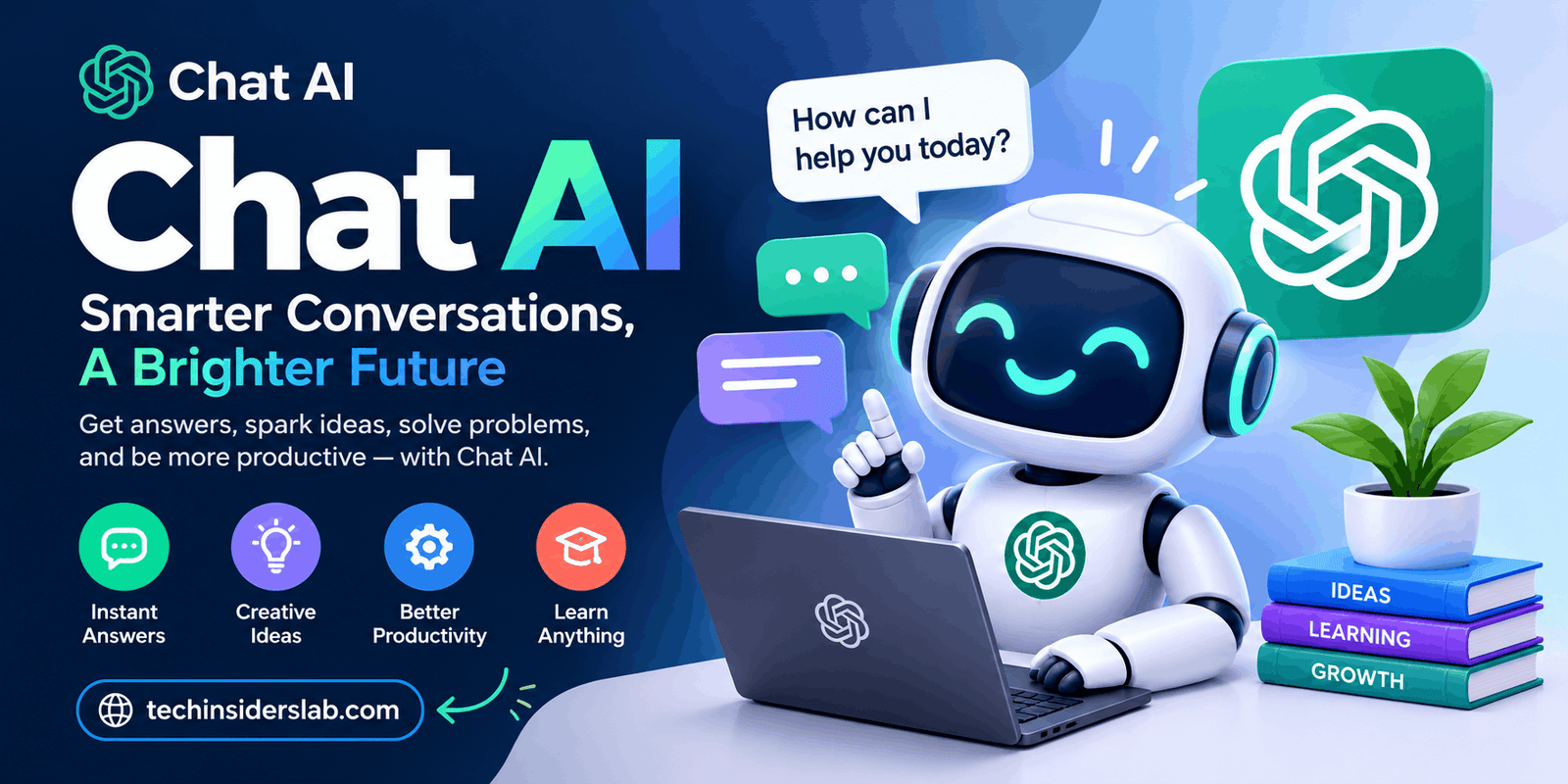
Artificial intelligence has quickly moved from being a specialized technology to becoming part of everyday digital life. One of the most visible examples is Chat AI, a technology that allows people to communicate with artificial intelligence through natural language. Instead of learning complicated commands or software interfaces, users can simply type or speak a request and receive a conversational response.
Chat AI can help with writing, learning, brainstorming, research, coding, translation, planning, summarization, and many other tasks. Modern AI assistants can also work with images and files, search for current information, and support voice-based conversations. These capabilities have made conversational AI useful for students, professionals, creators, businesses, and everyday users.
What Is Chat AI?
Chat AI refers to artificial intelligence systems designed to interact with users through conversation. These systems generally rely on large language models that have been trained to understand patterns in human language and generate responses based on the context of a conversation.
Unlike traditional search tools that mainly return a list of webpages, conversational AI attempts to understand what a person is asking and provide a direct response. For example, a user can ask an AI assistant to explain a difficult concept in simple language, rewrite a paragraph, create a study plan, or help troubleshoot a programming problem.
Chat AI does not simply function as a digital search box. Its conversational nature allows users to ask follow-up questions, change requirements, request explanations, and refine the response.
How Does Chat AI Work?
At the core of modern Chat AI systems are large language models. These models process text and use learned patterns to predict and generate appropriate sequences of language.
When a person enters a prompt, the AI analyzes the words, context, and instructions. It then generates a response based on the patterns and information available to the model or its connected tools.
The process can be viewed in a simple way:
- The user enters a question or instruction.
- The AI analyzes the language and context.
- The underlying model generates a response.
- The system presents the response in conversational form.
- The user can ask another question to refine the result.
Modern systems can go beyond text generation. Depending on the platform and available features, Chat AI may analyze uploaded documents and images, perform data analysis, generate images, use web search, and communicate through voice.
Main Features of Chat AI
The capabilities of Chat AI continue to expand, but several functions are particularly useful.
1. Conversational Questions and Answers
The most basic use of Chat AI is asking questions. Users can request explanations about technology, education, science, history, business, or everyday topics.
The ability to ask follow-up questions makes the experience more flexible than a traditional question-and-answer system. A user can ask for a shorter explanation, a real-world example, or a beginner-friendly version without starting the conversation again.
2. Writing Assistance
Chat AI can help create and improve written content. It can generate outlines, rewrite sentences, summarize information, improve grammar, and adjust writing for different audiences.
Writers can also use AI for brainstorming. Instead of asking the system to produce an entire article, users can ask for possible headings, topic ideas, questions readers may have, or alternative ways to explain a concept.
3. Education and Learning
Students can use Chat AI as an interactive learning assistant. It can explain complicated subjects step by step, create practice questions, summarize study material, and help learners understand concepts that may initially seem difficult.
The biggest advantage is the ability to continue asking questions. If an explanation is too advanced, the user can request a simpler version or ask for examples.
However, students should treat AI-generated information as assistance rather than automatically assuming every answer is correct.
4. Coding and Technical Support
Developers can use Chat AI to understand programming concepts, review code, identify possible errors, and generate examples.
It can also help beginners learn programming by explaining what individual sections of code do. Experienced developers may use it as a brainstorming or debugging assistant.
AI-generated code should still be tested carefully because a response can contain incorrect logic, outdated approaches, security problems, or assumptions that do not match a particular project.
5. Translation and Language Assistance
Chat AI can help users translate text and understand language differences. It can also rewrite content in a more formal, casual, simple, or professional style.
This makes conversational AI useful for people communicating across languages or preparing content for international audiences.
6. Image and File Understanding
Modern Chat AI platforms can work with more than plain text. Users may be able to upload documents, screenshots, charts, or other supported files and ask questions about them.
For example, an uploaded document can be summarized, while an image can be examined for visible information. ChatGPT’s current capabilities include image input, file uploads, data analysis, and image generation, depending on the account and available features.
7. Web Search
Another important development is the integration of web search with conversational AI.
When current information is required, systems such as ChatGPT can search the web and provide responses supported by online sources. This is particularly useful for topics that change frequently, although users should still review citations and verify important information.
Benefits of Chat AI
Chat AI offers several practical advantages.
Faster Access to Information
Users can describe what they need in ordinary language instead of constructing multiple searches. The AI can organize information into explanations, lists, summaries, or other formats.
Improved Productivity
Routine tasks can often be completed more quickly with AI assistance. Drafting emails, summarizing documents, brainstorming ideas, creating outlines, and organizing information are examples of tasks where Chat AI can reduce repetitive work.
Personalized Explanations
A major advantage of conversational systems is adaptability. Someone can request a beginner explanation while another user can ask for a technical discussion of the same subject.
24/7 Availability
AI assistants can be accessed whenever users need help. This makes them useful for independent learning, brainstorming, writing assistance, and quick problem-solving outside normal working hours.
Accessibility
Voice-based interaction can make AI more convenient for people who prefer speaking rather than typing. Current ChatGPT voice functionality supports natural conversations and spoken responses, with available capabilities depending on the user’s account and platform.
Chat AI for Businesses
Businesses are increasingly exploring conversational AI for internal and customer-facing tasks.
Companies can use AI assistants to help draft documents, organize information, answer common questions, support employees, and accelerate certain research workflows.
Customer service is another important area. AI-powered chat systems can handle common questions and provide basic assistance before a customer needs human support.
However, businesses should not treat AI as a replacement for human judgment in every situation. Sensitive decisions, confidential information, legal matters, financial decisions, and high-impact business processes may require additional controls and human review.
Limitations of Chat AI
Despite its usefulness, Chat AI is not perfect.
One major limitation is that AI systems can produce incorrect information. A response may sound confident and convincing while still containing factual errors.
This is sometimes described as an AI hallucination. Users should therefore verify important claims rather than relying blindly on generated answers.
Current AI systems can also have limitations related to context, reasoning, data freshness, and interpretation. Even when web search is available, search results and citations may sometimes be incomplete or incorrect, so checking important sources remains important.
Privacy and Security Considerations
Privacy is another important consideration when using Chat AI.
Users should think carefully before entering confidential business information, passwords, financial information, private documents, or other sensitive data into an AI service. Organizations should establish clear policies about what employees are allowed to submit to AI systems.
NIST’s Generative AI Risk Management Profile highlights several risks associated with generative AI, including privacy risks, sensitive-information exposure, harmful bias, and inaccurate outputs.
Good AI usage therefore requires more than simply knowing how to write prompts. Users should understand what information they are sharing and when human verification is necessary.
How to Get Better Results From Chat AI
The quality of an AI response often depends on the quality of the instruction.
Instead of asking:
“Write something about technology.”
A more useful prompt might be:
“Write a beginner-friendly explanation of artificial intelligence in 800 words, using clear headings and practical examples.”
Useful prompting techniques include:
- Clearly explain the goal.
- Provide relevant context.
- Specify the desired format.
- Mention the intended audience.
- Give important constraints.
- Ask for examples when necessary.
- Request revisions instead of accepting the first response automatically.
Users can also break large tasks into smaller steps. For example, they can first request an outline, then develop individual sections, and finally ask the AI to review the complete draft.
Chat AI vs. Traditional Search
Traditional search engines and Chat AI serve different purposes.
Search engines are excellent for discovering websites, comparing sources, finding specific pages, and exploring a broad range of information.
Chat AI is useful when users want information organized into a conversational answer. It can summarize concepts, explain difficult subjects, transform information into different formats, and continue the discussion through follow-up questions.
In practice, the two technologies can complement each other. Chat AI can help users understand information, while original sources can be used to verify important claims.
The Future of Chat AI
The future of Chat AI is likely to involve more multimodal interaction and deeper integration into everyday software.
Text, voice, images, files, web information, and data analysis are increasingly being combined into a single conversational experience. Current AI assistants already demonstrate this direction through features such as voice interaction, image understanding, file analysis, web search, and image generation.
The next stage will likely focus not only on generating answers but also on helping users complete more complex workflows. This could make AI assistants increasingly valuable for education, software development, business operations, research, and personal productivity.
At the same time, responsible AI use will remain important. Better accuracy, privacy protection, transparency, security, and human oversight will be necessary as conversational AI becomes more deeply integrated into important activities.
Conclusion
Chat AI has changed the way people interact with digital technology. Instead of relying only on menus, commands, or traditional search boxes, users can communicate with software using natural language.
From writing and education to coding, research, translation, image analysis, and productivity, Chat AI can support a wide range of activities. Its biggest strength is flexibility: users can ask questions, provide additional context, request changes, and continue a conversation until they reach a useful result.
However, AI should be viewed as an assistant rather than an unquestionable source of truth. Fact-checking, privacy awareness, and human judgment remain essential.
As conversational AI continues to develop, its role in everyday technology will likely become even more significant. For users who understand both its capabilities and its limitations, Chat AI can become a powerful tool for learning, creating, researching, and working more efficiently.