introduction
Physics is one of the most important branches of science, but many students find it challenging because it involves complex concepts, mathematical formulas, and abstract ideas. Traditional classroom methods often depend on textbooks and lectures, which may not be enough for every learner. Modern educational platforms are changing this experience by making science more interactive, engaging, and easier to understand.
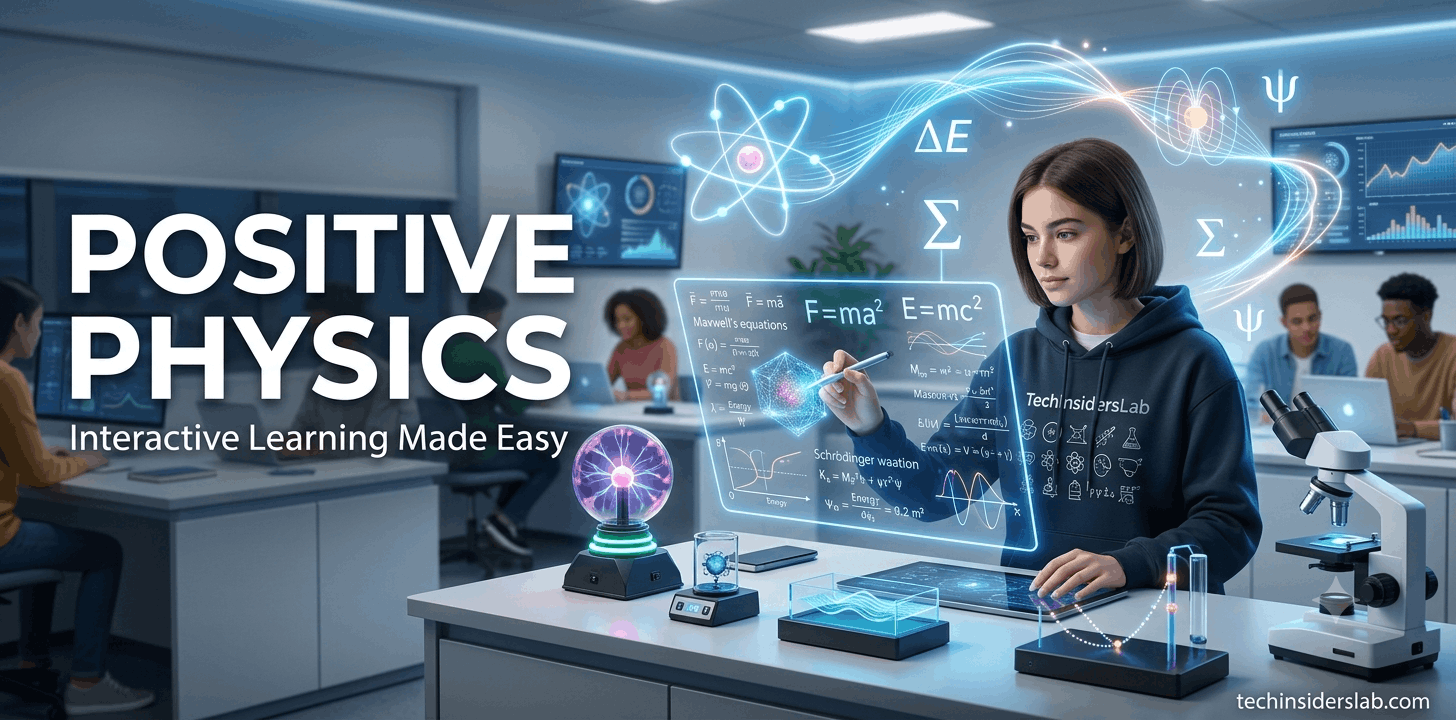
Positive Physics is an online learning platform designed to help students develop a better understanding of physics and other STEM subjects through interactive lessons, practice activities, and personalized learning tools. The platform focuses on simplifying difficult concepts and allowing students to learn at their own pace.
With technology becoming an essential part of education, Positive Physics provides students and teachers with digital resources that make learning more effective and accessible.
What Is Positive Physics?
Positive Physics is an educational platform that provides digital learning resources for students studying physics and related science subjects. It is designed to support both classroom learning and independent study by offering structured lessons, practice problems, and instant feedback.
Unlike traditional learning methods where students may only memorize formulas, Positive Physics focuses on helping learners understand concepts through repeated practice and interactive activities.
The platform is especially useful for students who need additional support with topics such as:
- Motion and forces
- Energy and work
- Electricity and circuits
- Waves and sound
- Light and optics
- Matter and measurements
- Scientific problem-solving
By combining technology with educational methods, Positive Physics helps make complicated scientific ideas easier to learn.
The Purpose Behind Positive Physics
The main goal of Positive Physics is to improve science education by creating a more engaging learning environment. Many students struggle with physics because they believe it is only about difficult calculations. However, physics is about understanding how the world works.
Positive Physics aims to:
- Make physics easier to understand
- Encourage students to practice regularly
- Provide immediate feedback
- Help teachers monitor student progress
- Support different learning abilities
The platform focuses on building confidence among students and helping them develop problem-solving skills.
How Positive Physics Works
Positive Physics uses a digital learning approach where students can access educational content online. Lessons are organized into different topics, allowing learners to study concepts step by step.
A typical learning process includes:
1. Learning the Concept
Students first explore a physics topic through explanations and examples. This helps them understand the basic principles before solving problems.
2. Practicing Problems
After learning the concept, students complete practice questions designed to strengthen their understanding.
3. Receiving Feedback
The platform provides feedback that helps students identify mistakes and improve their knowledge.
4. Tracking Progress
Teachers can use learning data to understand student performance and provide additional support when needed.
This approach creates a continuous learning cycle where students can improve through practice and correction.
Key Features of Positive Physics
Positive Physics offers several features that make it different from traditional study methods.
Interactive Learning Materials
One of the biggest advantages of digital education platforms is interactive content. Instead of only reading information, students actively participate in the learning process.
Interactive activities help learners:
- Visualize scientific concepts
- Understand relationships between ideas
- Apply knowledge through practice
- Develop stronger memory retention
Practice-Based Learning
Physics requires practice. Understanding a formula is not enough; students need to know how and when to apply it.
Positive Physics provides practice exercises that allow students to improve their:
- Calculation skills
- Logical thinking
- Problem-solving ability
- Concept understanding
Regular practice helps students become more confident when solving physics problems.
Instant Feedback System
Immediate feedback is an important part of effective learning. When students know why an answer is incorrect, they can correct their mistakes quickly.
Positive Physics helps learners:
- Identify weak areas
- Understand errors
- Improve accuracy
- Learn from mistakes
This makes the learning process faster and more effective.
Benefits of Positive Physics for Students
Students can gain many advantages by using Positive Physics as part of their learning routine.
Better Understanding of Difficult Topics
Physics contains many abstract concepts that are difficult to imagine. Digital explanations and repeated practice can help students understand these ideas more clearly.
Self-Paced Learning
Every student learns differently. Some learners need extra time with certain topics, while others progress faster.
Positive Physics allows students to study according to their own learning speed.
Improved Confidence
Many students lose confidence when they struggle with physics. Continuous practice and improvement help learners develop a positive attitude toward science.
Better Exam Preparation
Practice questions and structured lessons can help students prepare more effectively for tests and examinations.
Positive Physics for Teachers
Positive Physics is not only beneficial for students but also provides support for educators.
Teachers can use the platform to:
- Assign digital lessons
- Monitor student progress
- Identify learning gaps
- Provide targeted assistance
- Save preparation time
Instead of spending hours creating every practice activity manually, teachers can use ready-made educational resources.
Positive Physics in Modern Education
Technology has changed the way students learn. In the past, education mostly depended on textbooks, classroom lectures, and written assignments. Today, digital platforms are helping students learn through interactive methods that make education more engaging and effective.
Positive Physics represents this modern approach by combining science education with technology. It allows students to practice physics concepts digitally, receive instant responses, and improve their understanding through continuous learning.
Modern students often prefer visual and interactive learning because it helps them connect theoretical concepts with real-world examples. Physics becomes easier when learners can understand how forces, energy, motion, and other scientific principles work in everyday life.
Positive Physics and STEM Learning
STEM education focuses on Science, Technology, Engineering, and Mathematics. Physics plays an important role in STEM because it explains the basic principles behind many technologies and engineering systems.
Positive Physics supports STEM learning by helping students develop:
- Analytical thinking
- Mathematical reasoning
- Problem-solving skills
- Scientific understanding
- Logical decision-making
These skills are valuable not only for academic success but also for future careers in engineering, technology, research, and other science-related fields.
Advantages of Positive Physics
Positive Physics offers several benefits that make it a useful learning resource.
1. Easy Access to Learning Resources
Because it is an online platform, students can access educational materials from different locations. This flexibility allows learners to study whenever they have time.
2. Encourages Regular Practice
Physics improvement requires consistent practice. Positive Physics helps students build a regular study routine by providing structured exercises.
3. Helps Different Types of Learners
Every student has a different learning style. Some understand concepts through explanations, while others learn better through solving problems.
Digital learning platforms support multiple learning approaches.
4. Saves Time for Teachers
Teachers can reduce the workload of preparing assignments and tracking student performance manually. Digital tools make classroom management more efficient.
5. Builds Student Confidence
When students practice regularly and see improvement, they become more confident in their ability to understand physics.
Limitations of Positive Physics
Although Positive Physics provides many benefits, there are some limitations to consider.
Requires Internet Access
Since it is an online learning platform, students need a stable internet connection and suitable devices to use it effectively.
Cannot Fully Replace Teachers
Digital platforms are powerful learning tools, but teacher guidance remains important. Teachers provide explanations, motivation, and personal support that technology cannot completely replace.
Learning Depends on Student Effort
A platform can provide resources, but students still need dedication and regular practice to achieve good results.
Positive Physics vs Traditional Physics Learning
Traditional physics education usually depends on classroom lectures, textbooks, and written homework. While this method has been effective for many years, digital learning platforms provide additional advantages.
Traditional Learning
Advantages:
- Direct interaction with teachers
- Classroom discussions
- Social learning environment
- Immediate human guidance
Challenges:
- Limited practice time
- Less personalized learning
- Students may struggle without extra support
Positive Physics Learning
Advantages:
- Self-paced learning
- Instant feedback
- More practice opportunities
- Digital accessibility
- Progress tracking
Challenges:
- Requires technology access
- Needs student discipline
- Works best with teacher support
The best approach is often a combination of classroom teaching and digital learning tools.
Who Should Use Positive Physics?
Positive Physics can be useful for different types of learners.
High School Students
Students studying basic and advanced physics can use the platform to strengthen their concepts and prepare for exams.
Teachers
Educators can use Positive Physics as a classroom support tool to provide additional practice and monitor student progress.
Independent Learners
Students who want to improve their physics knowledge outside school can benefit from structured online learning.
STEM Students
Learners interested in science, engineering, and technology can use the platform to develop strong physics foundations.
How Positive Physics Improves Physics Skills
Physics is not only about memorizing formulas. It requires understanding relationships between different concepts and applying knowledge correctly.
Positive Physics helps students improve important skills such as:
Concept Understanding
Students learn why physical processes happen instead of only memorizing equations.
Problem Solving
Practice activities help learners develop step-by-step approaches to solving scientific problems.
Critical Thinking
Physics requires analyzing situations and selecting the correct methods. Regular practice improves logical thinking.
Mathematical Application
Students learn how mathematical formulas are used to explain real-world phenomena.
Future of Online Physics Education
The future of education is moving toward personalized and technology-based learning. Artificial intelligence, interactive simulations, and adaptive learning systems are expected to make digital education even more effective.
Platforms like Positive Physics show how technology can support students by making learning more flexible and engaging.
Future improvements may include:
- More advanced AI learning assistance
- Personalized study plans
- Interactive physics simulations
- Better performance analysis
- Virtual science experiments
As educational technology continues to develop, online learning platforms will likely become an important part of science education.
Conclusion
Positive Physics is a valuable educational platform that helps make physics learning more interactive, accessible, and effective. By combining digital technology with practice-based learning, it allows students to understand complex scientific concepts more easily.
With features like structured lessons, practice exercises, and progress tracking, Positive Physics supports both students and teachers in achieving better learning outcomes. While it cannot replace the role of teachers, it works as a powerful educational tool that enhances traditional learning methods.
For students who want to improve their physics skills and build confidence in science, Positive Physics provides a modern and practical way to learn. As digital education continues to grow, platforms like this will play an increasingly important role in shaping the future of science learning.