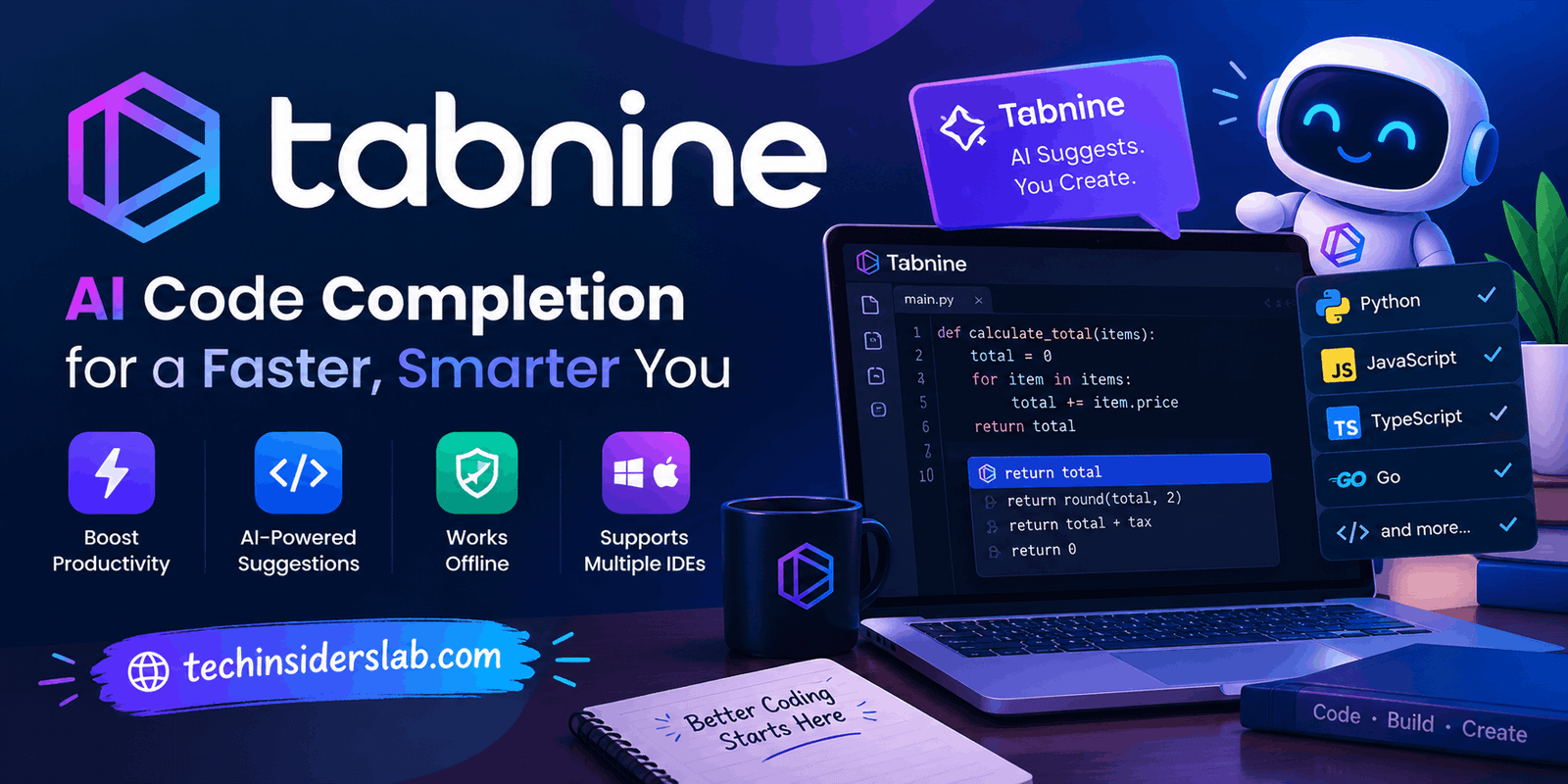
Tabnine:AI Coding Assistant for Faster and Smarter Software
introduction
Software development has changed significantly with the introduction of artificial intelligence. Developers no longer have to write every function, search through documentation for every small issue, or manually create repetitive pieces of code. AI-powered coding tools can now assist with writing, understanding, testing, debugging, and improving software.
Tabnine is one of the AI-powered developer tools designed to bring this type of assistance directly into the software development workflow. It provides AI-based code completion, natural-language coding assistance, code explanation, testing support, documentation features, code review capabilities, and agentic workflows. Its current platform is designed around context-aware development, allowing AI assistance to work with a developer’s codebase and organizational standards.
For individual developers, Tabnine can reduce repetitive coding work. For development teams, its focus extends toward privacy, governance, customization, and enterprise software development.
What Is Tabnine?
Tabnine is an AI coding platform and developer tool that helps programmers create and maintain software with artificial intelligence. Instead of functioning only as a traditional autocomplete system, its current platform covers multiple stages of the software development lifecycle.
Developers can use Tabnine to generate code from natural-language instructions, complete existing code, explain unfamiliar code, identify potential improvements, generate tests, create documentation, fix problems, and refactor applications.
One of Tabnine’s important characteristics is its focus on contextual assistance. Rather than treating every coding request as an isolated question, the platform can use information from the development environment and connected project resources to produce suggestions that are more relevant to the application.
This makes Tabnine particularly interesting for developers working on larger projects where understanding the existing codebase is just as important as generating new code.
How Does Tabnine Work?
Tabnine works within the developer’s coding environment and uses AI to interpret programming tasks and provide relevant assistance. Depending on the feature being used, it can analyze information such as the current file, open files, imported packages, variables, comments, project structure, and other available development context.
For example, a developer may write a comment describing what a function should do. Tabnine can then suggest an implementation. Similarly, a developer can select existing code and ask the AI to explain it, improve it, refactor it, or create tests.
Its newer platform also emphasizes organization-level context. Tabnine’s Context Engine is designed to connect information from repositories, documentation, APIs, and development systems so that AI agents can better understand how a particular organization builds software.
The overall idea is simple: instead of forcing developers to adapt their workflow to a generic AI assistant, Tabnine aims to adapt AI assistance to the developer’s existing environment.
Key Features of Tabnine
1. AI Code Completion
Code completion is one of the fundamental capabilities of Tabnine. While developers type, AI-generated suggestions can help complete lines, functions, and larger sections of code.
This can be useful when writing repetitive structures, common programming patterns, or functions that follow established conventions.
Instead of manually typing every part of a routine implementation, developers can review an AI suggestion and accept, modify, or reject it.
2. Natural-Language Code Generation
Developers do not always need to begin with code. Tabnine can convert natural-language instructions into programming code.
For example, a developer can describe a feature such as creating a form validation function or processing data from an API. The AI can use the description as an instruction and generate an initial implementation.
This can be particularly helpful during prototyping because developers can move from an idea to working code more quickly.
3. AI Chat for Development
Tabnine also provides AI chat functionality inside the development workflow. Developers can ask questions about programming tasks, existing code, project behavior, or implementation approaches.
The platform positions its AI chat as assistance across multiple stages of software development, including planning, creation, testing, documentation, review, explanation, and maintenance.
This means the tool can be useful beyond simple autocomplete.
4. Code Explanation
Large software projects often contain code written by different developers or teams. Understanding an unfamiliar function can take considerable time.
Tabnine can explain existing code in natural language, helping developers understand what a function, class, or section of an application is doing.
This feature can also be useful when developers work with programming languages, frameworks, or legacy applications they have not used before.
5. Debugging and Code Fixes
Finding and correcting programming errors is another area where AI assistance can help.
Developers can provide instructions describing a problem or select problematic code and ask Tabnine to suggest a fix. Its platform also includes an AI-powered Code Fix Agent designed to generate fixes and present suggestions through a diff-style workflow.
AI-generated fixes should still be reviewed by developers, particularly when changes affect security, databases, authentication, payments, or other critical functionality.
6. Refactoring
Refactoring means improving the structure of existing code without changing its intended behavior.
Tabnine can help developers modify code based on natural-language instructions. This can include restructuring functions, improving readability, changing implementation patterns, or adding functionality.
For large projects, context-aware assistance can be useful because a change in one part of an application may affect other components.
7. Test Generation
Testing is an essential part of software development, but creating comprehensive tests can require significant time.
Tabnine provides AI assistance for generating tests and test plans. Its testing capabilities can consider existing tests and project conventions when generating additional test cases.
This can help developers create a starting point for unit tests and other testing activities.
However, generated tests should be reviewed carefully. A test can technically run successfully while still failing to verify the most important behavior of an application.
8. Documentation Generation
Software documentation can easily become outdated when developers focus primarily on implementation.
Tabnine includes documentation capabilities that can help generate documentation for selected code, including classes, functions, comments, and API-related documentation.
This can reduce some of the manual effort involved in documenting software projects.
9. Code Review
Code review is another part of the modern Tabnine platform. Its AI Code Review capabilities are designed to examine code against an organization’s rules and standards and identify areas that may require changes.
For development teams, this can help establish more consistent coding practices.
AI review does not eliminate the need for human code review. Instead, it can act as an additional layer that catches certain issues before or during a team’s normal review process.
Tabnine and Privacy
Privacy is an important consideration when AI tools interact with source code.
Tabnine places significant emphasis on code privacy and states that its proprietary models are not trained on customer code. Its current platform also advertises zero code retention and deployment options that include SaaS, VPC, on-premises, and fully air-gapped environments.
This focus is particularly relevant for organizations working with confidential software, proprietary technologies, regulated information, or sensitive intellectual property.
The ability to control where an AI coding platform operates can be an important consideration for companies with strict infrastructure and security requirements.
Tabnine for Enterprise Development
Tabnine is not limited to individual programming assistance. Its current platform includes features aimed at larger engineering organizations.
The Enterprise Context Engine is designed to provide AI agents with a broader understanding of an organization’s architecture, repositories, documentation, dependencies, and development standards.
Tabnine also supports connections with development systems such as Git repositories and Jira, allowing project information to become part of the context used by AI workflows.
For organizations, this approach can be useful because software development rarely happens inside a single source-code file. Requirements, tickets, documentation, APIs, coding standards, and historical decisions can all affect how software should be built.
Tabnine and AI Agents
Modern Tabnine goes beyond traditional autocomplete through AI agents.
These agents can support different development activities, including code generation, testing, documentation, explanation, code fixing, and review.
The difference between basic autocomplete and an AI agent is the scope of the task. Autocomplete generally helps with the next piece of code, while an agent can work through a larger objective involving multiple steps.
This makes agentic development particularly useful for tasks that would otherwise require developers to repeatedly switch between coding, documentation, testing, and debugging tools.
Benefits of Using Tabnine
There are several potential benefits to using Tabnine as part of a development workflow.
Faster coding: AI-generated completions can reduce repetitive typing and speed up routine development.
Better understanding of code: Explanation features can help developers navigate unfamiliar projects.
Support across the development lifecycle: Tabnine can assist with planning, coding, testing, documentation, review, and maintenance.
Project-aware assistance: Context from a codebase can make suggestions more relevant than completely generic responses.
Enterprise privacy options: Organizations can choose different deployment models depending on their security requirements.
Flexible AI models: Tabnine’s platform supports multiple AI models and gives organizations options around model selection and deployment.
Limitations to Consider
Like other AI coding tools, Tabnine should not be treated as a replacement for programming knowledge.
AI-generated code can contain errors, inefficient approaches, incorrect assumptions, or security problems. Developers need to inspect generated code before using it in production.
Another consideration is context. AI assistance becomes more useful when the system has enough information about the project, but organizations also need to decide what information should be accessible to AI systems.
There is also a learning curve. Developers need time to understand how to write effective prompts, review AI suggestions, and integrate AI into their existing workflow.
Therefore, Tabnine works best as a development assistant rather than an autonomous replacement for engineering judgment.
Who Can Use Tabnine?
Tabnine can be useful for different types of software developers.
Beginners can use AI explanations and examples to better understand programming concepts, although they should still learn the underlying fundamentals.
Experienced developers can use code completion, refactoring, debugging, testing, and documentation assistance to reduce repetitive work.
Development teams can use project-aware AI assistance to improve consistency across their codebase.
Enterprise organizations may find features such as private deployment, governance, contextual AI, and security controls particularly relevant.
Tabnine in Modern Software Development
AI coding assistants are becoming an increasingly visible part of software development. The role of these tools is also expanding from simple code prediction toward broader AI-assisted development workflows.
Tabnine‘s current direction reflects this shift. Its platform combines coding assistance, AI chat, organizational context, AI agents, governance, security controls, and multiple deployment options.
This approach is especially relevant for organizations that want the productivity benefits of AI while maintaining greater control over their development environment.
For developers, the practical value depends on the type of project, programming language, existing workflow, and amount of repetitive development work involved.
Conclusion
Tabnine is an AI coding and developer tool designed to assist programmers throughout the software development lifecycle. Its capabilities extend from traditional code completion to code generation, explanation, debugging, refactoring, testing, documentation, review, and AI-powered agent workflows.
One of its major areas of focus is contextual and private AI development. By connecting AI assistance with project information, organizational standards, repositories, and development workflows, Tabnine aims to provide more relevant assistance than a basic standalone coding chatbot.
For individual developers, it can reduce repetitive coding tasks and provide useful programming assistance. For teams and enterprises, features such as organizational context, governance, security, and flexible deployment can become equally important.
As AI continues to become part of everyday software engineering, tools such as Tabnine are helping shape a development workflow in which programmers collaborate with AI while remaining responsible for reviewing, testing, and maintaining the final software.